

Watchmaker: Heat wave leads to one strange Saturday
Saturday was without question the strangest midsummer Thoroughbred-racing Saturday I can recall, and I’m sure many other folks feel the same way.
At one point approaching midafternoon Eastern, the only tracks running were Gulfstream, Woodbine, Thistledown, Arlington, and Prairie Meadows. It felt more like a lost Tuesday than an important Saturday thanks to the cancellation of the cards at Saratoga, Finger Lakes, Laurel, Delaware, Parx, Penn National, Belterra, and Ellis, and, of course, the unprecedented semi-cancellation and mid-program delay at Monmouth.
As we are all aware, Monmouth attempted to run its 14-race Haskell card on Saturday, swimming against a tide recognized by every other track in the same region, two of which (Saratoga and Finger Lakes) are located well north of the Oceanport, N.J., oval. Now, I’m going to leave the question of whether it was safe to run in extreme heat Saturday at Monmouth to the most critical stakeholders in the matter – the horsemen, jockeys, veterinarians, and track management. But clearly, Monmouth felt it knew something the eight canceled tracks referenced above didn’t.
(As an aside, I’m not really buying into one justification offered that the actual track side of the Monmouth facility is subject to sea breezes that the backyard and paddock don’t get. I worked at Monmouth years ago, and while it is true that the front side of the track faces the ocean, it is by no means on the ocean. The track is about three miles inland. Besides, Saturday’s winds, such as they were, were out of the west and southwest, not the east.)
Anyway, we are also all aware that after running delayed first and second races, Monmouth abandoned its plan to run the entire card. Management canceled the remaining overnight races and ran the six scheduled stakes races, starting at 6 p.m., when it would presumably be slightly, if imperceptibly, cooler.
:: Get PPs, Clocker Reports, picks, and more from DRF's Saratoga/Del Mar One-Stop Shop
This created a mid-card delay of four hours and 49 minutes that some people dubbed the longest post-time drag in racing history. But I can’t imagine it was funny to the poor folks who braved the brutal conditions and went to Monmouth for the races. Handing those folks, many of whom probably paid what I was told to be $10 for grandstand general parking, a five-hour racing delay with hardly any other simulcast options to bet on was not exactly the ultimate customer-friendly stuff.
There was a strong inference from Monmouth management that this all-stakes resumption of racing at 6 p.m. was the Plan B alluded to when it was grilled late last week about running on Saturday when so many other Eastern tracks canceled well in advance.
If that is true, and this was indeed the Plan B management had in its back pocket, then it seems that instead of attempting to fight a losing battle against Mother Nature in the hopes of being the featured player on a day when cancellations left the racing stage wide-open, everyone involved would have been far better off if Monmouth simply had announced Friday morning that it was going to implement this plan. If everyone knew a day in advance that Haskell Day at Monmouth would be a refashioned into a six-race, all-stakes card starting at 6, horsemen could have adapted, and fans could have planned. I bet lots of fans would have made a thing out of being at an early-evening, all-stakes Haskell program. That would have been much better than essentially telling them, “We’ll be back in about five hours. Hope you stick around in oppressive conditions.”
Of course, Monmouth didn’t even have to get that fancy. Unless there was an unspoken obstacle in the way, it could have just rescheduled the Haskell card for this Saturday.
Two more points before moving on to actual Saturday racing:
• Like most people who respect science, I believe global warming is real and a looming threat. I’m not saying this absurd heat wave gripping much of the country is a direct function of global warming because global warming doesn’t work that way. But with global warming already under way, we will likely see more weather extremes like this heat wave, and the game needs to prepare for it. Improvising on the relative fly is no answer.
• Finally, after everything that went down Saturday, it was borderline insulting to see the Haskell field circling the wagons behind the starting gate after the rescheduled post time of 8:05. The race went off at 8:12.
Saturday racing notes:
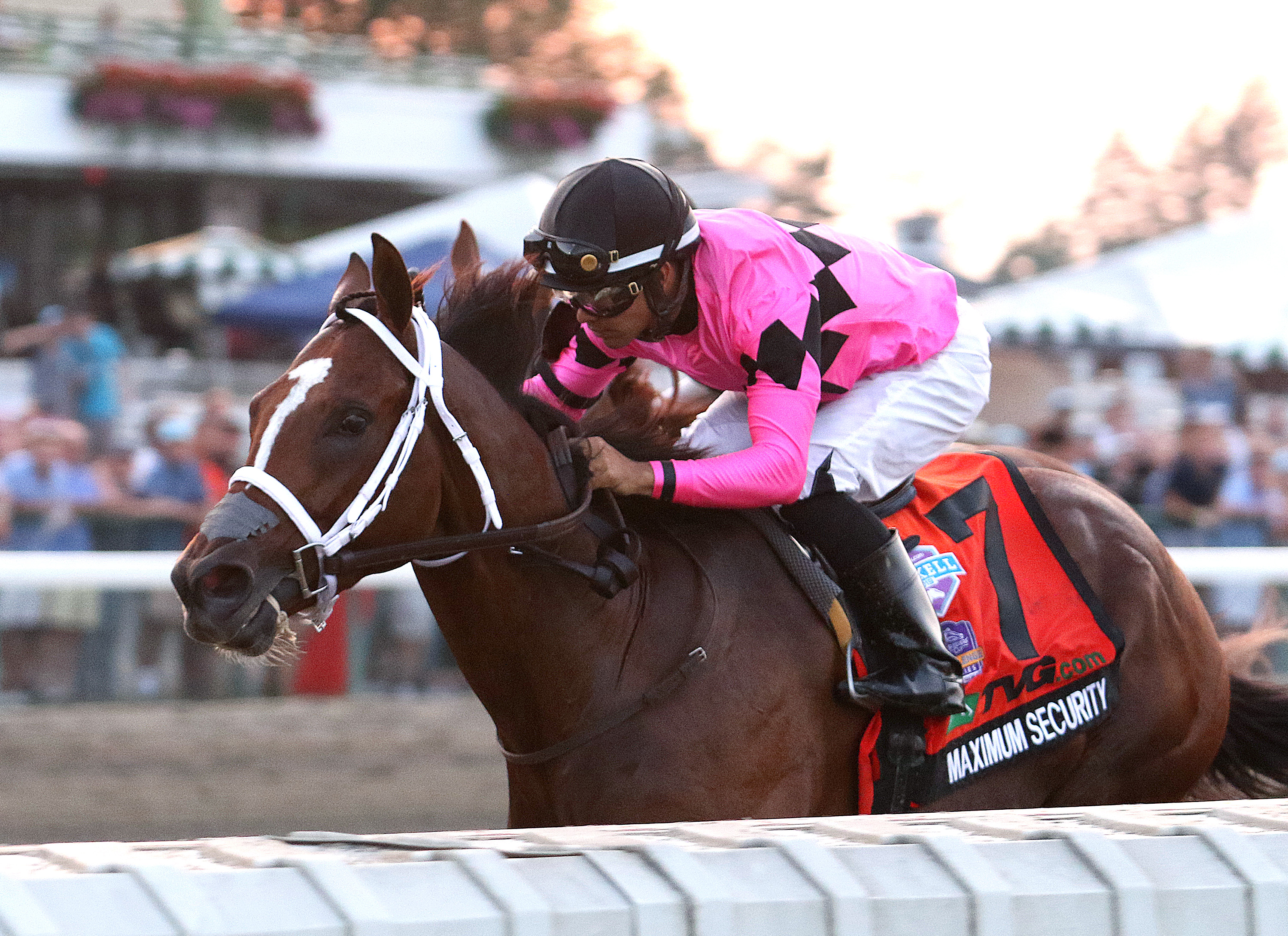
• Maximum Security gave his candidacy for champion 3-year-old male a big boost with his game victory in the Haskell. Maximum Security, who, of course, finished first in the Kentucky Derby before rightfully being disqualified, now has two Grade 1 victories on the year, with the Haskell complementing his win in the Florida Derby. None of his contemporaries has more than one Grade 1 win on the year.
Right here, it is important to note that Eclipse Award championships are more than mere Grade 1 counting contests, and Maximum Security’s Haskell score did not occur in a vacuum. It only felt that way.
While admirably game, Maximum Security was on his belly to turn back Mucho Gusto. Mucho Gusto is a fine colt who had won five of seven career starts going into the Haskell, but he was also a decided second stringer in the Bob Baffert barn while on the road to the Kentucky Derby behind Game Winner and Improbable. Maybe Mucho Gusto has improved, but his Beyer Speed Figures going into the Haskell did not indicate a significant breakthrough.
The point is that Mucho Gusto giving Maximum Security the battle he did adds context to the Haskell outcome.
• It was an amusing sight seeing the 1-20 (geez, there have been a lot of 1-20 shots lately) Midnight Bisou late on the far turn in Monmouth’s Molly Pitcher. Midnight Bisou had two horses right in front of her and one to her immediate outside, and all were in drives while she was loaded with run.
Midnight Bisou eventually got through inside, and while her one-length victory wasn’t her most artistically pleasing success, the Molly Pitcher was only a bridge race for which she obviously wasn’t fully cranked, and she still won comfortably.
I’ve been a little tough on Midnight Bisou in that every time she wins (which is frequently), I note her record at 1 1/16 miles (the Molly Pitcher made her 9 for 9 at that distance) and add that she is 0 for 4 going longer. But even though I do not believe that to be a statistical anomaly, let me be clear: Midnight Bisou is really, really good.
• At first blush, Catalina Cruiser’s one-length victory in the San Diego Handicap at Del Mar (at odds of 1-10) might have seemed similar to Midnight Bisou’s Molly Pitcher, but go deeper, and the feel of it was very different.
Catalina Cruiser’s effort lacked the brilliance of his wins in last year’s San Diego and Pat O’Brien, and even his narrow win in the True North on Belmont Stakes Eve, which came against a strong track bias and off a seven-month layoff.
It says a lot about Catalina Cruiser and horses like him who establish high standards and then let you down a bit when they don’t meet them, even in victories. Still, if Catalina Cruiser is to be a major player at the top of whatever division he targets – going short, going long, or going right down the middle at a mile – he’ll have to do better than he did Saturday.