

Three major farms file suit on Jockey Club's limitation of stallion books
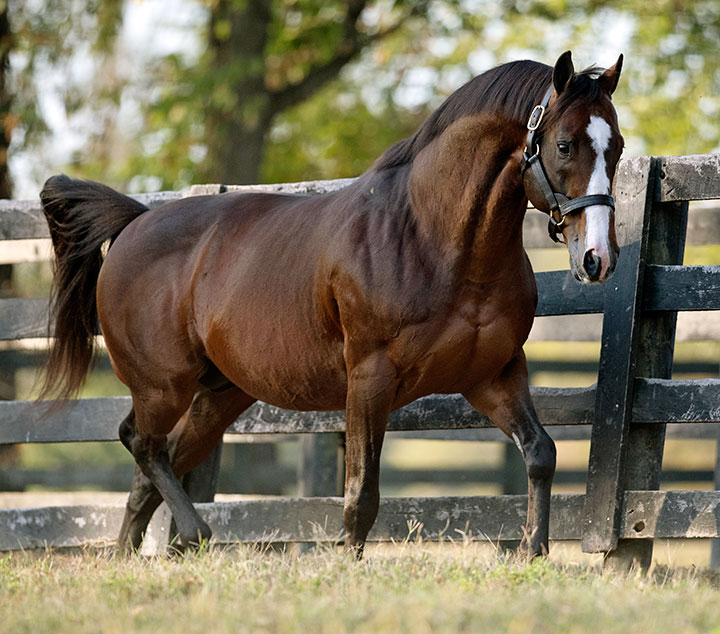
Coolmore's Ashford Stud, Spendthrift Farm, and Three Chimneys Farm, three prominent Kentucky farms standing some of the nation's most well-known stallions, have together filed a lawsuit challenging The Jockey Club's rule limiting the books of future stallions, the first legal challenge to the first such rule of its kind adopted by North America's governing Thoroughbred breed organization.
Last May, The Jockey Club announced that it was adopting a rule putting a cap of 140 mares bred annually on stallions born in 2020 or after. There is no cap on stallions born before 2020.
"The rule reflects The Jockey Club’s goal to preserve the health of the Thoroughbred breed for the long term," the organization said in a statement issued Tuesday.
The rule states that: “The total number of broodmares bred per individual stallion whose year of birth is 2020 or thereafter shall not exceed 140 per calendar year in the United States, Canada, and Puerto Rico.” By phrasing the rule as per calendar year rather than per breeding season, mares bred within North America but on Southern Hemisphere time later in the year will still count toward the cap. Mares covered outside of those jurisdictions, such as in Australia or other Southern Hemisphere countries by stallions who shuttle, would not count toward the cap, as they would be under the jurisdiction of the respective locations' own breed organizations.
Between them, the plaintiffs in the lawsuit, which was filed in the U.S. District Court, Eastern District of Kentucky, Central Division, currently stand 47 stallions in Kentucky, the epicenter of the Thoroughbred bloodstock industry in North America. B. Wayne Hughes' Spendthrift Farm stands 24 stallions in Kentucky -- it also holds interests in regional stallions -- including the nation's two-time reigning leading sire Into Mischief, the continent's most expensive stallion at a fee of $225,000 for this season. Coolmore stands 16 stallions at its Ashford Stud in Kentucky, including Triple Crown winners American Pharoah and Justify; the international operation is headquartered in Ireland and also shuttles stallions to the Southern Hemisphere, including at its Coolmore Australia. Three Chimneys, which has a controlling interest held by the Borges-Torrealba family, stands seven stallions following the death of Fast Anna earlier this month; the roster is headlined by Horse of the Year Gun Runner.
In a joint release issued Tuesday morning, the plaintiffs argued that the Kentucky Horse Racing Commission, which oversees and regulates horse racing in the state, unlawfully delegated power to The Jockey Club, of which membership is by invitation only; Jonathan Rabinowitz and Marc Guilfoil, in their respective capacities as chairman and executive director of the KHRC, are named as defendants in the complaint, along with The Jockey Club. Although the KHRC was not directly involved in the adoption of the mare cap rule, the lawsuit contends that, in their roles, Rabinowitz and Guilfoil are responsible for overseeing how the state delegates authority over the breed to The Jockey Club.
The complaint argues that the two organizations breach sections 1, 2, 3, 8, and 29 of the Constitution of the Commonwealth of Kentucky, which are designed to protect property rights and limit delegations of power by governmental bodies to private entities. The plaintiffs also believe that the breeding restrictions would violate the due process and equal protection rights of stud farms granted by the 5th and 14th amendments to the U.S. Constitution; the suit also argues that the rule violates the Sherman Antitrust Act and suppresses competition.
"The introduction of the stallion cap by The Jockey Club is a blatant abuse of power that is bad law, bad science, and bad business," Hughes, speaking of behalf of the plaintiffs, said in the release. "A handful of individuals from a private club in New York have been allowed to make a decision that will negatively impact the future of Thoroughbred racing and breeding both in Kentucky and the whole country. We have filed this complaint to defend the industry from anti-competitive, un-American, and arbitrary decision making that is not based on scientific evidence.
"If they can limit the number to 140, what’s to stop them from limiting it to 100 or 80 or any other number down the road?" Hughes continued. "What if your mare isn’t one of the 140? We are really concerned about the small breeder’s ability to survive this."
The individuals Hughes referenced are the members of The Jockey Club’s board of stewards, whom the suit states “have conflicting economic interests – owning and/or representing various competing racing and breeding private entities” that the suit alleges would stand to benefit from having mares excluded from the books of popular stallions and thus shifted to other horses. At the time the rule was announced, in May 2020, the stewards were Barbara Banke, Everett Dobson, C. Steven Duncker, Ian Highet, Stuart Janney III, William Lear Jr., Michael O’Farrell Jr., John Phillips, and Vinnie Viola.
According to The Jockey Club’s Report of Mares Bred for the 2020 season, which was released last October, 1,067 stallions covered 27,970 mares in North America during 2020. In the comparable timeframe in 2019, The Jockey Club reported that 1,134 stallions covered 29,218 mares. The decrease for 2020 was in line with the projections of a shrinking foal crop, a trend that will likely continue in the years to come as the ongoing coronavirus pandemic continues to put economic pressure on breeders.
According to The Jockey Club's 2020 figures, 42 stallions covered 140 mares or more on the season. As stated, the new rule capping books does not apply to active stallions. The busiest stallions in the country were Ashford resident Uncle Mo, who covered 257 mares, and Into Mischief, who covered 248. Rounding out the top 10 busiest stallions overall were Mendelssohn (Ashford) with 242, Vino Rosso (Spendthrift) with 238, Constitution (WinStar Farm) with 231, Mitole (Spendthrift) with 230, Justify with 222, Audible (WinStar) with 219, Omaha Beach (Spendthrift) with 215, and Munnings (Ashford) with 207.
The first crop of colts affected by the rule would be 4-year-olds in the 2024 breeding season, with some likely entering stud then. However, the effects of the rule could be seen far earlier than that. Buyers purchasing young horses strongly consider colts' residual values as stallion prospects, meaning the economic effects of the cap could begin to come into focus during the 2021 yearling sales this summer and fall.
"The Jockey Club publicly proposed a draft rule in September 2019 and received many thoughtful comments, which the stewards carefully considered in formulating a rule that will promote diversity of the Thoroughbred gene pool and protect the long-term health of the breed," The Jockey Club said in a response to the lawsuit issued Tuesday. "Because the rule applies only to stallions born in 2020 or later, any effect on future stud fees or breeding economics is speculative. The Jockey Club stands by the rule and its purpose, which is to preserve the health of the Thoroughbred breed for the long term."
The KHRC cited its policy of not commenting on pending litigation, but did issue a statement saying that the commission “is aware of this lawsuit, and our legal team looks forward to addressing these issues in the litigation process.”
Other breed registries that deal with racing stock have also implemented book caps or other restrictions on reproductive activity, with various legal challenges. The United States Trotting Association, the regulatory body for Standardbred racing and breeding in the U.S., imposed a 140-mare limit for stallions who debuted in 2009 or later, also an attempt to address genetic diversity as artificial insemination, legal in that breed, expanded a stallion's availability far beyond his immediate surroundings. Antitrust lawsuits were filed alleging restraint of trade by the USTA, with the breed organization prevailing in the legal battles.
In 2002, the American Quarter Horse Association reached a settlement with breeders allowing them to register foals which were the product of embryo transfers between mares. Under previous rules, breeders could produce multiple foals out of their star mares per year, but only one foal was eligible for AQHA registration each year. Under the settlement, foals produced via transfer to surrogate mares were eligible if they met other registration requirements. Ten years later, owners filed a lawsuit claiming that the breed organization's policy prohibiting the registration of equine clones violated antitrust laws. A federal court jury unanimously ruled in favor of the plaintiffs; ultimately, however, the Fifth Circuit Court of Appeals ruled in favor of the AQHA.