

Three decades later, 1988 Breeders' Cup has yet to be topped
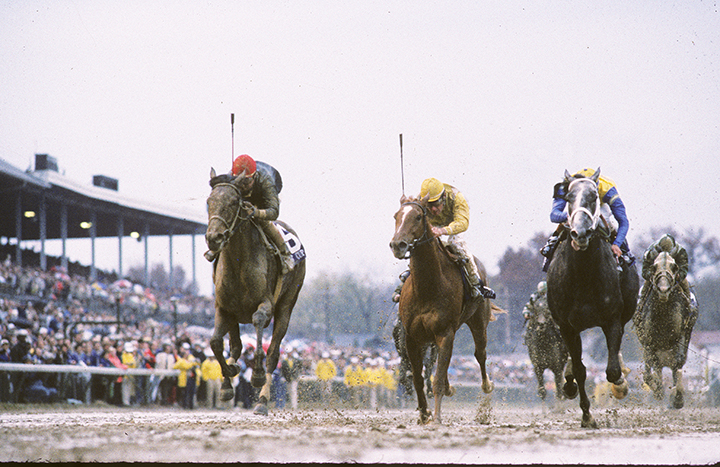
When the Breeders’ Cup landed at Churchill Downs in 1988, the event was a mere stripling of 4. But even at that stage, the championship series had delivered on its promise of crowning champions and showcasing the elite of the breed by age, surface, and distance.
Architects John Gaines and John Nerud had drawn up the Breeders’ Cup as an advertisement for the industry, to showcase a full afternoon of the best the sport had to offer on national television. Something like a four-hour version of the “Ed Sullivan Show” with all Beatles and Alan King, and no spinning plates. The architects, the participants, and the audience all deemed the first four Breeders’ Cups an unqualified success. Attendance and handle numbers (even in the pre-account wagering days) boomed, and horsemen’s pockets were lined with lottery-like cash.
The Breeders’ Cup at Churchill seemed like a homecoming. This was the place where they ran America’s greatest race and just down Interstate 64 from heart of the breeding industry. If the Kentucky Derby was for the hoi polloi, then the Breeders’ Cup for the cognoscenti. The Louisville track was made for both.
The storylines coming into the fifth Breeders’ Cup were thick with consequence, but much of the drama, as it turned out, focused on two trainers, one based on the East Coast, the other on the West, both destined for the Hall of Fame. Much of what transpired that day made important contributions to their legacies as giants of the sport.
Shug McGaughey was just 37 years old when the Breeders’ Cup came to Churchill. He was three years into his employment as the contract trainer for the powerful Phipps Stable and in 1988 everything was clicking. He seemed to have a quality runner in every division. One of them, the 12-for-12 filly Personal Ensign, was on the precipice of becoming the first major horse since Colin in 1908 to retire undefeated.
Easy Goer, his heavy favorite for the Juvenile, was a massive, copper-coated colt who had torn through the major one-turn preps at spacious Belmont Park, which accommodated his Brobdingnagian stride. He would be facing severely outmatched competition, but still had to withstand the crucibles of a tighter-turning track and a distance of ground.
McGaughey also had the favorite in the Sprint with Mining, an undefeated Mr. Prospector colt who had won the Vosburgh with speed to spare, and a double-barreled entry of Seeking the Gold and Personal Flag, Personal Ensign’s full brother, in the Classic.
:: Visit our Breeders' Cup one-stop shop for PPs, Clocker Reports, and more
To that point, McGaughey was having the kind of year that was giving Eclipse voters pause to consider him for the outstanding trainer Eclipse Award, breaking the three-year stranglehold on the trophy by the other protagonist of the 1988 Breeders’ Cup, D. Wayne Lukas.
Lukas, then 53, had been the dominant trainer in Thoroughbred racing for the better part of the last decade. In particular, he had made the Breeders’ Cup his personal playground. The lucre he accumulated through the championship program over the previous three years had helped him break earnings records in each successive season. He had six Breeders’ Cup wins in all and had a running three-race win streak in the Distaff, which included a tour-de-force victory by Lady’s Secret that clinched the 1986 Horse of the Year. He also had won the last two Juveniles.
Lukas came to Churchill Downs heavily armed. He had a record 11 entries, including five in the Juvenile Fillies. One of the other six happened to be Winning Colors, who just six months earlier had become the third filly to win the Kentucky Derby over the same Churchill surface. However, the big gray was coming off perhaps the worst start of her career, a dismal fourth in the Spinster at Keeneland.
There was plenty of talent to go around outside of the McGaughey-Lukas purview. Miesque had galloped in the previous year’s Mile at Hollywood, and no one doubted she would do it again for her French connections, jockey Freddie Head and trainer Francois Boutin. Sunshine Forever had recently dominated his older turf rivals with three straight Grade 1 wins, but faced some stiff competition from Europe in Indian Skimmer and Triptych.
The star of the day was supposed to be reserved for the leading handicap horse, Alysheba. The Horse of the Year title was his to lose in the Classic. Surely the racing gods would finally reward poor Jack Van Berg, the popular hardboot trainer who had suffered agonizing photo-finish defeats in three of the first four Classics, including a heartbreaker at Hollywood to Ferdinand with the 3-year-old model of Alysheba.
But the racing gods were getting grief from the weather gods. A slow-moving cold front had settled over Louisville and the outdoor portion of the crowd of 71,237 – incredibly, a Breeders’ Cup record – and the participants on the racetrack were treated to stinging rain showers and gusts of wind up to 30 mph. The track was reduced to the consistency of Jell-O pudding. Though some of the featured players, like Personal Ensign, had shown a predilection for the gooier going, as she did when she shook off Gulch in the Whitney, others, like Alysheba, clearly did not. His only start over a track worse than good was a desultory sixth-place finish as the favorite in the previous year’s Travers.
McGaughey and Lukas were scheduled to square off in four of the seven Breeders’ Cup races. Lukas drew first blood when Gulch won the Sprint under a brilliant ride from Angel Cordero Jr., coming up big after losing to Mining in the Vosburgh. The previous year, Gulch was a middle- to classic-distance horse for LeRoy Jolley, but after owner Peter Brant turned the horse over to Lukas at the beginning of the year, the trainer devised a plan to campaign him at shorter distances and cleverly had him tightened for the six furlongs of the Sprint.
“He was quick enough to win those type of races,” Lukas said.
Far back in the field was 8-5 favorite Mining, suffering his first career defeat. He had decisively beaten Gulch over a muddy track in the Vosburgh, but McGaughey admitted, “It was a hard race and he had problems throughout his career.”
“The racetrack at Churchill was deep, and it pulled against him,” McGaughey said.
In the next race, the Juvenile Fillies, Lukas was like Ulysses Grant at Vicksburg. He overwhelmed the field by superior numbers.
“I knew we’d be awful strong,” Lukas said of his quintet. “I thought all of them merited a chance.”
Lukas had blanketed the tote board at the Breeders’ Cup before. In 1985, he ran 1-2-4 in the Distaff and 1-2 in the Juvenile Fillies. Most of those horses ran in the gold and blue colors of Eugene Klein, the former San Diego Chargers owner who in those days was Lukas’s biggest benefactor. At the finish of the ’88 Juvenile Fillies, Lukas filled the top three slots for three different owners, but the spot at the top was occupied by the tiny chestnut Open Mind, carrying Cordero in the Chargers’, and Klein’s, colors.
The sweep was unprecedented and hasn’t been repeated since. Then again, in 10 years Lukas set a number of standards – frequent equine flyer miles, immaculately landscaped barns, stratospheric earnings records. He even changed horse racing fashion, and not just with the finely tailored suits he wore. All of the jockeys riding for Lukas that day wore form-fitting, aerodynamic silks, which supposedly cut down on drag and gave horses an advantage of about a length over a mile distance. After the Juvenile Fillies, the new silks were 2 for 2 and had an ROI of $8.50.
In the Distaff, however, Lukas’s Derby winner Winning Colors and the rest of the field might need more than a length. In Personal Ensign, they were running against history.
The Distaff was to be Personal Ensign’s glorious exit from the racetrack, and McGaughey, who had an even shorter-priced favorite later on the card with Easy Goer, was brimming with confidence.
“She won the Beldame pretty easy, and the Maskette” – in which Personal Ensign had pounded Winning Colors into submission – “was one of her best races,” he said.
Lukas still liked his chances, despite the fact that Winning Colors was coming off a clunker in her final prep, the Spinster.
“She had an excuse,” Lukas said. “She didn’t care for the track. I knew if we get her back over to Churchill, where she had her best career race, we had a shot, even realizing we were up against a great filly in Personal Ensign.”
When Winning Colors won the Derby, it was 72 degrees, sunny, with white, puffy clouds above and dry, harrowed sand, clay, and loam beneath her feet. The conditions were the meteorological and surface opposite for the Distaff. The heavily muscled filly, though bred to like the slop, had never run over a heavy, wet track. Personal Ensign’s pedigree and past performances indicated that the footing would be no problem, and her 1-2 odds bore out the public’s enthusiasm for her chances.
What unfolded was a contest of operatic proportion. Winning Colors shot to the lead under Gary Stevens, as she did in the Derby, and established a galloping rhythm by which you could set a metronome. Even though the track was wet, the fractions that flashed from the Teletimer – 24.20 seconds, 47.80 – were an ominous portent for any horse attempting to come from the 10 lengths back, which is where Personal Ensign and jockey Randy Romero found themselves after a half-mile. Normally close to the pace, the undefeated filly was clearly struggling with the track.
Stevens kept rolling along into the stretch with plenty of horse and a three-length lead. Personal Ensign was closing, Romero having gotten her to the outside for better footing, but it hardly seemed like she had enough racetrack to run down the leader, with still five lengths to make up. McGaughey’s heart sank.
“I thought maybe she might hit the board,” he said.
Cue the swelling violins and rumbling tympani. Changing to a fresh lead in midstretch, Personal Ensign pinned her ears back and stride by stride cut into Winning Colors’s margin. Pesky Goodbye Halo, the Charlie Whittingham-trained filly who had taken the headline in the Oaks the day before that year’s Derby, had been the closest to the lead from the bell and decided she wasn’t quite done. Both fillies cut into the front-runner’s margin inch by inch, but it was Personal Ensign who surged late.
Up in the announcer’s booth, Tom Durkin, doing his first Breeders’ Cup under the spires, captured the drama below.
“Here comes Personal Ensign, unleashing a furious run on the outside . . . a sixteenth of a mile from the wire. Winning Colors is there, and here is the wire . . . and it is Personal Ensign . . . ”
“I later watched a video of the Breeders’ Cup they had produced,” said Durkin, “and I was out there. My face was crimson, my jugular was popping.”
A great roar went up as Personal Ensign hit the wire two inches before Winning Colors. In the words of Jack Buck, everyone there couldn’t believe what they just saw. Even today, Lukas, despite having come up on the losing end, says the ’88 Distaff was “one of the great races of my career.”
“The only time I thought she was going to win was the last jump,” said McGaughey who couldn’t fathom what had happened and could take no credit for it. “It wasn’t anything I did, it wasn’t anything Randy Romero did. It was all her.”
As one warrior returned to be unsaddled and the other to have her pictured taken, the ancient Churchill grandstand shook in appreciation. Up in the announcer’s booth, Durkin opened the glass windows so that he could be part of the 70,000-strong chorus. “I’m screaming myself hoarse along with everybody else,” said Durkin, “and a guy yells at me, ‘What are you doing? You gotta call four more races!’ ”
It did seem like they could have ended the Breeders’ Cup right there and then and everyone would have gone home happy. Still, there was more business to conduct, not the least of which was Easy Goer’s expected coronation in the Juvenile. At 3-10, the Alydar colt was the shortest-priced horse in Breeders’ Cup history.
Lukas, who after four races had two wins, was beaten a dirty nose in the Distaff, and saddled longshot Steinlen to finish a gallant second to Miesque in her repeat Mile victory, felt he had a chance with 9-1 Is It True, a sprint-bred colt whom he had to talk Klein into buying.
Though Lukas often went from strength to strength with his Breeders’ Cup horses, he operated on an instinct that would serve him well for decades after. He saw a scenario where if everything played just right, he had a shot. You gotta be in it to win it.
“We felt we had a chance if we could get to the front and open up on the turn on” Easy Goer, said Lukas, and that’s exactly what happened. By the time Pat Day set Easy Goer down for the drive, Is It True had a three-length lead and not a lot of racetrack to cover. At the wire, the margin was 1 1/4 lengths, and the biggest upset in Breeders’ Cup history was complete.
Easy Goer would revisit his Waterloo six months later, losing the Derby on a similarly dank and dismal day over a similarly viscous track to his bête noire, Sunday Silence.
It hardly seemed there was anything more the enervated audience could take, but the Turf served up another shocker when Great Communicator tow-roped the field under the cagey Cajun Ray Sibille. Then under the cover of darkness, Alysheba, illuminated only by the photo-finish camera light, emerged a half-length to the good of the McGaughey-trained Seeking the Gold.
Van Berg had been redeemed for three previous bad beats in the Classic, and Alysheba, who had been dubbed “America’s Horse,” left the racing stage as Horse of the Year and the sport’s greatest money earner with nearly $6.7 million.
Sometime after McGaughey had absorbed another narrow defeat in the Classic, he was on his way out of the track, in pitch darkness, when he passed by Charlie Whittingham, a winner of a Derby and a Breeders’ Cup Classic of recent vintage, who asked his somewhat crestfallen colleague, “How’d you do today?”
“Well,” McGaughey replied in a bit of understatement, “I had a win and two seconds.”
“Well, I’d say you had a pretty good day,” offered the wizened Bald Eagle.
“That’s something I’ll take with me until they put me in the ground,” McGaughey says today.
Thirty years later, McGaughey and Lukas are back at Churchill for the 35th Breeders’ Cup. Neither is there with a favorite, but beware of both.
McGaughey, who got his Juvenile win the next year with Rhythm, tries for his 10th Breeders’ Cup victory with Code of Honor in this year’s running. A son of Noble Mission – the long-winded full brother to another great undefeated horse, Frankel – Code of Honor nearly fell on his nose two steps out of the gate in the Champagne but valiantly and impressively charged up to finish second to Complexity, one of the two Juvenile favorites.
“He’s the kind of horse who’s improved in every aspect,” McGaughey said. “Physically, he was always a smaller-type horse and he’s starting to grow into himself.”
Lukas will try for extend his own Breeders’ Cup record of 20 championship victories in the Dirt Mile with Bravazo and Warrior’s Club, and in the Juvenile with a hopefully named maiden, Derby Date. Though Bravazo, a 2018 version of the prototype Lukas dance-every-dance stalwart, and Warrior’s Club, the people’s house horse owned by the Churchill Racing Club, are outsiders against the likes of Catalina Cruiser, don’t count them out. Lukas has a long and honored list of discounted Breeders’ Cup winners, including Cash Run (1999 Juvenile Fillies, 32-1), Spain (2000 Distaff, 55-1), and Cat Thief (1999 Classic, 19-1).
McGaughey will not be one of the skeptics. “He said something at his Hall of Fame induction that I will never forget and has changed my outlook a great deal,” he said. “You can’t be afraid to lose.”