

Team behind Justify has plenty of experience to draw on
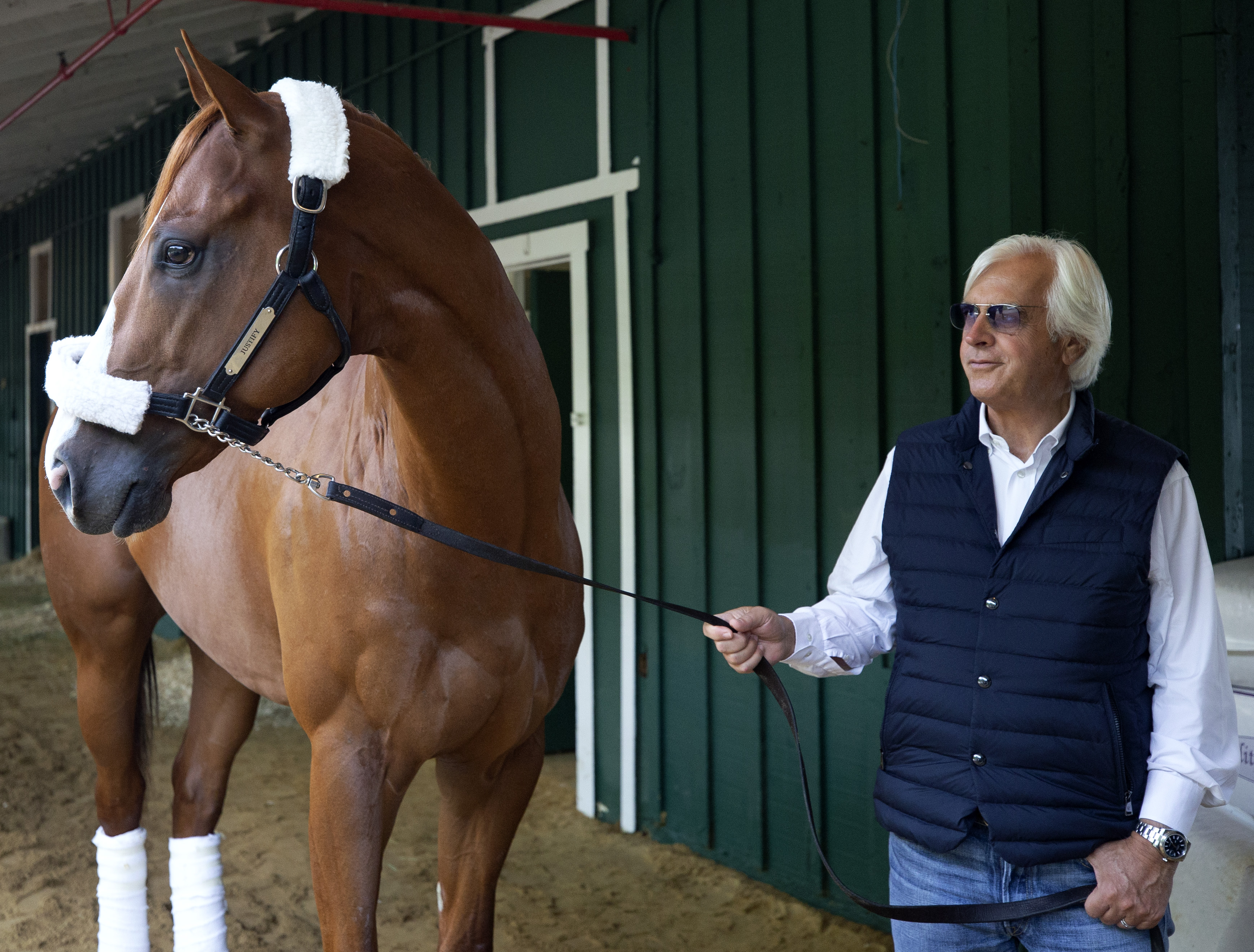
Triple Crown hero American Pharoah was a once-in-a-lifetime horse. But most horse people are quick to tell you that horses are the best teachers, and American Pharoah also proved a learning experience for the team that is now on the brink of a once-in-a-lifetime accomplishment – for the second time – with unbeaten Justify.
“We learned a lot from Pharoah,” trainer Bob Baffert said. “The great horses, they’ll really teach you a lot.”
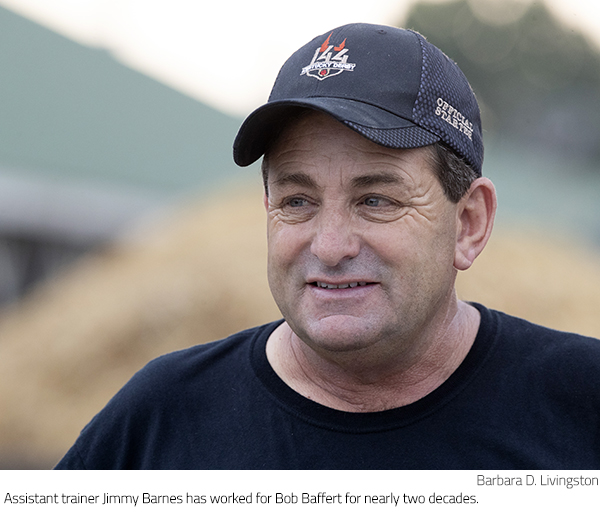
American Pharoah isn’t the only horse the people associated with Justify are able to to draw experience from. Baffert, of course, brought Silver Charm, Real Quiet, and War Emblem tantalizingly close to racing history before coming up short in the Belmont Stakes. Assistant trainer Jimmy Barnes has been with Baffert for nearly two decades. He and groom Eduardo Luna, who also cared for champion Arrogate, both hit the road with American Pharoah. And while this is exercise rider Humberto Gomez’s first classics go-round with the barn, he has galloped other outstanding horses, including Intercontinental and Medaglia d’Oro.
“I have a great team,” Baffert said. “Jimmy, [Luna], everybody knows what to do. We’re put in these situations constantly, all year long . . . I’m just glad we had Pharoah and we had Arrogate, West Coast, this guy – the hits keep coming. We just pinch ourselves – is this really, truly happening?”
Baffert: Quarter Horses part of experience
It might seem strange to draw from experiences preparing sprinters to rocket a quarter-mile to prepare a horse to stretch out to 1 1/2 miles. But the 65-year-old Baffert does use experiences from his days training Quarter Horses to inform him – particularly when it comes to the high-pressure crucible of the Triple Crown, and its three races in five weeks.
“We’d run, we’d qualify, and you’d come back a week later and have to run faster,” Baffert recalled. “Two weeks [off] was pretty good. Three weeks is like a lifetime for a Quarter Horse.
“[You had to] really get them to settle down. It’s a controlled runaway. The break is so important, the gate, it’s still very important to me.”
Indeed, Justify has gate schooled several times recently. The lessons have paid off, jockey Mike Smith said at the Preakness.
“If you go back and really look at it, he’s just staring down the racetrack, wouldn’t take his eyes off those doors until they opened,” Smith said. “He jumped extremely well.”
Baffert said the importance of keeping a horse fit and in good condition to handle the rigors of racing is another lesson he learned working with Quarter Horses.
“He has to go a mile and a half, and I want to make sure, when I throw Mike Smith on his back, he has a full tank of gas,” Baffert said. “I want to make sure that he’s fit. When they hit the stretch, if they get in a battle I want them to hit another gear. I want to give them that opportunity.”
Baffert places high importance on a horse’s weight and condition, particularly as the weather warms in June. He saw the heat take a toll on War Emblem 16 years ago.
“The thing [Justify has] going for him is he’s a big, strong horse and can handle a lot,” Baffert said. “He eats everything you put in front of him, and that’s the main key, that they don’t lose weight. I remember War Emblem, the heat got him. He wasn’t eating well. He lost a lot of weight during that time.”
Barnes: Back on the horse
Jimmy Barnes joined the Baffert barn in November 1998, and as a hands-on assistant is an integral part of the operation.
“He makes my job so much easier,” Baffert said. “I have to be concentrating on all these horses, where they’re gonna run, dealing with the ownership, buying horses. When he’s back here with the horse, I don’t have to worry about it. He knows what to do, he knows the way I think. We’ve been through so many situations, he knows, okay, when this happens, this is what we do. We learn from these good horses.”
Last September, Barnes, 58, fractured his pelvis in a freak accident when the stable pony he was riding stumbled. He got back to the barn within a month, but had to make adjustments from his typical role escorting trainees from the pony, as he was first on crutches in the barn office and then on a golf cart going to the track to watch and clock works.
“I was in the barn, I was the dispatcher,” Barnes said. “I was working on setlists, making phone calls, working the radio, telling Bob, ‘okay, so and so’s coming out.’ Slowly but surely I regained my strength and was able to start heading out to the racetrack and watching the horses train. Which was a little different, because I’m more of a hands-on assistant, where I’d be on the pony. So that took a little bit to get adjusted.”
Barnes was off the “electric horse” and back on the pony by the time Justify was moved from Baffert's barn at Los Alamitos to Santa Anita in January. Barnes said that the pressure of developing Justify from an unstarted maiden those few months ago to Derby winner felt similar to the pressure of getting American Pharoah to the Derby on a tight schedule after the colt missed the Breeders’ Cup due to injury and didn’t make his 3-year-old debut until March.
“[Justify] moved himself right along in his training program,” Barnes said. “You can’t have any setbacks, you can’t have hiccups along the way because there’s just not enough time. The same thing with American Pharoah, when we made his comeback. We only had X amount of days from when we scratched at the Breeders’ Cup to when we made our first start. You had to move right along. At that point, you’ve just got to take one race at a time.”
Luna: Vital piece of puzzle
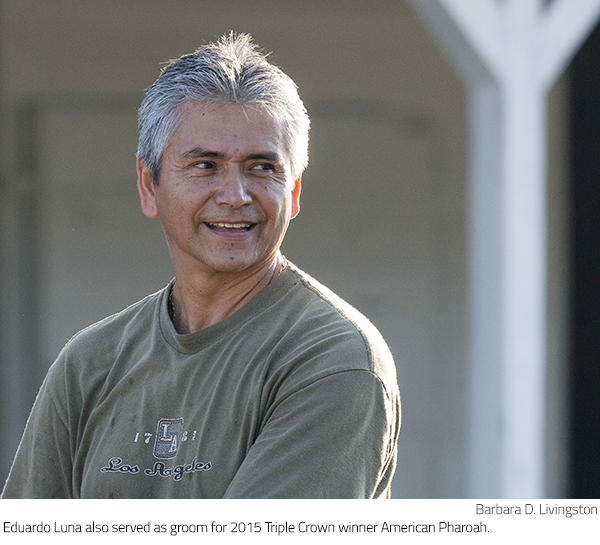
The quiet man walking by Justify’s head in a yellow rain slicker as the field assembled for the Kentucky Derby walkover, and two weeks later leading him through the fog following a dramatic Preakness Stakes has been here before. He was the same man by American Pharoah’s side soothing him as he danced through his own Derby walkover three years prior; holding the colt’s head, hair plastered down by rain, in the Preakness winner’s circle; and walking back to the backstretch at Belmont, escorting him out of a celebration 37 years in the making.
“Because of him, for the first time, I got to be around the biggest races,” groom Eduardo Luna said.
Luna, whose friends call him Lalo, has been with the Baffert barn for more than a decade. He was entrusted with American Pharoah when the colt was a juvenile, was the groom for Arrogate, and now handles Justify.
Luna, a native of Colima, Mexico, speaks little English. More importantly, he speaks fluent horse, picking up minor details about the charges in his care while going through the daily routines of feeding, grooming, and maintenance, such as putting protective bandages on and cleaning the horse’s stall. Baffert noted following the Preakness that communication with grooms is an important piece of the puzzle, as a groom might be the first to notice if a horse is giving off a signal that something is out of the ordinary – for example, by going off his feed, which has never been a concern with Justify.
Gomez: Always learning
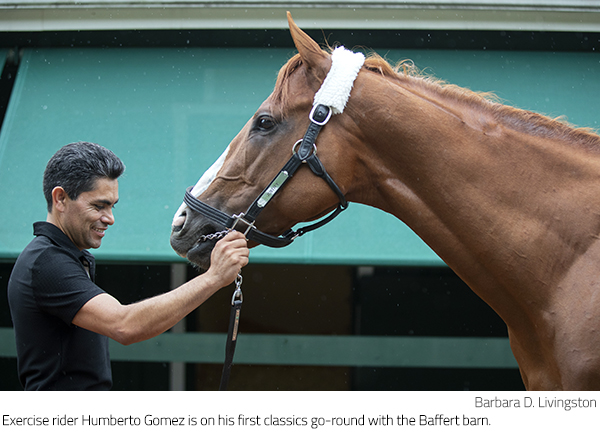
When regular exercise rider Humberto Gomez rides Justify onto the track, he doesn’t think about the crowds that have been showing up at Churchill Downs to watch the Triple Crown hopeful gallop – it’s just the man and his horse. Especially with only a handful of locally based Belmont hopefuls galloping in a reserved training window, making his job easier aboard Justify.
“When I go to the track, I don’t think that people are there,” Gomez said. “I just think it’s a normal day by myself with him. I don’t think about the pressure.
“When there are more horses on the track, that’s when he gets really, really competitive. That’s his personality.”
Gomez, 43, knows about competitive horses. When he began a productive run with the late Hall of Fame trainer Bobby Frankel, one of the first horses he galloped was Aptitude, who finished second in the 2000 Kentucky Derby. He also galloped champion turf female Intercontinental and Grade 1 winners Medaglia d’Oro and Megahertz. Gomez has also galloped for Julio Canani, Kristen Mulhall, Doug O’Neill, and John Shirreffs, among others.
“Every one is different, and you always learn different things from every horse,” Gomez said. “Looking at the videos, I look at my mistakes. Sometimes they make fun of me, like, ‘Oh, you’re looking at yourself.’ But honestly, I’m trying to look at the videos over and over and over to see what I’m doing wrong. The smart horses, they teach you if you’re doing something wrong. Because they’re so easy to ride, when you do something wrong, they let you know. They respond.”
In keeping with the theme of communication, Baffert said that feedback from Gomez is a part of making his training plans.
“He is a really top rider on him, and he tells me,” Baffert said. “He’ll let me know this or that, and it makes my life a lot easier.”
Gomez has faced his own personal challenges this Triple Crown season. His father, Ulpiano Portela Gomez – whom the rider credits with getting him into the business, first taking him to the races in Mexico City when he was 12 – died May 15, four days before the Preakness, back home in Mexico. Elliott Walden of co-owner WinStar Farm recognized the rider’s hard work through an emotional time following the Preakness.
“As Bob said, his crew works so hard, and everyone on the racetrack works so hard,”Walden said. “It was great to see [Gomez] right after the race, and I told him, this is for your dad.”
‘Draw on all experience’
Put every hour of time spent at a horse’s side, in the saddle, or making training plans together, and what do you have? Pieces in a puzzle. For a team that has already found an incredible amount of success, there is confidence in the methods used to put those pieces together.
“You have to draw on all experience,” Baffert said. “I think I’m at a stage of my life now that I was ready for this. If I’d have had these horses 25 years ago when I first got in, I probably would have been second-guessing myself . . . It’s all gut feeling.”
And as they go about Justify’s final preparations, one thing is certain.
“We’re all in it together,” Baffert said. “It’s like Camp Justify. We’re going into this as a team.”
