

Sparkman: Sizing up the 'Mexican Pharoah'
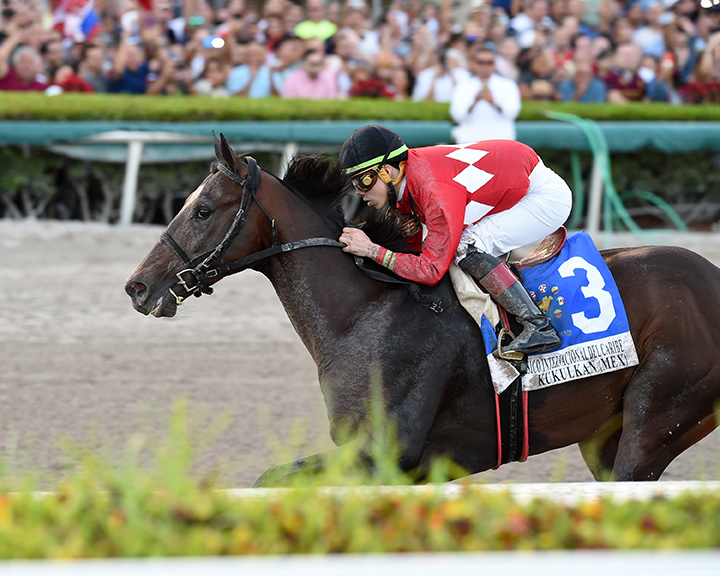
The longest of long shots in the Jan. 26 Pegasus World Cup is likely to be Cuadra San Jorge’s Kukulkan, despite the fact that the Mexican-bred colt is undefeated in 14 starts, including a 10-length romp in the Caribbean Classic at Gulfstream Park on Dec. 8.
Winner of the Mexican Triple Crown, all three races by open lengths, Kukulkan is known in his native land as the “Mexican Pharoah,” a tribute to American Triple Crown winner American Pharoah, but he required 1:54.80 to traverse 1 1/8 miles in the Caribbean Classic, resulting in what will doubtless be the worst last-race speed figure of any Pegasus entrant.
The Caribbean Classic (known in Latin America as the Clasico del Caribe) is restricted to horses bred in racing countries that border the Caribbean Sea, and at Gulfstream, Kukulkan defeated rivals from Venezuela, Panama, Puerto Rico, and Mexico, none of which is exactly known for producing horses up to top international standard.
In fact, none of the 10 stakes races, including six local Group 1 races, that Kukulkan won in Mexico qualifies for black type since Mexico is not included in Part 1 of the annual International Cataloging Standards handbook that determines the distribution of black type worldwide.
It is difficult to impossible, however, to determine prior to the Pegasus just where Kukulkan might fit in the international pecking order. He won three nine-furlong Group 1s in his last three starts at the Hipodromo de las Americas in Mexico City by a total of 34 lengths in significantly faster times than at Gulfstream but still has never broken 1:50 for the distance, three to four seconds slower than a Grade 1 horse would be expected to run the distance on American dirt.
Equally obviously, however, we have no comparative form to determine how fast the Hipodromo de las Americas surface is compared with Gulfstream Park.
Kukulkan was bred in the name of Haras San Jorge, which is owned by Mexico’s second-richest individual, German Larrea Mota Velasco, chief executive of Grupo Mexico, one of the world’s largest mining operations, and his pedigree is entirely American, as are those of almost all Mexican-bred horses of recent vintage. His sire, Point Determined, was one of only 33 black-type winners sired by 2001 Horse of the Year, champion 3-year-old male, and dual classic winner Point Given.
:: DRF BREEDING LIVE: Real-time coverage of breeding and sales
Bred in Kentucky by Bowman and Higgins Stable and Robert N. Clay Jr., Point Determined was the only stakes winner out of Merengue, by Broad Brush, and was purchased for $290,000 by Second Wind Stable at the 2004 Keeneland September yearling sale. Pinhooked to the Barretts March sale of 2-year-olds in training, Robert and Beverly Lewis paid $750,000 for him and sent him to trainer Bob Baffert.
Point Determined won the second of his two starts at 2 and quickly developed into a Derby prospect at 3, running second to A.P. Warrior in the Grade 2 San Felipe and second to Brother Derek in the Grade 1 Santa Anita Derby.
Point Determined made no impact behind Barbaro at Churchill Downs but bounced back to win the Grade 3 Affirmed Handicap before running second in the Grade 2 Swaps, but that was the last time the real Point Determined showed up. He did not race at 4 because of injury and was sold for $100,000 to Oscar Benavides at the Lewis dispersal in 2007.
He ran three times in minor company at 5 before his purchase by German Larrea and retirement to stud at Haras San Jorge.
Point Determined has sired 17 stakes winners by Mexican standards, including last year’s Caribbean Classic winner, Jala Jala (out of Buzz Song, by Unbridled’s Song).
Kukulkan is the only stakes winner out of the winning Bernardini mare The Real Mayo, a half-sister to stakes winner French Dip, by Speightstown. Their dam, Mayo on the Side, by French Deputy, captured the Grade 1 Humana Distaff.
Kukulkan’s third dam, Slewveau, by Slew o’Gold, was from one of the last crops bred at Bill duPont’s Pillar Stud, where the author was General Manager.
An otherwise beautiful filly whose conformation was marred by severely offset knees, Slewveau nevertheless won twice, earning $66,899 after her purchase for $50,000 by agent Clint Goodrich at the Pillar dispersal in 1992. Slewveau was a half-sister to Gravesend Handicap winner Comic Blush, by Blushing Groom, and stakes winners Starita, by Star de Naskra, and Dr. Adagio, by Cure the Blues. Starita, in turn, is dam of Canadian champion 2-year-old filly Honky Tonk Tune, by Cure the Blues.
Those three stakes winners were the best produce out of Istria, by Silly Season, who was purchased by Bill duPont in the early 1980s after earning German champion 2-year-old filly honors in 1979.
:: Want to get the latest news with your past performances? Try DRF’s new digital PPs
