
Saratoga's 2020 meet handles $702.5 million, second highest in track history
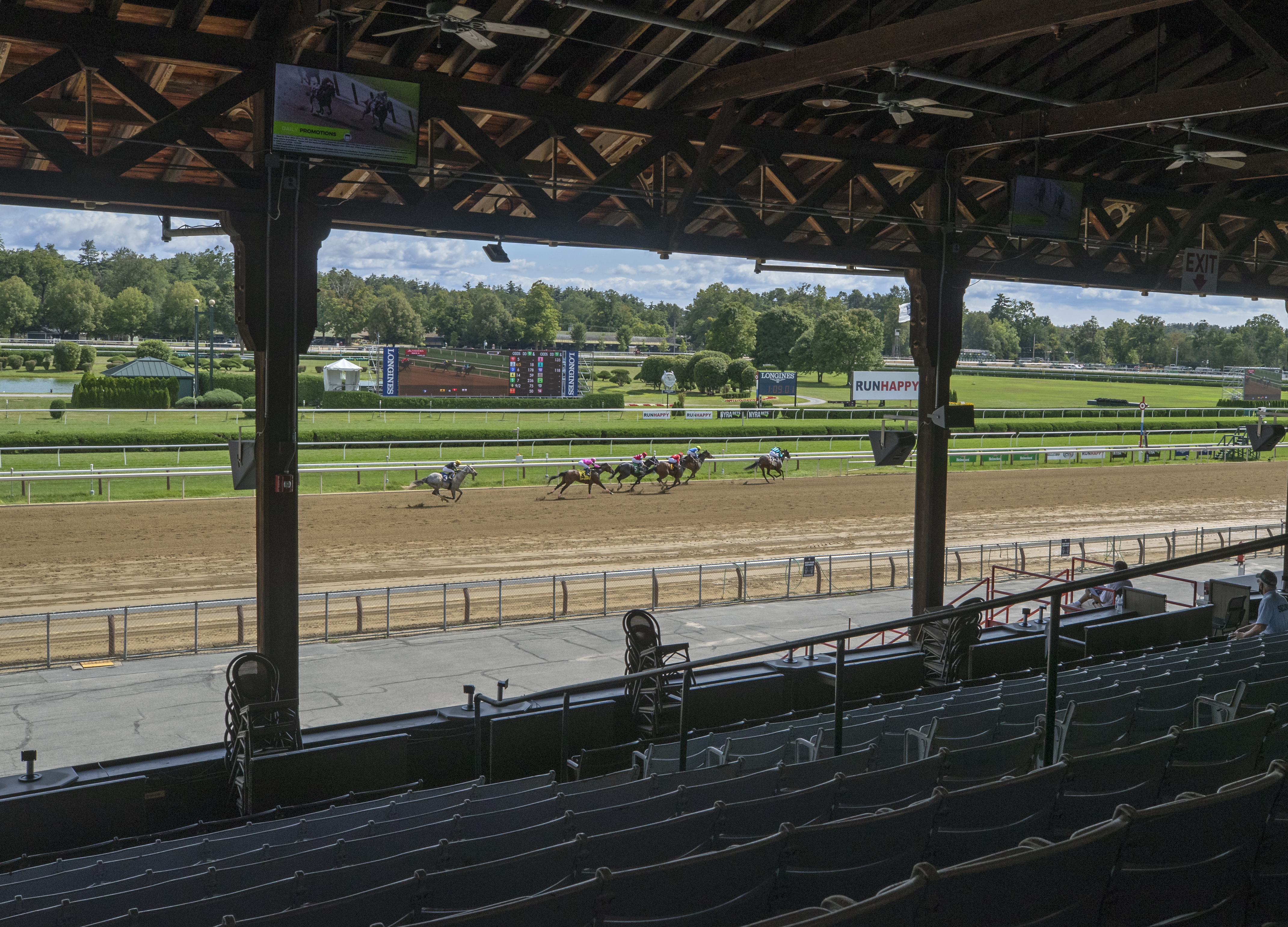
SARATOGA SPRINGS, N.Y. – The New York Racing Association’s confidence in the brand that is Saratoga was rewarded with box-office business at the 2020 meet despite the inability to have fans ontrack due to restrictions owing to the COVID-19 pandemic.
All-sources handle for the 40-day meet that ended Monday was $702,535,468, the second highest in the history of the track. Only last year was higher with $705,343,949. This year’s meet consisted of 40 full cards. Last year, one full card and half of another were canceled due to weather.
“While the 2020 Saratoga meet was a success in many ways, it will most be remembered for the absence of our passionate fans and the irreplaceable energy that they bring to Saratoga each summer,” Dave O’Rourke, NYRA’s president and CEO, said in a press release. “Despite not being able to attend in person, horseplayers watched and wagered with tremendous enthusiasm, and we thank them for their continued support.”
In an interview with Daily Racing Form on Sunday, O’Rourke said NYRA had sought to allow fans at Saratoga – as many as 1,800 in the picnic area – but “the state wasn’t ready to do that and honestly it was the right call.
“Yes, you could spread people out, but when the races are going on everyone’s going to push up to the rail. We’ve had limited numbers [of owners] here, and you could still see that happening and it has to be policed. If you multiply that by 10, it would have been a difficult task.”
Naturally, O’Rourke is hoping to have fans back on track at Saratoga next year.
“This is not something anyone’s going to ever want to do again,” O’Rourke said of a spectator-less Saratoga.
:: DRF's Saratoga headquarters – Stakes schedule, previews, recaps, past performances, and more
The lack of patrons cost NYRA approximately $15 million in lost revenue from ticket sales and concessions, O’Rourke said.
As good as handle was, O’Rourke said the best story of the meet was the fact there were no positive COVID cases reported on the backstretch during the eight-week meet. Everybody who came to work at Saratoga from downstate or out of state had to produce a negative COVID test before entering the backstretch or track at the beginning of the meet. Only those who displayed any symptoms were subsequently tested. None of those tests came back positive.
“This is the kind of year where you’re just looking for light at the end of the tunnel, to get through and to be able to operate up here and for everyone to be healthy and safe” was big, O’Rourke said.
Since fans were not allowed ontrack, there were some who questioned the wisdom of coming to Saratoga and adding a layer of expense to NYRA and horsemen. But management was steadfast in its forecast that handle at Saratoga would be higher than at Belmont during this period. With the casinos closed for six months, purse money is generated soley through handle.
“It wouldn’t have been the same [at Belmont,] and depending on what the purse structure looked like it would have eaten into the purse cushion and it wouldn’t have given us as much reserve to get through the end of the year uninterrupted,” O’Rourke said.
Tempering the all-sources handle figure at Saratoga is the fact that money wagered ontrack is worth three times more to NYRA and horsemen than money wagered offtrack. Money wagered through NYRABets, NYRA’s advance-deposit wagering platform, by New York residents is considered ontrack handle and that figure this year was $64,384,833. Last year’s ontrack handle was $146,618,750.
There were 409 races run at the meet in 2020, six more than in 2019. There were 183 turf races run, with 32 being rained off to the dirt. Last year, there 178 turf races run, with 34 moved off to the dirt.
Average field size in 2020 was 7.40 per horse, compared to 7.90 a year ago, a decline due in large part to less participation from Kentucky-based horsemen.
Saratoga unveiled a new main track this meet that was widely lauded by horsemen. There were five racing-related fatalities at the meet and four training fatalities over the main track, one over the Oklahoma turf course. There were four racing-related fatalities at the 2019 meet.
Todd Pletcher won his 14th Saratoga trainer’s title, defeating Chad Brown 32-28. Considering how Brown dominated the last two Saratoga meets, this title caught Pletcher by surprise.
“Next to the first one in 1998 this is probably the most rewarding,” Pletcher said. “I thought we had a stable that was training well, but I didn’t anticipate having as good a meet as we’ve had. We were understaffed with the COVID restrictions and everything, we had a lot of people step up put in a lot of overtime hours and a lot of hard work. It’s a big-time team effort.”
Mike Maker and Christophe Clement tied for third with 20 wins, while Bill Mott, who won three races Monday, tied Linda Rice for fifth with 15 wins.
Brown did lead all trainers in purse money won with $2,162,010, about $1,000 more than Mott.
On the jockey side, Irad Ortiz Jr. beat out his brother Jose, 59-58 for his second Saratoga title in the last three years and third overall. The two entered Monday’s final card tied at 57, but Irad went 2 for 12 on closing day while Jose went 1 for 11.
Ortiz won despite missing three cards due a left wrist injury.
“For a second, I didn’t think I could come back for the last two weeks from my injury and thank God I’m back and was able to keep riding and win some races and [lead] the standings,” Irad Ortiz Jr. said. “It’s something really special to me.”
Joel Rosario finished third with 48 wins – including a meet-best 13 stakes – followed by Luis Saez (45) and Jose Lezcano (27).
Seth Klarman’s Klaravich Stables won its sixth straight Saratoga owner’s title with 13 wins. Mike Repole was second with nine, followed by Three Diamonds Farm (eight) and the Noda Brothers (five).
NYRA will move on to Belmont Park for a 27-day meet that begins Sept. 18, a week later than usual. There will be an 18-day Aqueduct fall season from Nov. 1 to Dec. 1. A winter schedule has not yet been laid out, but with the Resorts World casino next to Aqueduct set to open Wednesday, albeit at 25 percent capacity, NYRA should be getting a much-needed secondary revenue-generating source.
“I’d say that’s a positive,” O’Rourke said. “If you were handicapping that particular aspect that’s earlier than we would have handicapped it.”