

Racing in the time of corona: Smaller tracks in the spotlight
John Lies arrives in the morning at Will Rogers Downs and oversees entries as the track’s racing secretary, climbs into the announcer’s booth in the afternoon and calls the races, and before heading home stays a few days ahead on the track’s morning line, which he makes.
He’s usually busy, even more so now. A lot more racing fans are watching.
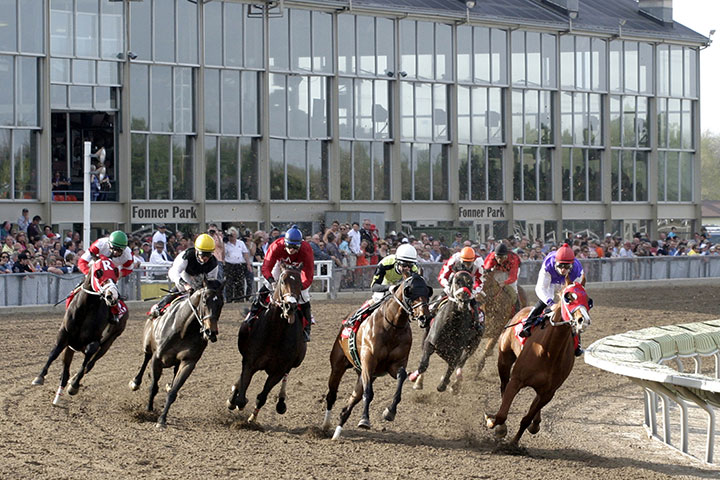
The track where he works – located 32 miles outside of Tulsa, Okla. – and Fonner Park, about 6 1/2 hours up Interstate 135 in Grand Island, Neb., are two small tracks that usually fly under the radar of horseplayers nationwide. But both have had significant increases in business recently owing to the coronavirus pandemic that has shuttered tracks across the country.
That has resulted in increased attention, not only from horseplayers and the national media – including Steve Byk’s popular “At the Races” show on Sirius XM – but from horsemen looking for opportunities that have been truncated at other tracks in recent weeks.
“The difference has been dramatic,” Lies said in a telephone interview. “It’s largely impacted by the global pandemic, but the racing here got tougher even before the meet started with our stall applications, where we had a number of rookie trainers, the most impactful being Robertino Diodoro. But as the meet has gone on, the racing has become more competitive by a mile.”
Horseplayers are taking note. Will Rogers raced 25 days last year and handled $16.8 million. That handle figure was surpassed on the eighth day of this year’s 29-day season. After 10 days, through Tuesday, Will Rogers had handled $26.5 million.
Fonner also has had a surge in overall handle. On Tuesday, spurred by a carryover of just shy of $500,000 in the Dinsdale late pick 5, Fonner set an all-time record for a single-day handle for the state of Nebraska, with $7.2 million, half of that fresh money for the pick five. For the week ending Sunday, April 5, Fonner handled more than $7.8 million. The equivalent week in 2019 produced handle of $958,424.
Since the meet began last month, Fonner has added an early pick five, an early pick four, and a late pick four, all because “demand was there,” according to Chris Kotulak, the track’s chief executive officer.
“We wouldn’t offer those wagers before the mammoth pools because we didn’t want to distract” from the pick five, Kotulak said.
“It’s paid off handsomely for our horsemen and their purse account,” Kotulak said.
The increase in handle has not been as impactful to the bottom line at Fonner itself, though, Kotulak said. Fonner and Will Rogers, like bigger tracks Gulfstream and Oaklawn, are operating with essential personnel only, no fans allowed ontrack. According to Kotulak, Fonner is heavily reliant on ontrack patrons, which was something Fonner had to concede when convincing local authorities to allow them to race.
“Every Saturday we would sell out the stands, with 6,000 people, so that’s a significant loss in terms of food and beverage and seating,” Kotulak said. “That’s how Fonner Park butters its bread. A mammoth handle in front of an empty grandstand does little for Fonner. It’s a screaming success for the horsemen. It’s survival for Fonner.”
Because Fonner was required to race without patrons, the track chose to give up its weekend slot and race Mondays through Wednesdays, trying to take advantage of soft spots on the racing calendar. Kotulak said he subsequently received calls from all over the world seeking to take the track’s simulcast signal.
“I got calls from people who I’m sure didn’t know where Fonner was, just knew it was on the calendar,” he said. “Now we’re going into homes of people who never knew of us. We’re in the UK, France, Australia, South America.”
At Will Rogers, Lies said he has benefited from an influx of better-quality horses that have given him the opportunity to present cards that are long on variety and depth. On Wednesday’s card, for instance, there were 94 entries in 10 races, before scratches.
“I’m able to blend the cards better,” he said. “I can fill a two-other-than, have cards that give handicappers a variety – claimers, maiden-claimers, maiden special weight, a good allowance, and an old-fashioned handicap. Short, long, fillies and mares. I used to maybe split a maiden-claiming race, find creative ways to run all the races we’re required to run by license.”
Anyone who listens to Lies during Del Mar when he hosts the simulcast show there knows he is a thorough, top-notch handicapper. He brings that skill set to setting the Will Rogers morning line. Better fields and more horses equals a more attractive gamble. That, coupled with the increased attention on Will Rogers, means more sophisticated bettors are tuned in.
“There’s more and smarter money in the pools right now,” he said. “People are playing our races who use Beyer Figures, sheets. You have to be sensitive to that audience.”
Lies has called races at Lone Star and Kentucky Downs, among many other tracks. As the track announcer at Will Rogers, he said he has tried not to allow the increased attention impact the way he approaches that craft.
“I was greatly influenced Trevor Denman, so I like to be cognizant of who the favorite is, how much horse a rider has under him, things like that,” Lies said. “I’ve changed two small things. The outcome of these races is greater, so I do think my level of enthusiasm has gone up, hopefully without shrieking. And I’ve tried to make sure my cadence, or tempo, matches the way the race is unfolding. In a stakes race with three or four about to push for home, it’s going to unfold quicker.”
The events at Will Rogers and Fonner have become far more important to the content provided by Byk, who since 2007 has broadcast three hours a day, five days a week, whether it’s summer at Saratoga and Del Mar, or now.
“I don’t want to say it’s business as usual, because it’s not, but it is much like the regular approach to the show, which is to present whatever’s topical today. The news of the day is fodder,” Byk said.
“Whatever I can do to be a resource, whatever the storylines are from the races, that hasn’t changed, whether it’s the pick five at Fonner or interviewing Kent Sweezey after he won three on the card the other day at Tampa, and a fourth the next day. I had Andrew Hawkins on to talk about Australian racing, and I do Hong Kong regularly already.
“Hopefully, I can give people a diversion for three hours. It’s a captive audience. Literally captive.”
Byk has devoted significant portions of his recent shows to Thoroughbred aftercare, bringing on experts to provide information to owners and trainers on how to navigate tax ramifications and federal small business loans, or simply helping trainers find housing for their personnel when relocating to Kentucky.
“Topics ripped from today’s headlines are always the content of the show,” he said.
The content may be different. But – as with those able to glean income or enjoyment from the racing that remains – it’s still essential.