

Preakness 2021: Using DRF Formulator to make an informed bet
It’s Preakness Day, and if you haven’t done so yet, it’s time to pop open a new tab in your web browser and pull up the Pimlico past performances – DRF Formulator style.
“Daily Racing Form” and “past performances” are synonymous terms in Thoroughbred racing, and for several years now, DRF has been enhancing its digitized, sortable, interactive version of the past performances that racing bettors and fans have come to rely upon.
Formulator is an invaluable tool, its functionality suited both to the novice or casual race-player and to those diving deeper into Thoroughbred wagering, already well versed in the art and science of handicapping.
Everything you need to handicap and bet is right there in Formulator. Let’s open the Preakness past performances and take a look.
(As the DRF Race of the Day on Saturday, free DRF Formulator past performances for the Preakness are available here.)
The first thing to do when beginning this interactive experience: Customize the look of the past performances showing up in your screen. You can include as many running lines for each horse as you like, up to their entire career, and there are seven different basic filter options you can modify to adjust a race’s PPs to isolate only certain characteristics of interest. Two other buttons allow you to bring up a DRF Bets wager pad, with live odds and video, and to include any pertinent news and handicapping analysis for a given race: There is plenty of that, of course, related to this Preakness.
Opening the past performances, we see data expressed mainly in black type; anything in blue is a hyperlink, a place to click and open a door to more information. Take the No. 1 horse in the second leg of the Triple Crown, a longshot named Ram. His sire’s name, American Pharoah, is hyperlinked in blue: Click on it and you’ll find all pertinent information regarding American Pharoah’s career as a stallion, such as the average winning distance of his progeny, his offspring’s race record at various distances and surfaces, and the career past performances of the stallion in question. May 2015 – American Pharoah won the Preakness by seven lengths in the slop.
:: Join DRF Bets and get ready to watch and wager on the Preakness with a $250 first deposit bonus
Perhaps even more valuable in the pedigree section – the horse’s dam. Clicking on her name will open her record as a broodmare, including career past performances for all the horse’s siblings, which can be incredibly helpful, especially in a maiden race loaded with first-time starters or when investigating a horse trying new things. Ram, for instance, never has raced at a distance beyond 1 1/16 miles and now tries 1 3/16 in the Preakness. Click on the “sibling PPs” button after opening his dam’s page and you’ll find all the running lines for his two brothers with race records. Coal Front was a fine performer, winning the $1.5 million Godolphin Mile. All but two of his starts came at one mile or shorter; he eked out a win in his lone try over 1 1/16 miles and faded badly in his lone start at 1 1/8 miles. Conquest Titan won twice, at one mile and seven furlongs, and took a step back in his lone try at a distance as far as 1 1/8 miles. Well, then – it looks like Ram isn’t obviously going to benefit from the longer distance he tries Saturday.
The date, race number, and race venue for every North American race in a horse’s past performances has a blue hyperlink: Click on it and a cascade of essential data flows onto your screen. Let’s look at another Preakness longshot, the No, 6 horse, Rombauer. This colt finished fifth last fall in the Breeders’ Cup Juvenile. Click the link and an interactive chart of the race comes up. The chart opens in standard form but has many, many interactive features. I always change the standard chart appearance to “incremental pace,” which shows the fractions every horse recorded throughout the running of the contest and can provide an essential understanding of race shape. Rombauer, for instance, closed from 11th to finish fifth, but was he actually running fast late in the race, or just passing really tired horses? His final 2 1/2-furlong split was 31.28 seconds, better than the nine horses that finished behind him, but worse than the top three finishers, two of whom raced closer to a fast pace than Rombauer. How did the BC Juvenile horses perform in their subsequent starts? You can click “next race” and the chart changes to show every horse’s subsequent start or click on the name of any horse in the race to pull up a full set of past performances.
Want to watch the race in question for yourself? Fine – there’s a “race replay” button that brings up a replay, with pan view and head-on view. The BC Juvenile had a distinct late flow to the race shape: Was that merely a function of the lone race, or a trend throughout the entire card? Easy to determine since at the top of the “chart page” there are links to the same kind of interactive charts for every race on the day.
:: DRF's Preakness Headquarters: Contenders, latest news, past performances, analysis, and more
Back on the regular past performance page, I like to merge workouts into a horse’s running lines; seeing the breezes interspersed between running lines helps me envision the day-to-day and week-to-week patterns of an entrant. Rombauer, unlike many Preakness runners, comes into the race fresh, unraced since the Blue Grass on April 3 at Keeneland. His workout pattern catches the eye, however, four Santa Anita breezes coming after his Blue Grass, and on the page we can see the last three of them have ranked high in terms of time at a given distance on the morning of the breeze – two of the works were second-fastest of the day, his final drill the fourth-fastest of 56 half-mile works on May 8. Rombauer is looking a little interesting. Click on his dam: The first sibling that appears is Treasure Trove. He turned in a stinker, the data shows, just yesterday in the Pimlico Special, but earlier this year was tried over two miles and finished a respectable fourth in a 1 1/2-mile race.
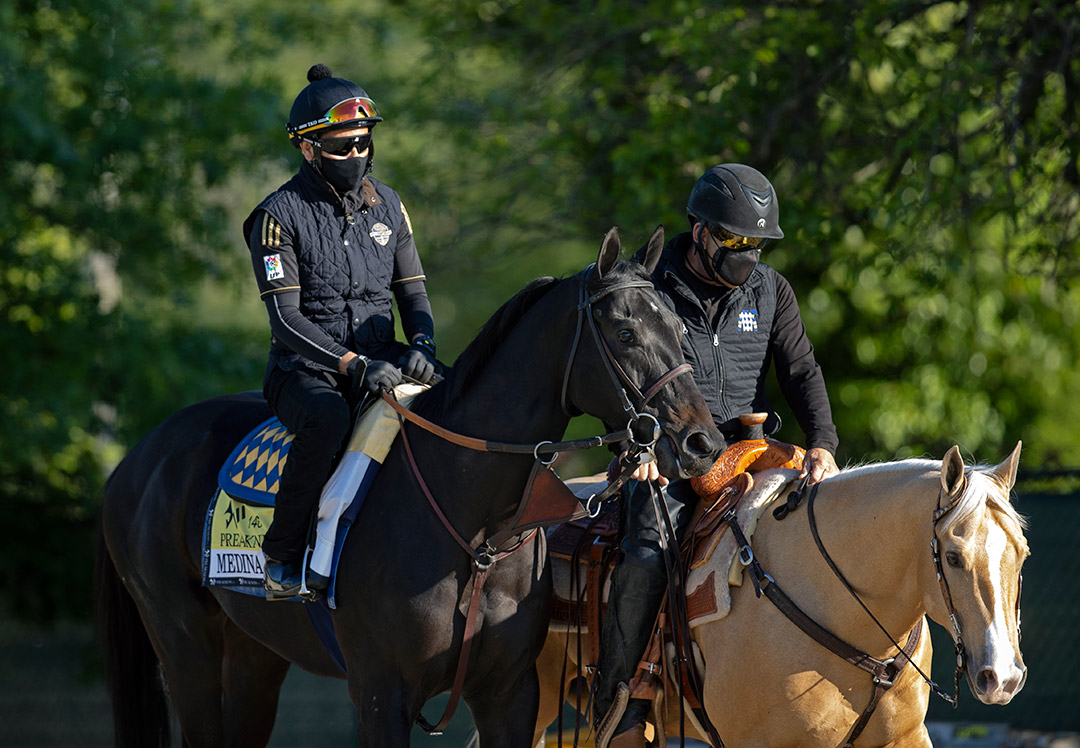
What about the favorite, the Derby winner, Medina Spirit? We’ll have a look, and do so through another important Formulator tool, trainer stats. All DRF past performances have had trainer stats included for decades but Formulator allows you to customize how you view a trainer’s record. If we click on “Bob Baffert,” Medina Spirit’s trainer, his page comes up, including, believe it or not, a record, sorted in chronological order, of every Baffert starter over the last five years. The bare bones of every race already is on the page in summary form, but you also can choose “past performance” and look at the career past performances of every Baffert runner during the five-year span.
This is all wonderful, but what can be more useful, for a given race, is filtering the trainer stats to fit the race under consideration. Click the “customize” button and you’ll pull up 20 different categories for filtration. There are default categories within each, but many also have customizable range settings. For Baffert, I’m going to apply four pertinent filters: 3-year-olds, dirt races, route races, and Grade 1 stakes. Over the last five years, Baffert has 63 runners under such conditions, with 20 winners and 39 in the money; the return on investment on the winners is a robust $2.85. Dig a little deeper and find the 32 percent strike rate, which is remarkably high in and of itself, is even better. Nine times Baffert had two runners in the same race, and on two other occasions he had three; Baffert won four times in these races with multiple starters, making his record look even better. I’ll add one more filter pertinent to Medina Spirit, “winner last out.” That narrows the sample to 33, with 15 winners, 24 in the money.
Medina Spirit’s a short price, but Baffert is so strong in these situations. It’s early, still, but this afternoon is going to be busy, so let me go back to the Preakness past performance page and open the wager pad. One click, on “wagering and video,” and there you are. On the top right corner of every horse’s past performance we find a box for “notes” and a box labeled “position,” which refers to how you want to use a horse in a vertical wager, that is, an exotic bet on this single race. If you want to play a multi-race wager, that box will change to “A-B-C” in order to create a ticket weighting your opinion. Click the option you want and the play will automatically form in the wager pad at the top of the screen. Here, I’m playing vertically, betting a trifecta, using Medina Spirit as the lone horse in the win spot and trying to run second and third choices Concert Tour and Midnight Bourbon out of the second position. Any horse you don’t want to use in your bet, click “toss,” which I’m doing with Concert Tour and Ram. I’m clicking Keepmeinmind, Crowed Trade, and Rombauer into the second and third slots and using all the other un-tossed entrants for third. The play forms on the wager pad, I follow the steps toward “place bet,” click that button, and have put money behind opinions formed through Formulator study.
One landing spot for all the racing data you could possibly digest, with an expression of your opinion – your bet – just a click away. Good luck with the Preakness, though you will find less need for luck with the power of DRF Formulator behind your wagers.