
New York Gaming Commission hears testimony on whether whip rules should be changed
The New York Gaming Commission on Monday heard two hours of testimony from a variety of racing constituencies as the regulatory body begins to explore whether to change rules governing the use of the whip in a race.
The testimony is the first step in a process that New York’s racing regulators have promised to address in the midst of action by a number of other major racing jurisdictions to restrict the use of the whip in a race. Barry Sample, the chair of the gambling commission, started off the discussion by saying that deliberations over any potential amendments would take some time, and that “no one should expect the commission to act today.”
As has happened in other states, the discussion Monday centered on whether racing needs to restrict the use of the whip in order to address public-perception problems, even as many riders express concerns that some restrictions are making their jobs more dangerous and limiting their use of a tool to encourage horses to do their best.
New York’s current rule allows riders to use the whip five times in succession before giving a horse “the opportunity to respond.” The rule also gives the stewards wide discretion to penalize riders for “abusive” use of the whip, even if the rider did not break the five-strike limit.
A panel of three New York stewards opened the discussion by unanimously saying that the current rule works well in the state. The stewards stressed that they believed the riders in New York are some of the best in the U.S., and that they rarely have to warn a rider twice about misuse of the whip.
:: Enhance your handicapping with DRF’s Belmont Clocker Report
“We don’t have a problem here,” said Carmine Donofrio, one of the stewards. “We deal with what we have to deal with, and the riders know what to expect here in New York.”
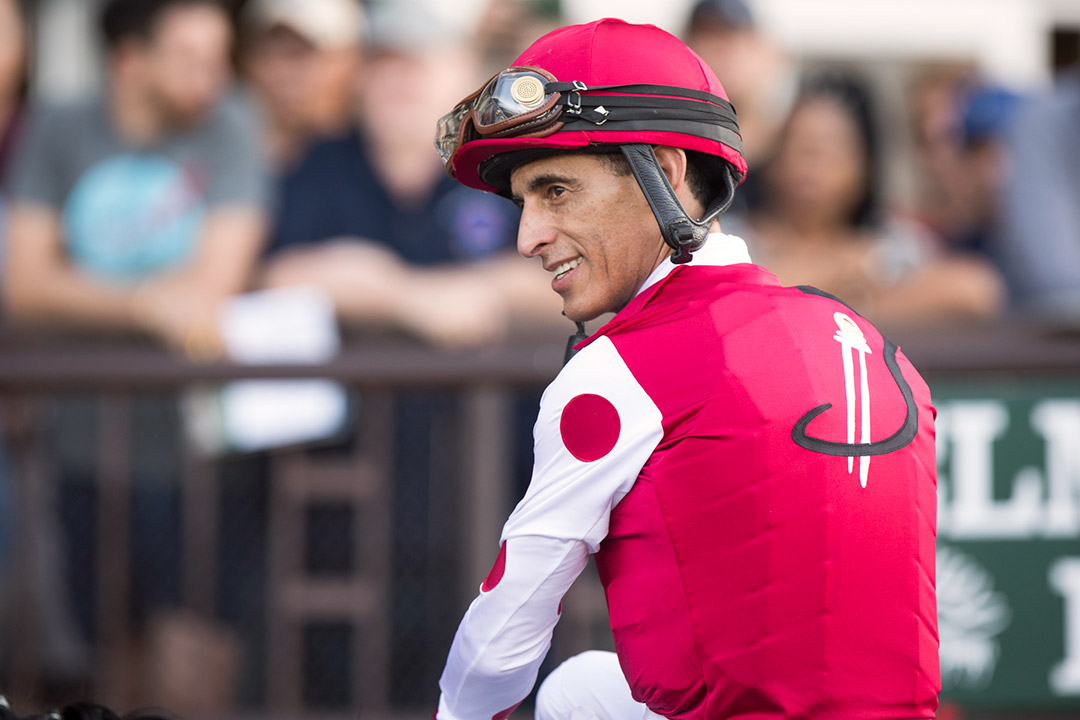
A number of Hall of Fame jockeys appeared virtually to provide testimony, including New York mainstays John Velazquez and Javier Castellano. The jockeys said that modifications to the design and materials in the whips used by riders have resulted in a tool that is far more humane to use than whips in the past, and they urged the regulators to keep the remaining rule in place.
“If it’s not broken, don’t fix it,” Velazquez said.
But officials with a number of racing companies and The Jockey Club pushed back against those assertions, saying that surveys have revealed that potential fans of racing are increasingly turned off by the very act of using a whip to strike an animal. Jim Gagliano, the chief operating officer of The Jockey Club, told the commission that racing needs to “evolve” along the lines of other animal-use industries.
“To me and The Jockey Club, we see a future where hitting an animal with a stick will not be acceptable, certainly not for urging,” Gagliano said. “We recognize that these are difficult things to change, and it’s going to take a while.”
The Thoroughbred Safety Committee of The Jockey Club has already approved a recommendation that would ban the use of the whip for any purposes other than ensuring the safety of horse and rider.
Martin Panza, the senior vice president of racing for The New York Racing Association, said that officials for the company have noticed that criticisms over the use of the whip on social media has increased in the past year. He said that regulators should put in place rules limiting the use of the whip in order to defuse those criticisms, contending that New York would look like an outlier if it did not adopt some restrictions.
“The train has left the station,” Panza said. “Whether we like it in New York or not, we are probably going to have to do something or we are going to get attacked.”
A number of other representatives of racing companies that have banded together in the past year to form the Thoroughbred Safety Coalition recommended that before moving forward on a rule the commission study the results in jurisdictions that have put in place new restrictions.
“We need to make those evaluations,” said Craig Fravel, the chief executive officer of racing operations for The Stronach Group, which owns tracks in California, Florida, and Maryland.
* Also at the meeting, the commission unanimously approved a hearing officer's recommendation to revoke license privileges to a former groom, Ramzan Antooa, for life. Antooa, a former groom for trainer Christophe Clemente, was arrested on Aug. 1, the day after he released an unraced 2-year-old filly from her stall at Belmont Park. The filly, whose name was Pasta, suffered fatal injuries after she fell on the road outside the barn. Antooa was arrested and charged with burglary in the 3rd degree and reckless endangerment of property.