
Necropsy report for Medina Spirit inconclusive
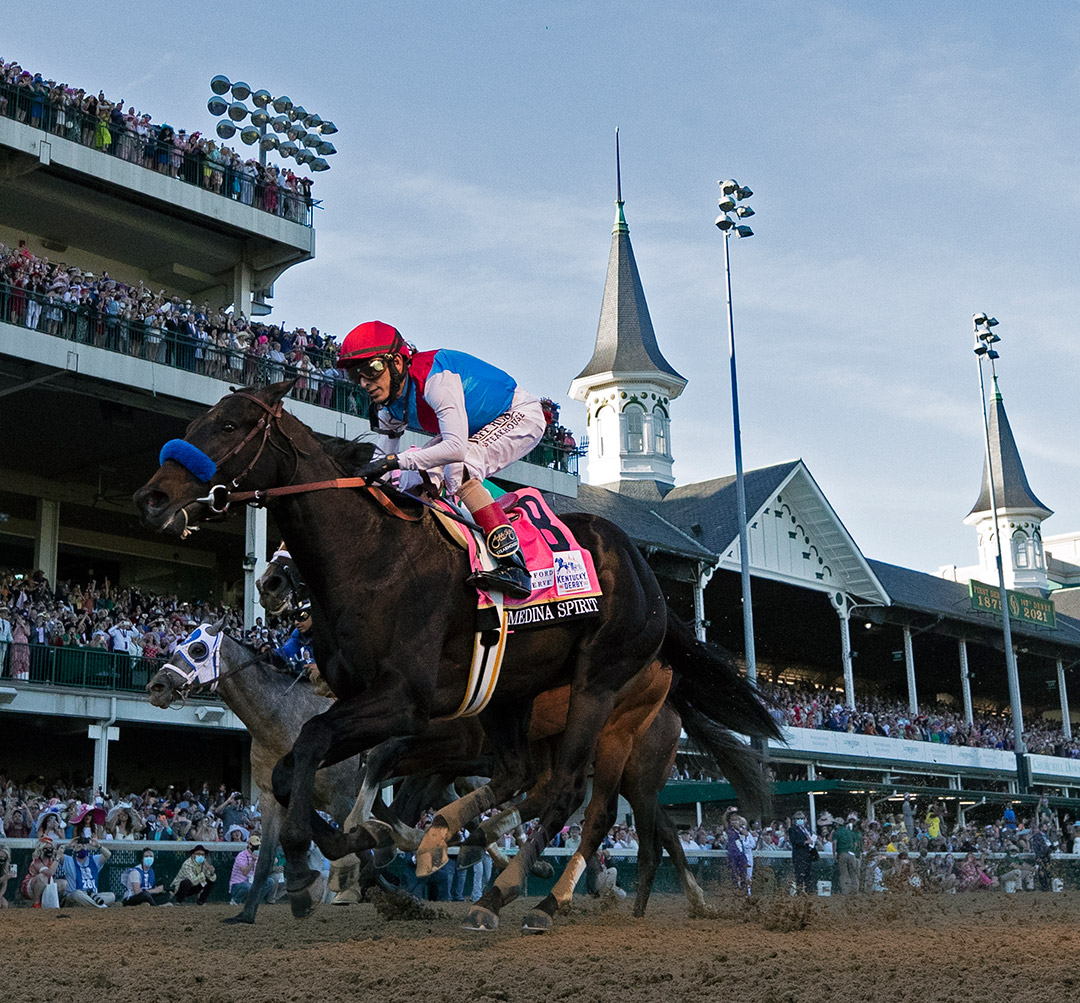
Officials who conducted the necropsy of Medina Spirit, the late 2021 Kentucky Derby winner who tested positive for a regulated medication following the race, have not been able to identify a conclusive cause of death for the horse after he collapsed on Dec. 6 just after finishing a workout at Santa Anita Park in Southern California, according to a report released on Friday by the California Horse Racing Board.
The report, which was prepared by staff at the University of California-Davis, with assistance by the CHRB, said that an analysis of the horse’s tissues and blood samples did not turn up any illegal drugs or medications. At the time the horse collapsed, multiple veterinarians suggested that the most likely cause of death was a heart attack, but many of those same veterinarians said that a necropsy may not be able to conclusively identify a heart attack as the cause.
“The swollen lungs and foam in the trachea [windpipe], enlarged spleen, and congestion and mild hemorrhages in other tissues seen on the postmortem examination are common in horses dying suddenly, and are compatible with, but not specific for a cardiac cause of death,” a release from the CHRB said on Friday.
Any horse that dies at a licensed racing or training facility in the state of California is required to be necropsied under the state’s racing regulations. The report was prepared by six employees of UC-Davis, and results of the report were reviewed by toxicology and pathology experts at the University of Kentucky and University of Guelph in Ontario, Canada, according to the CHRB.
Dr. Francisco Uzal, a diagnostic pathologist at UC-Davis, said on a conference call organized by the CHRB on Friday that a heart problem was the leading suspect in the death, but that the scientists who worked on the necropsy could not definitively identify the cause, a common problem with horses of all breeds.
“It’s definitely frustrating,” Uzal said. “We see this in all sorts of horses, including backyard horses and working horses, not just racing horses.”
The workout after which Medina Spirit collapsed was his second since finishing second in the Breeders’ Cup Classic a month earlier. The horse was preparing for a 4-year-old campaign for owner Amr Zedan and trainer Bob Baffert. At the time of his death, Medina Spirit had won five races in 10 career starts, with purse earnings of $3.5 million.
The immediate supervisor of the report was Dr. John Pascoe, the executive associate dean of the UC-Davis School of Veterinary Medicine, who was placed in that position after the CHRB’s equine medical director, Jeff Blea, was placed on administrative leave earlier this year.
Blood, hair, urine, and tissue samples were collected from Medina Spirit just after the 3-year-old colt collapsed and died on the track, according to the CHRB, and the tests were negative for prohibited medications, the executive director of the CHRB, Scott Chaney, said on the conference call.
Several hours after he died, Medina Spirit’s body was transported to facilities at UC-Davis to perform the necropsy, according to the report, and tissue samples from the horse’s “heart, lungs, liver, spleen, kidney, stomach, intestines, muscle, brain, spinal cord, testicles and other glands … were examined under the microscope for evidence of abnormalities.”
The report said that toxicology tests were conducted to screen for the presence of “hundreds of substances, both legal medications and prohibited drugs, including, amongst others, erythropoietin, clenbuterol, and betamethasone.” It said that the tests turned up the presence of furosemide, the diuretic that is widely used to mitigate bleeding in the lungs, and omeprazole, an anti-ulcer medication, but that all other tests were negative.
“No other drugs, heavy metals [including cobalt], or toxicants were detected,” the report said.
The report also said that Medina Spirit’s thyroxine levels were “below normal reference limits.”
The blood sample was tested for thyroxine “out of an abundance of caution,” said Dr. Ashley Hill, the director of the California Animal Health and Food Safety diagnostic laboratory at UC-Davis, because of links between use of the supplement and a handful of sudden deaths at California tracks in 2013. Several of those horses were trained by Baffert.
Hill also acknowledged on the conference call that the low levels of thyroxine found in Medina Spirit were not a “definitive” result, because the research to establish baseline results for thyroxine used live horses. Also, thyroid levels are affected by exercise, Hill said.
Sudden deaths in racehorses are uncommon but not unusual. At the time Medina Spirit collapsed, 13 of the 71 horses who had died at California racetracks in 2021 were classified as sudden deaths, with heart attacks being the primary cause. The report said that in the case of sudden deaths, only 53 percent of necropsies are able to identify a cause of death with “certainty.”
Dr. Uzal called the lack of a definitive conclusion in sudden-death cases “the rule of thumb, not just with us, but in most racing jurisdictions around world.”
Uzal said that the lab at UC-Davis has saved samples of Medina Spirit’s blood and tissues so that “if some new technology were to come to light in the future, we could go back and test the samples.”
Horses trained by Bob Baffert have tested positive for regulated medications six times in the past three years. The string of positives has led Churchill Downs to ban Baffert through the 2023 Derby, and the New York Racing Association recently held an administrative hearing seeking the go-ahead to ban the trainer after previous efforts were blocked by a federal judge.
The inquiry into Medina Spirit’s death has been complicated by a controversy surrounding Dr. Jeff Blea, the equine medical director of the CHRB. Blea, one of the most respected equine practitioners in the U.S., had his veterinary license suspended by the California Veterinary Medical Board in December, under a complaint alleging he administered medications to racehorses “without any documented examination or diagnosis” during a five-month period in 2020 and 2021, when he was still a practicing veterinarian.
Following the suspension, the CHRB removed Blea from any oversight role of the Medina Spirit probe, and he was later placed on administrative leave from his position. In late January, the CHRB board released a statement saying that Blea “has their full support and confidence to continue in his role” as equine medical director despite the suspension. Animal-rights advocates in California have powerful connections in the state’s political realms.
The Derby positive for the regulated anti-inflammatory medication betamethasone has compounded interest in the death of Medina Spirit. The case has not yet been adjudicated, but stewards in Kentucky are expected to hold a hearing next week, a proceeding that has been delayed by attempts from Baffert’s attorneys to lay the foundation for a case in which they will argue that the positive was due to the application of a skin ointment to treat dermatitis, rather than through a joint injection, the more common route of administration for betamethasone.
Regardless of the route of administration, Kentucky regulations prohibit the presence of betamethasone in post-race samples and call for the disqualification of horses that test positive for the medication. Racing officials in Kentucky and other states caution trainers and veterinarians to refrain from injecting betamethasone within 14 days of a race in order to avoid a post-race positive.
The Derby win last year was the seventh for Baffert, a record. Baffert was inducted into the National Museum of Racing’s Hall of Fame in 2009, but his voluminous record of accomplishments has been tarnished over the past several years by his string of medication positives. None of the positives have resulted in Baffert serving any days of suspension.