

Mongolian Groom must pay highest nomination fee, but that has gotten less expensive
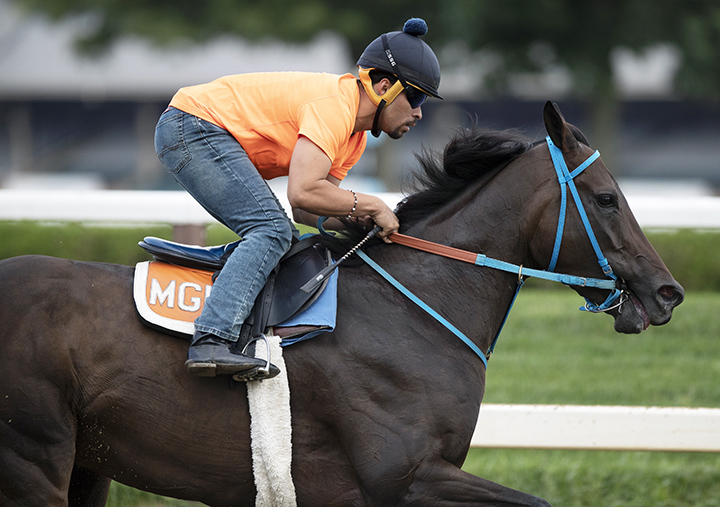
The decision by the connections of Mongolian Groom to make him eligible to the Breeders’ Cup Classic by paying a nomination fee of $200,000 seems a steep price to pay, but in fact he could have gotten in earlier for a far cheaper price, and the Breeders’ Cup has made the process much more affordable than in its earlier days.
Mongolian Groom’s situation became paramount after he won the Awesome Again Stakes on Sept. 28 at Santa Anita. The Awesome Again is a Win and You’re In toward the Classic on Nov. 2 at Santa Anita, which means that entry and starting fees totaling $150,000 for the Classic are waived. But Mongolian Groom was the only horse in the Awesome Again who was not nominated to the Breeders’ Cup, so even though he got the “win” part down, the “in” needed addressing.
The $200,000 fee is due at the time of pre-entries on Oct. 21, and will make Mongolian Groom, a 4-year-old gelding, eligible to the Breeders’ Cup for the rest of his racing career.
Mongolian Groom is a son of the Mineshaft stallion Hightail, who stands for $2,500. Hightail, however, was not nominated to the Breeders’ Cup program for the breeding year of 2014, the year Mongolian Groom was conceived. Had Hightail been nominated, the owners of Mongolian Groom when he was a foal could have nominated him to the Breeders’ Cup for $400.
Owing to that situation, Mongolian Groom thus defaulted into a program where he could have been nominated for $18,000 by July 15 of his 2-year-old year. He could have been nominated before July 15 of this year for $100,000. But because both deadlines came and went without him being nominated, he now must pay the highest fee, $200,000.
:: BREEDERS’ CUP 2019: See DRF’s top contenders
For horses who were not nominated as foals but whose sires were nominated to the program – like Breeders’ Cup Mile contender Uni, a daughter of More Than Ready – the fee at this stage is $100,000.
“I think we will go to the Classic,” said Enebish Ganbat, who trains Mongolian Groom for the Mongolian Stable of owner Ganbaatar Dagvadorj. “He has to pay. There’s no other way.”
The current fee is a far cry from the usurious rates charged in the early days of the Breeders’ Cup, when horses had to pay 12 percent of a race’s purse if their sire was nominated to the program, and 20 percent if the sire wasn’t nominated.
In 1984, Wild Again was famously supplemented to the inaugural Breeders’ Cup Classic for $360,000 – 12 percent of the Classic’s then $3 million purse – despite him being a longshot against the likes of Slew o’ Gold and Gate Dancer. He won at 31-1, surviving a lengthy inquiry.
Back then, horses not nominated to the Breeders’ Cup had to be supplemented to their race each year. Bayakoa, whose sire was not nominated to the program, had to pay supplemental fees of $200,000 in both 1989 and 1990 to run in the $1 million Distaff, which she won both times.
The steepest fee ever paid was $800,000 in 1998 to make Gentlemen eligible to the Classic, then worth $4 million. He was eased.
Gentlemen didn’t run in the Breeders’ Cup the next year, but had he, there would have been no need to supplement anew. In 1997, the Breeders’ Cup tweaked its rules so that a horse only had to be supplemented once to be eligible the rest of his career.
Over the past two decades, though, the fees for late nominations have trended down. But there are still plenty who need to pay up each year. Since the current program was instituted in 2011 – according to data provided by Dora Delgado, the invaluable executive vice president of racing and nominations for the Breeders’ Cup – approximately 40 horses per year are made eligible, as Mongolian Groom would be, through the racehorse nomination program.
Most pay prior to the July 15 deadline to take advantage of the lower rate, but not all end up running, owing to injury or performance.
There were suitors who came forward willing to help toward the $200,000 fee, Ganbat said.
“Many people were happy to pay $200,000, but they wanted to go 50-50, and the owner doesn’t want that,” Ganbat said.
Ganbat said having won a prep for the Classic at the track where Mongolian Groom trains and where the Classic will be run this year was a major factor in the decision.
“We have the advantage. The horse is at the track, no transportation,” he said. “He likes the track. Why not go?”
