

Medina Spirit can run in Preakness
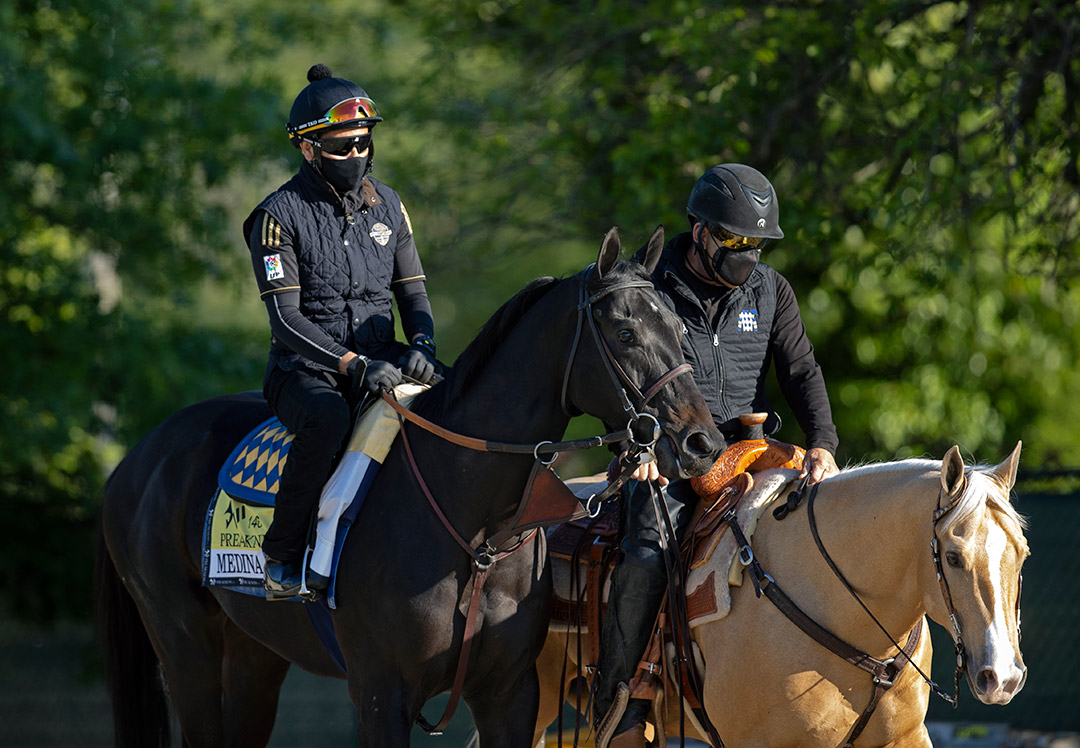
Pimlico Race Course in Baltimore will allow Kentucky Derby winner Medina Spirit to be entered in Saturday’s Preakness Stakes, according to Craig Robertson, the attorney for the horse’s trainer, Bob Baffert.
The decision was reached after officials for the track and its parent company, 1/ST, began discussions on Monday afternoon with Robertson centering on how to avoid a legal skirmish over the plan to run the horse in the race, the second leg of the Triple Crown. Pimlico had been weighing whether to bar the entry of the horse after Baffert announced on Sunday that the horse tested positive after the Derby for betamethasone, a regulated anti-inflammatory medication.
“We’re good to go,” Robertson said, in confirming the agreement.
:: Join DRF Bets and get ready to watch and wager on the Preakness with a $250 first deposit bonus
All of Baffert’s horses entered to race on Friday and Saturday will be tested prior to their races, according to a copy of the deal. In addition, Baffert will be required to provide any medical or veterinary records for the horses to Pimlico officials and 1/ST’s chief veterinary officer, Dr. Dionne Benson.
Earlier on Tuesday, Robertson said that samples have already been pulled from Medina Spirit in order to determine if betamethasone has cleared the horse’s system. The drug is a commonly used medication to treat joint inflammation, and, in Maryland, it cannot appear in a post-race sample above the level of 10 picograms per milliliter of blood serum. Baffert said that the horse tested at a concentration of 21 picograms on May 1, the day of the Derby.
The agreement follows a whirlwind 48 hours for Medina Spirit, his connections, and the racing industry. Following Baffert’s announcement, Pimlico released a statement saying that it was reviewing “the relevant facts and information relating to the reported medication positive” in regard to allowing Medina Spirit to run in the Preakness. That statement followed a decision by Churchill Downs to ban Baffert from entering any horses in the track’s races until the positive is fully adjudicated.
Baffert has said that he will not be attending the races at Pimlico this week, despite having the likely favorite and the highly regarded Concert Tour in the Preakness. On Monday, Pimlico had allowed Baffert to enter his horse Beautiful Gift in Friday’s Black-Eyed Susan Stakes, telegraphing that its decision on a ban would apply to Medina Spirit alone. The training of all of Baffert’s horses are being overseen by his longtime assistant Jimmy Barnes, who arrived with the horses on Monday.
The entry of the horse came on the same day that Baffert announced Medina Spirit had been treated daily with an ointment containing betamethasone to treat dermatitis on his hind end from early April until the day prior to the Derby.
Post positions for the Preakness Stakes are being drawn at 4 p.m. Eastern.
Prior to the negotiations beginning on Monday afternoon, Robertson had said that he had a motion ready to file seeking a temporary restraining order to stop Pimlico from enforcing a ban on the horse. He predicted that a judge would be eager to hear the motion prior to the draw on Tuesday, given the national implications of barring the Derby winner from a race prior to any official post-testing result being announced.
“I don’t think we’ll have any problem getting a resolution” prior to the draw, Robertson had said.
If Baffert’s account of the positive is accurate, the adjudication of the Medina Spirit case is at an early stage. Following a positive from initial post-race tests, which are typically kept confidential, trainers are notified of the finding and given the opportunity to have a split sample tested to confirm the initial result, a process that usually takes four to eight weeks. If the split-sample test confirms the initial positive, stewards schedule a hearing to take testimony on the violation before issuing penalties.
The timing of the positive and Baffert’s announcement of the initial test before a split-sample confirmation put Pimlico in a difficult position. If the track decided to allow the horse to run, then it would be forced to deal with the fallout of the failed test and the perception of a tainted performance during the running of a nationally broadcast race. If the track barred the horse, it would have to confront the legal implications of intervening in a case prior to its connections being granted the barest due-process considerations.
Baffert himself made an unusual decision in announcing the result of the initial Derby test, a strategy almost certainly influenced by the controversy surrounding a post-race positive for scopolamine, a known environmental contaminant, in his horse Justify after the Santa Anita Derby in 2018.
Justify went on to win the Triple Crown, and it was only later learned that the California Horse Racing Board threw out the positive months after the Santa Anita Derby after an investigation concluded the horse accidentally ingested the substance. The CHRB’s decision to dismiss the case without public hearings drew intense criticism from some quarters of the sport, and it led to lawsuits that required the CHRB to re-hear the case.
With Medina Spirit, Baffert was almost certainly intending to avoid a similar situation, considering that the split-sample test could be returned and reported as early as the week prior to the Belmont Stakes, and after the horse had already run in the Preakness. Such a revelation would generate an uproar that would pale in comparison to that surrounding Justify.
:: DRF's Preakness Headquarters: Contenders, latest news, past performances, analysis, and more
Racetracks have the right to exclude participants from their tracks, although that right has several limitations. While there is ample case law protecting the right to exclude, courts have also sympathized with barred individuals when they feel tracks have violated due-process protections.
Pimlico and its parent company have aggressively used the tactic in recent years.
In 2019, following a spate of equine fatalities at the company’s Santa Anita Park in Southern California, it barred the trainer Jerry Hollendorfer from the company’s tracks, contending that his horses broke down more frequently than those of other trainers. More recently, the company has enforced bans on the trainer Marcus Vitali, citing a history of violations of racing rules, and also the trainer Wayne Potts, for allegedly associating with Vitali.