

Long live the Jonathan Sheppard Stakes
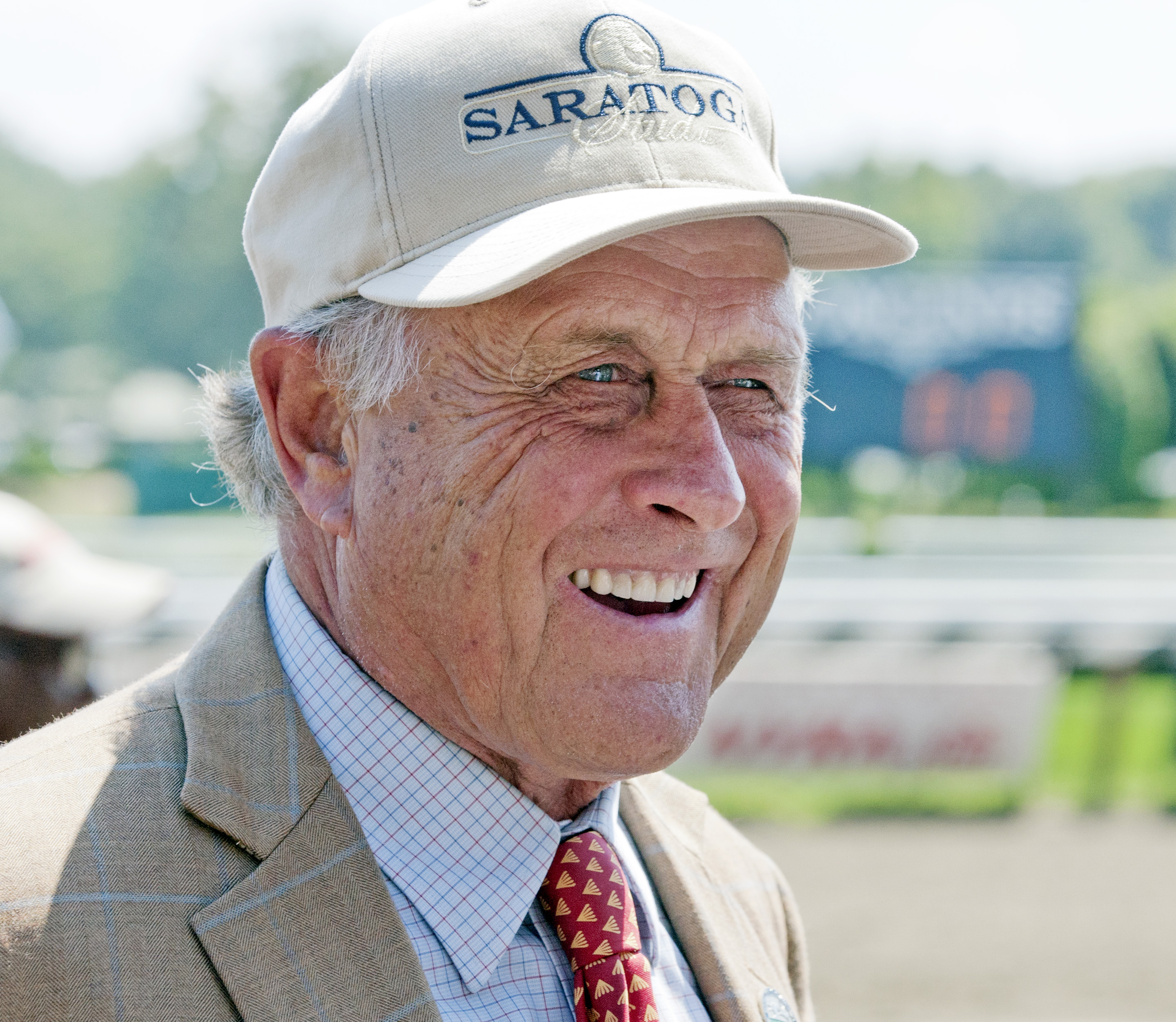
This season at Saratoga will be the first one since 1937 where the New York Turf Writers Cup will not be run. In its stead will be first running of the race in honor of Jonathan Sheppard, Hall of Fame trainer, gentleman, and legend of the turf, both on the flat and over the jumps.
The name change came as the result of a brief conversation I had back in March with Bill Gallo Jr., longtime president of National Steeplechase Association. Gallo felt Sheppard’s recent retirement from the game deserved acknowledgement, and what better place to celebrate and fully dignify the great man’s contribution to the sport than the Spa, where for 47 consecutive years, from 1969 to 2015, Sheppard saddled at least one winner, a record of Dimaggioean proportions. Not to mention his meet training championships in 1984 and 1985 and winning most steeplechase races run at Saratoga for years on end, including the race that now bears his name 15 times.
As the last in a long line of presidents of the New York Turf Writers Association, I guess it was up to me to grant permission for the name change, but this seemed as much of a no-brainer as checking the box for Todd Pletcher and American Pharoah on this year’s Hall of Fame ballot.
It was with a twinge of both sadness and relief to give up the race name. It meant that the NYTWA, the oldest professional sports writing organization in the United States, had really come to its end, and I guess these words are the official proclamation. The population of turf writers nationwide is sparse and even in New York, where every general circulation newspaper once had at least one reporter and one handicapper, the number over the last 20 years has dwindled to a solitary figure. Other than at Saratoga and a few major race days during the year, DRF’s David Grening stands sentinel to an otherwise empty press box.
The New York Turf Writers Association was born in 1923, founded by none other than Grantland Rice, he of the “Four Horsemen” fame:
Outlined against a blue-gray October sky, the Four Horsemen rode again. In dramatic lore they are known as Famine, Pestilence, Destruction and Death. These are only aliases. Their real names are Stuhldreher, Miller, Crowley and Layden.
Rice is generally acknowledged as the first great sportswriter of the modern era and elevated the prose of covering games played by boys and men to first-class literature. Like many of his peers, he deemed the contests played over the loam between white, goose-necked fences to be of the highest regard. The great practitioners that followed him – Joe Palmer, Red Smith, Charles Hatton, Joe Hirsch – were at one time or another members of the NYTWA and have graded races, awards, or both named after them.
Not long after it was founded, in 1931, the New York Turf Writers began holding a dinner and dance during the Saratoga meeting at various locations, including places like Riley’s Lake House and the Arrowhead Inn. Those on the guest list had blood that was bluer than the deepest azure sky: In addition to the Whitneys and Vanderbilts of the racing set, there were the Hearsts of California and the Dixons of Philadelphia. Their migration to upstate New York each summer for the Turf Writers dinner was dutifully reported in the society pages of The New York Times.
At those early gatherings I’m sure there was plenty of backslapping and congratulations for a job well done racing the best horses in the land – the Whitneys had Twenty Grand and Alfred Vanderbilt raced Discovery – and maintaining their lifestyle in the middle of the Great Depression. But in 1936 Rice and the other forefathers of the NYTWA decided to elect year-end winners of select categories and celebrate them in a more formal setting.
Thus in 1937, the Turf Writers included on the annual dinner-dance program the presentation of four awards: Alfred Vanderbilt was named “The Man Who Did Most for Racing” – he would go on to do much, much more; William Woodward, who had recently bred and raced his second Triple Crown winner in five years, was outstanding breeder; Hirsch Jacobs was outstanding trainer; and Sonny Workman outstanding jockey.
Throughout the years, the honors went to more names that adorn awards, race courses, and Grade 1 stakes: Phippses, Mellons, Wideners, more Whitneys. Alfred Vanderbilt won “The Man Who Did the Most for Racing” so many times they eventually just named the award after him. The jockeys and trainers that were feted – Ben Jones, “Sunny” Jim Fitzsimmons, Max Hirsch, Eddie Arcaro, Bill Hartack -- were all in the first generation of Hall of Fame inductees.
By the time I attended my first Turf Writers dinner in the early 1980s, the NYTWA dinner was not only the pre-eminent social event on the Saratoga calendar, it was virtually the only event on the calendar. This was back when the meet was four weeks, six days a week. The 400 tickets for the event, held each third Monday of the meet, were usually sold out weeks in advance.
The soiree, black-tie optional, was held at the stately Gideon Putnam Hotel, nestled in verdant Saratoga State Park. When I arrived for the 7 p.m. cocktail hour, I was ushered into the Gideon’s anteroom, which was the size of a two-lane bowling alley and was stuffed with nearly all of the 400 guests. I was overwhelmed by the smoke, the perfume, and the heady mix of racing celebrities in my midst. The men were all in starched suits and tuxedos, the women in ball gowns of haute couture. I hadn’t seen so much sequins, brocade, and taffeta since my bar mitzvah.
Over here were Angel Cordero and Jorge Velasquez, over there, Woody Stephens, Allen Jerkens, and John Nerud. Somewhere in the middle of all the clamor was the youngest middle-aged woman I’d ever seen, looking like Cinderella. Marylou Whitney flitted from guest to guest, Sonny Whitney never far from her side.
The Turf Writers dinner maintained its cachet for about another 10 years, until the meet expanded and other social events were born to fill the social calendar. The crowds began to shrink and so did the numbers in the organization. Newspapers began trimming budgets, and horse racing reporters and handicappers were among the first cuts made.
The decline had a trickle-down effect. The NYTWA was a charitable and welfare organization, which meant that proceeds we got from our dues and the net profits from the dinner were distributed to various racing charities and our press box family, including custodians and food servers. Over the years, the NYTWA disbursed many tens of thousands of dollars to the racing community.
By 2011, we hosted our last event, at Saratoga National Golf Club, whose property is adjacent to the site of Riley’s Lake House, where many of those first dinners were held. Since then, the NYTWA has been more or less moribund, Grening’s soldiering on notwithstanding.
The last remnant of the Turf Writers was the race that bore its name. Now that is gone, too.
In the last years of his life, I used to occasionally share dinner with Joe Hirsch, a past president and proud member of the NYTWA. As dessert would arrive – it wouldn’t hurt a baby – Joe would always implore me to keep the organization going. He was a traditionalist, and the New York Turf Writers Association and its namesake Grade 1 steeplechase were damned fine traditions. It seems now, however, that it’s time for this tradition to pass. Besides, I think Joe would have kinda liked the name change.