

King: Don't automatically toss a trainer's longer-priced second entrant
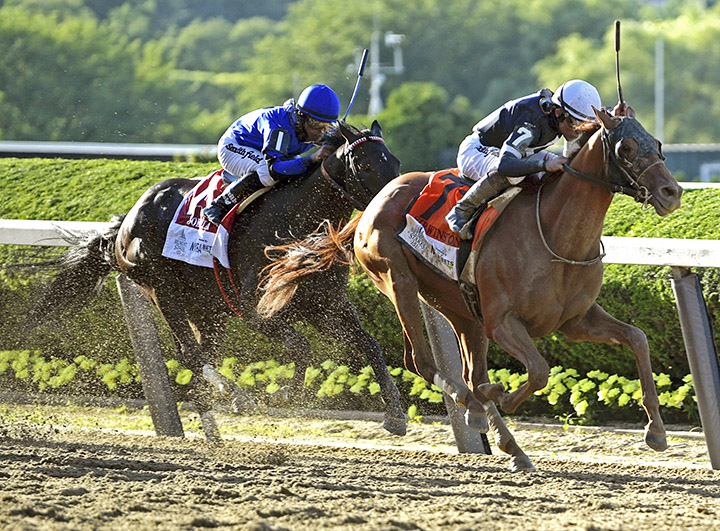
When Sir Winston upset last Saturday’s Belmont Stakes at odds of 10-1, beating nine rivals, including stablemate and Preakness winner War of Will, a 7-2 shot, it served as a reminder that sometimes the larger-priced of a trainer’s two entrants in a race is the one you want, particularly in major stakes races.
This was not the only time during the Triple Crown that this occurred. Five weeks earlier in the Derby, the Bill Mott-trained Country House was elevated to first on the disqualification of Maximum Security, resulting in a $132.40 win mutuel, dramatically higher than the $13.60 his stablemate Tacitus would have paid had he won.
So, still smarting from having not liked Sir Winston in the Belmont, I thought I’d explore this angle further to see if indeed the data support playing such horses or if our memories of these instances are selective. Perhaps wins from longer-priced horses simply prove more memorable, while those from the shorter-priced runners are rather forgettable.
To do this research, I checked the 2019 graded stakes results of the five trainers with the most starters in those races – Chad Brown, Steve Asmussen, Todd Pletcher, Mark Casse, and Bob Baffert. Then I isolated the 66 instances, a reasonable sample size, in which one of those trainers started multiple horses in these graded events.
Sometimes trainers ran more than two horses, topped by the five 3-year-olds Asmussen started in the Southwest Stakes at Oaklawn. In these cases, I placed the shortest price in one group and the largest in another, bypassing those in between.
The results? The shortest-priced uncoupled horses registered 14 victories, winning at a rate of more than 21 percent. Yet, owing to greater payouts, the highest-priced uncoupled stablemates came closer to profitability. Seven times these types connected, a win clip just shy of 11 percent, and a wager on each longer-priced entrant would have yielded an average $2 return of $1.96.
The noteworthy winners included the Bob Baffert-trained Roadster, who at 3-1 odds beat stablemate and favorite Game Winner in the Santa Anita Derby; Olympico’s 18-1 surprise in the Fort Marcy at Belmont, where Brown ran three horses in that race; and Cambier Parc, at 5-1, running down stablemate Newspaperofrecord for Brown in the Wonder Again at Belmont.
That is not to suggest that these upsets were the norm. Again, the shorter-priced horses won twice as often, and there were occasions when barnmates finished just as the public anticipated. That happened in the Grade 1 Manhattan, where Brown’s four starters – Bricks and Mortar, Robert Bruce, Raging Bull, and Olympico – ran first, second, third, and seventh, in odds order.
Rather, the point is that these higher-priced runners outperformed expectations, almost to the point where betting them blindly came close to leaving one in the black.
There are numerous theories about these results. I’ll give you mine, and it’s not about a trainer wanting to cash a bet. It’s about faith.
When a trainer runs a horse against a prominent barnmate, he is often telling horseplayers that he holds the less-fancied horse in high regard. After all, he knows his other horse better than anyone, having seen it day in and day out. That, to me, seems an endorsement worth heeding.
Beyond that, I would say the returns are a function of these horses being overshadowed, with the public tending to dial in on the shorter-priced horses while overlooking the others. And when tied together with the barn’s faith in the longer shot, it seems to add up to a reasonable long-term outcome.
Still, it is just an angle, and to generate some consistently healthy returns, one needs to incorporate sound handicapping to narrow down the field, eliminating those who clearly lack a winning profile. Perhaps a horse can be eliminated when he seems to be in a race because of a lack of alternatives, or because of the owner’s history of wanting to participate in high-profile races, irrespective of the outcome.
If one can thin the herd in this manner without tossing the high-priced, pocket-fattening winners, then this angle might just lead to consistent profits.
