

A Kentucky Derby victory would add to Japanese racing's recent dominance
LOUISVILLE, Ky.– Loves Only You surged late, overtook favored War Like Goddess, and won the Breeders’ Cup Filly and Mare Turf last Nov. 6 at Del Mar. Her victory marked a breakthrough, the first for a Japanese horse in a Breeders’ Cup race. That happened at 2 o’clock. Two hours later, Marche Lorraine, a 50-1 shot, held on by a nose to capture the Breeders’ Cup Distaff. Make that two Breeders’ Cup wins for Japan – in one day.
Five weeks later in Hong Kong, Loves Only You won the Group 1 Hong Kong Cup and another Japanese horse, Glory Vase, won the Group 1 Hong Kong Vase.
A dozen Japanese horses shipped to the next important international race meeting, the Feb. 26 Saudi Cup. That went pretty well, too. Stay Foolish won the $2.5 million Red Sea Turf, Authority the $1.5 million Neom Turf Cup, Dancing Prince the $1.5 million Riyadh Dirt Sprint, and Songlines the $1.5 million 1351 Sprint.
A month later more than 20 Japanese horses assembled in the United Arab Emirates for the March 26 Dubai World Cup card. Another home run. Bathrat Leon upset the Group 2 Godolphin Mile, Stay Foolish won the Group 2 Dubai Gold Cup, Crown Pride captured the Group 2 UAE Derby, Panthalassa was a dead-heat winner of the Group 1 Dubai Turf, and Shahryar won the Group 1 Sheema Classic. For good measure, Vin de Garde was third in the Dubai Turf, Authority third in the Sheema, and Chuwa Wizard a commendable third in the big race itself, the $12 million World Cup.

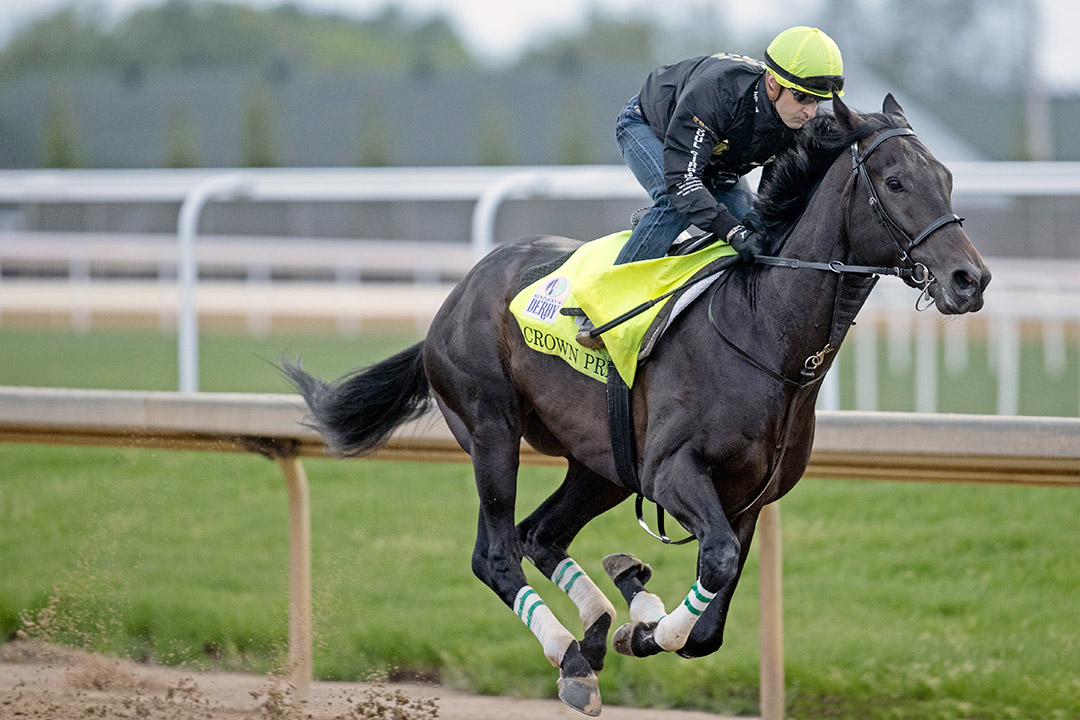
Japanese Thoroughbreds have gone on such a dizzying run of success since the first Saturday last November that Crown Pride, a Japanese horse stabled at Churchill Downs for more than a month, should be taken seriously the first Saturday this May.
As a 2-year-old, Crown Pride won a pair of nine-furlong dirt races by open lengths in Japan. He was less effective finishing sixth in his 3-year-old debut, the Feb. 20 Hyacinth Stakes, a one-turn mile run over a muddy track. But in Dubai, Crown Pride stalked the pace of Summer Is Tomorrow, wore him down with a furlong left to run, and emerged from that 1 3/16-mile fixture a 2 3/4-length winner. A Japanese horse winning the Kentucky Derby would surprise many, and this wave of Japanese success has surprised even the Japanese.
“The recent results have shown that Japanese horses have become stronger over the last decade but, to be honest, Japanese horsemen were surprised by the result over the past few months,” said Teruya Yoshida, 74, Crown Pride’s owner. “However, I am very pleased that it has been proved that our endeavors have not been in vain.”
A Crown Pride win in the Derby would perfectly tie together the global Japanese equine domination, since Yoshida occupies a central space in Japanese breeding and racing. Shadai Farm, Crown Pride’s breeder, is a pillar of Japanese Thoroughbreds. Yoshida runs Shadai along with his brothers Katsumi and Haruya, with the sons taking over the operation from their late father, Zenya.
Thirty-four horses stand stud at Shadai Stallion Station. Yoshida, in an email interview, said Shadai has a broodmare band numbering 640. Asked how many Grade 1- or Group 1-winning mares were being bred at Shadai, Yoshida said, “We have so many now I don’t know the exact number.”
Japanese breeders have imported at least 26 North American Grade 1 winners over the last five years, and those are just the top-level North American imports. Japanese breeders for years have brought in blue-blooded bloodstock worldwide, horses like 2011 Prix de l’Arc de Triomphe winner Danedream and the Aidan O’Brien-trained international star Magic Wand.
Zenya Yoshida brought Japan’s first major stallion, Northern Taste, from France in 1975, but it was Yoshida’s acquisition of Derby winner Sunday Silence in 1990 that truly set the course for the Japanese Thoroughbred’s rise. Crown Pride, a homebred, is by Reach the Crown, a grandson of Sunday Silence, and Sunday Silence appears in his female family as his second dam’s grandsire.
As the Japanese steadily built one of the world’s best bloodstock bases, their horses began venturing beyond Japan’s borders with greater frequency, although Japanese horses have raced globally for decades.
In 1959, a horse named Hakuchikara won the Washington’s Birthday Handicap, which later would come to be called the San Luis Obispo Handicap. Hakuchikara was the first Japanese horse to travel internationally, according to Kei Matsuzawa, general manager of the Japan Racing Association’s New York office.
In 1998, Seeking the Pearl became the first Japan-based international Group 1 winner when she landed the Prix Maurice de Gheest in France. Cesario, who won the 2005 American Oaks, was the first Japanese horse to win an American Grade 1.
Three Japanese horses have raced in the Derby: Master Fencer finished fifth in 2019, Lani was ninth in 2016, and back in 1995, Ski Captain, owned by Shadai, finished 14th.
“I don’t think the success has been sudden at all,” said Kate Hunter, an American based in Japan who has become a point person for traveling Japanese horses and is employed by Churchill Downs Inc. to recruit Derby runners “I think people are just finally paying attention . . . which has as much to do with quantity as it does quality. In the past, you’d get one or two per event, but now you are getting 7, 12, 22 horses per event, and that alone increases the odds of victory.”
Yoshida believes Japanese trainers have learned to better prepare their horses for top-level competition.
“I think the biggest thing is that we focused on the individuality of each horse,” he said. “We are not to be rushed, and all staff always thinks about a horse’s condition and which training is the best for that horse. The time we invest in caring for the horses has become overwhelmingly long in the last decade.”
Christophe Lemaire, Japan’s leading rider, has been tabbed for the Derby ride on Crown Pride. The colt’s trainer, Koichi Shintani, is less than a year into his own career but was a longtime assistant to acclaimed trainer Hideyuki Mori. “I already knew his excellence from that time, so I did not mind his short career as a trainer,” Yoshida said. “He is young, but he is capable and amazing.”
Crown Pride worked a fast half-mile here Wednesday, just three days from his date with the Derby. No American horse would breeze so quickly so close to a race, but Crown Pride’s training is typical for Japan. At home, his exercise rider Masa Matsuda said, Crown Pride spends at least 90 minutes out of his stall during a training session.
Japanese training centers have uphill turf gallops, trails for riding out, multiple surfaces at their disposal. American observers have noted the daily dressage-type work Crown Pride does in the Churchill Downs chute before going into gallops that tend to be farther and faster than American-style training; that’s standard for a Japanese training regimen. And as more Japanese horses have traveled, an industry obsessed with improvement has taken note of all that went into their preparation and experience.
“The Japanese learn and discuss every success and failure they have when they travel abroad,” Hunter said. “What did they do right and what they could have done better, regardless of the outcome. They like to prepare in great detail and ask a lot of questions and check in about every regulation and rule before ever setting foot in another country.”
Handle at JRA tracks is massive and betting there into the international pool will drive down Crown Pride’s win odds Saturday. Daily attendance at JRA tracks in 2019 averaged more than 20,000. Japanese racing clubs have brought fractional ownership to an engaged fan base and helped sustain the sport’s popularity within Japanese culture.
“In my father’s era, horse racing was sometimes seen unfavorably, but I feel that we have solid relationship now with the public and have built a positive culture around horse racing in Japan,” Yoshida said.
More than any international prize, the Japanese have coveted victory in the Prix de l’Arc de Triomphe. The mercurial Orfevre should have won the 2012 Arc but put his feet in the ground after taking command of the race, a loss that agonized Japanese racing fans. Could it be that Japan, through Yoshida, gets a Derby before an Arc? The foundation was laid long ago.
“My family policy was that all earned money was to be invested in horses,” Yoshida said. “Apart from horses, we are not interested in anything else. Horses are our life.”