Kentucky Derby post positions can greatly affect outcome of the race
In most races, the post-position draw happens out of the public eye. Racing-office officials randomly draw numbers, the starting-gate spot, and match them with the names of entered horses. For some races, tracks try to dress up the draw, making some pomp out of an essentially mundane activity. But if there is one race where the post draw really generates buzz, it’s the Kentucky Derby. With the Derby now annually filled to its 20-horse capacity, who is positioned where can make a tremendous difference in the outcome.
The Derby starts way down at the head of the long Churchill homestretch and there’s a run of more than a quarter-mile to the first turn. Still, the turn every year brings about a brutal jamming process as riders jockey for position into the bend. Three negative things can happen at this point: A horse can be caught wide, a horse stuck on the inside can get cut off by rivals coming over to save ground, and horses can encounter run-of-the-mill bumping and jostling.
The most notoriously poor post in the Derby is 1. Bob Baffert, the four-time winning Derby trainer, has a lot to do with this. Baffert has said he dislikes rail draws generally, and when Lookin at Lucky, favored at 6-1 for Baffert in the 2010 Derby, found significant trouble breaking from the rail en route to a sixth-place finish, Baffert blamed the draw for the defeat. He still does, in fact.
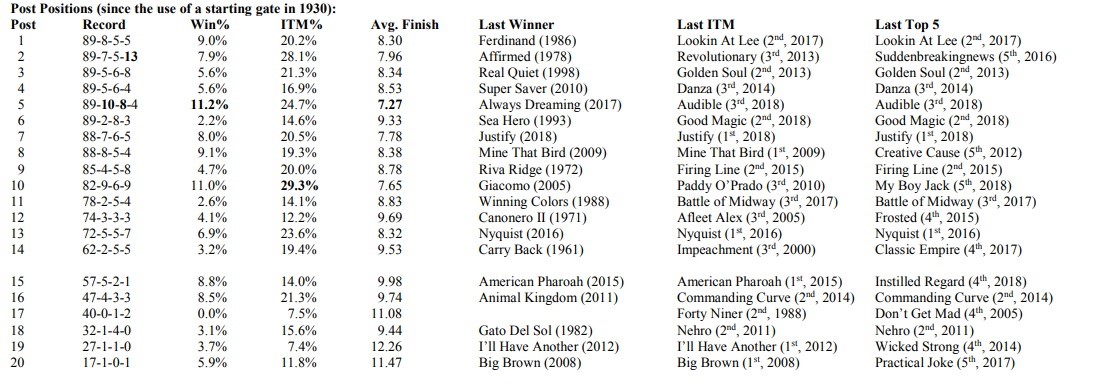
The last horse to win the Derby from the rail was Ferdinand in 1986. That seems like a long time between wins, but given the field size in the Derby, the expected number of winners (without even accounting for post-time odds) from the rail since Ferdinand’s score isn’t much higher than the actual number. In fact, the Kentucky Derby media guide shows horses from post 1 winning the Derby at a 9-percent clip and finishing in the money 20.2 percent of the time since the race began starting from a gate in 1930.
Those numbers are just about the same as post 8 (9.1% and 19.3%), which many trainers and jockeys would consider an ideal draw. Of course, the era of automatic 20-horse Derby fields is relatively recent and for many years within that sample far fewer horses started in the Derby, which helps boost the post 1 stats.
On the other hand, posts 9, 12, and 14 – all of which would generally be considered a better draw than the rail – haven’t yielded a Derby winner in much longer than post 1. And the Derby winner has never broken from post 17.
It was just in 2017 that Lookin at Lee finished second in the Derby breaking from post 1, and in cases like his, where a horse gets a clean run and doesn’t mind being inside, the draw can be advantageous. If you go back to Ferdinand, the only rail-drawn horses since who, based on the betting, had a reasonable expectation of winning the Derby were Cryptoclearance (fourth in 1987), Risen Star (third in 1988), Fly So Free (fifth in 1991), Crypto Star (fourth in 1997), and Johannesburg (eighth in 2002).
Among that group, only Risen Star could really use the draw as an excuse. By winning the Preakness and the Belmont he proved he was good enough to have won the Derby, and watching the race replay, you can see him shying away from heavy kickback going through the stretch the first time, which caused him to drop too far back and lose precious position. Perhaps with a better draw, Risen Star could have stayed closer to the leaders.
Post 2 is a difficult draw, too, although the horse breaking from post 1 heads almost directly into the inner rail before leaving the starting chute and crossing over to the main track, while the horse drawn in 2 at least has an animal inside him.
You know what’s much worse than a deep inside Derby draw? A far outside post. The narrative regarding the far outside is skewed because Big Brown won the Derby from post 20 in 2008 and I’ll Have Another won from post 19 in 2012. But beyond that, win rate and, more importantly, in-the-money rate drop precipitously with far outside gates. (The standard Churchill gate has 14 stalls; horses drawn 15 through 20 break from an auxiliary gate.)
Simon Rowlands, now a freelance racing writer and analyst in England and once a part of the Timeform team, recently posted two graphics on Twitter he gave me permission to use here.
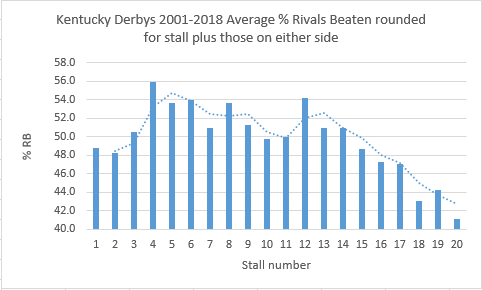
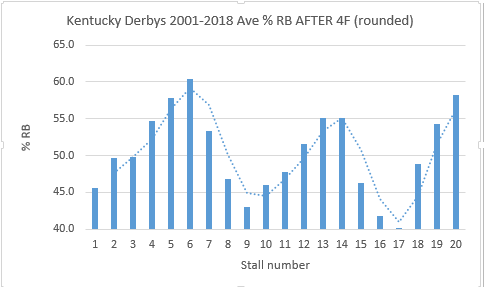
Wow – those are some very interesting graphics. The horses on the far outside, understandably, often get sent up for some early position, but from the energy spent to get there and the likelihood of ground loss on the first turn (more on that briefly), they pay a steep price in the end.
Meanwhile, the early-race tortoises drawn inside that are taking back and trying to avoid the scrum often find themselves inching into contention, or something like it, late in the game.
There is evidence, as you’d expect, that the extreme inside and outside posts lead to problems. I looked back through 15 years of Derby history and found that horses breaking from posts 1 and 2 generated trouble lines in the official race charts in 14 of 30 instances. Horses breaking from the two extreme outside posts were caught at least three paths wide in 12 of 30 instances.
However, if you scrape a layer off those statistics, you wonder how much difference it makes. Among those 60 runners, I found only one instance where horses clearly underperformed relative to their win odds. You could add a second if you believe Patch, 14th at 14-1 in 2017, should have done better. His subsequent history suggests otherwise.
So, those are some general parameters. How do things look with regard to the 2019 Derby runners?
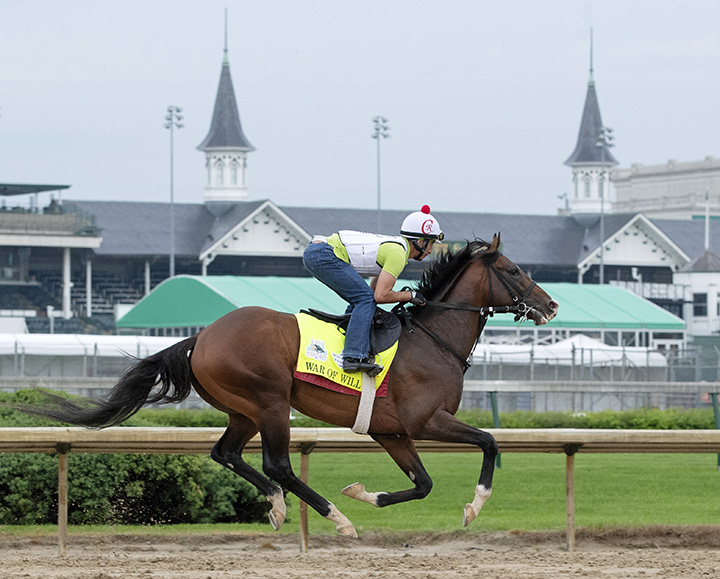
The connections of War of Will, the lucky horse drawn on the rail, say they are gunning and going for the lead from this starting slot. Well and good, but the last horse to make the lead from the rail was Songandaprayer in 2001; he wound up finishing 13th.
And here’s a really interesting post dynamic: Maximum Security, drawn in post 7, has been the early leader in three of his four starts (twice sprinting) and widely is expected to head to the front. But the five horses drawn between him and War of Will – Tax, By My Standards, Gray Magician, Improbable, and Vekoma – all are presser-stalker types. Will their riders go for it early or take a little hold to avoid getting caught up in a fast pace?
The scratch of favored Omaha Beach, who was going to be forwardly placed from post 12, and Haikal, who had post 11 but was scratched with a bruised hoof Friday morning, alter the pace dynamic as well as the implications of the draw.
With those two horses out, all horses drawn outside post 12, move in two spots in the starting gate.
Country House in post 18 has no speed and is going to drop back for position. But Bodexpress in post 19, Long Range Toddy in 16, and even Roadster in 15 have the type of positional pace that can lead to the sort of go-forward-get-caught-wide trip that produces the negative results we see in Mr. Rowlands’ data.
It also means Spinoff will start from the 17 hole – the post that never wins the Derby.
Here are the main body of the Derby media guide post-position stats: