

Kentucky Derby: Litfin on trips
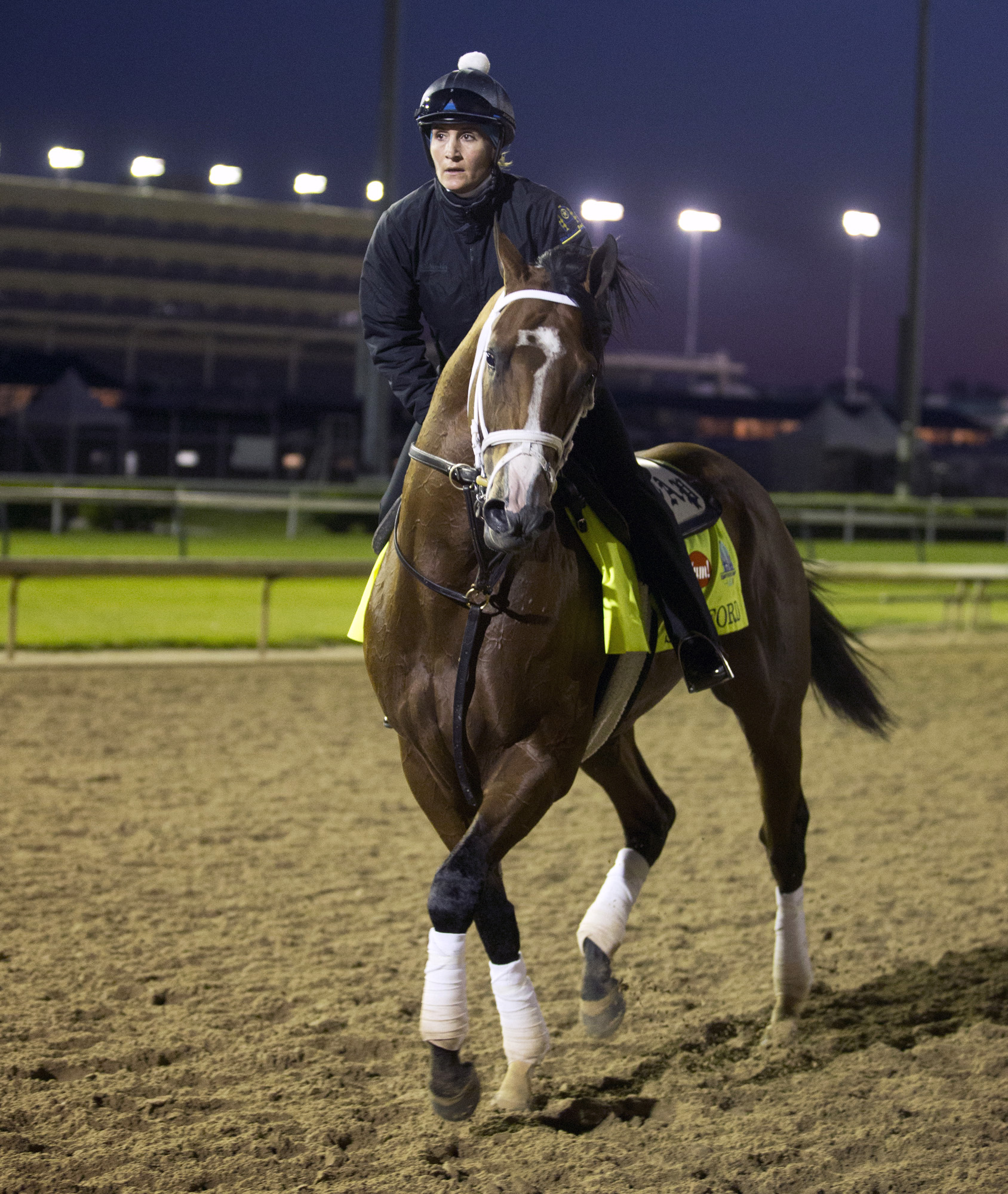
Derby Angles features DRF handicappers looking at individual handicapping factors and how they may play out in this year’s Kentucky Derby. The six-part series begins with Dan Illman’s take on pedigree and continues with Dick Jerardi on Beyer Speed Figure Patterns, Dave Litfin’s look at “trips,” Brad Free’s examination of post position, Kenny Peck’s pace projection, and Marcus Hersh on winning profiles and betting value.
Ideally, Kentucky Derby bettors want their key horse to get a trip that goes something like this: Break cleanly or at least with a minimum of contact; stake out a position within striking range of the early lead that affords some maneuvering room; continue to avoid traffic while gathering a head of steam heading into the far turn; find a clear lane once straightened away into the stretch; punch into sixth gear and hope it’s good enough.
Of course, that’s a scenario everyone connected with every horse wants. In a 20-horse field, whether they get it is a matter of each horse’s inherent ability and plain old racing luck.
To be sure, chaos happens. Recall the first two legs of the 2013 Triple Crown. A freshly blinkered Palace Malice triggered a monumental meltdown by running off through some of the fastest Kentucky Derby fractions ever. Two weeks later in the Preakness, Oxbow, among those incinerated by that pace, was allowed to run loose on the lead through a crawling tempo beneath a crafty Gary Stevens and school was out.
Sometimes, as last year, the Derby winds up remarkably uneventful in terms of trouble and the best horse runs himself into a perfect trip as if following a Hollywood script.
One of the best ways for handicappers to plot plausible trip scenarios is to use ESP. Not parapsychology, but the concept of running-style designations espoused by Tom Brohamer in his book “Modern Pace Handicapping,” (DRF Press) which is generally regarded as the first and last word on the subject.
“E” refers to horses that do their best work on or near the early lead.
The “S” or sustained horses are just the opposite, usually rallying from the rear-half of the field.
The “P” horses are pressers that lay about 1 to 3 lengths off the early lead and advance through the subsequent fractions. Pressers can sometimes be difficult to label, as they may show a race or two that qualifies as E or S, but their predominant style will be close to the pace and they are generally the most reliable types at any track - especially those E/P hybrids that are also capable of taking the lead if it’s presented to them.
Running through this year’s top 20 in earnings order pre-draw, here are the designations I assigned, some with more confidence than others: International Star (S); Dortmund (E/P); Carpe Diem (P); American Pharoah (E); Frosted (P); Mubtaahij (P); Materiality (E/P); El Kabeir (P/S); Upstart (P); Far Right (S); Itsaknockout (P); Firing Line (P); Danzig Moon (S); War Story (S); Tencendur (P); Stanford (E); Mr. Z (P); Ocho Ocho Ocho (P); Bolo (P); Keen Ice (S).
All told, we have the following breakdown:
E – 2; E/P – 2; P – 10; P/S – 1; S – 5
Stanford started off as a P in sprints, but is an E based on his first two routes. American Pharoah might be designated an E/P based on the Arkansas Derby; more likely, he is a fast but tractable E that does not have to lead early at any cost.
Dortmund is about as solid an E/P as you’ll find, having already demonstrated a number of different ways that he can beat you.
Though comparatively heavily raced with nine starts, El Kabeir remains difficult to classify after winning graded stakes on the lead, as a presser, and by making up a 12-length deficit.
The point of congestion in this year’s matchup involves the pressers, who make up half the field. They would like to be situated within a few lengths of the front, but the laws of physics say they can’t all occupy that space at the same time. This subset includes contenders such as Frosted (top Beyer of 103), Upstart (108), Firing Line (104) and Bolo (101), all of which have posted at least one triple-digit Beyer Speed Figure, as well as Mubtaahij, who rates as a bona fide X factor based on his Dubai races.
Among the five labeled as sustained horses, none has posted a triple-digit Beyer. Only two, International Star and Far Right, have won a graded stakes.
The likely pace scenario
The ESP matchup suggests that this could be a Derby that favors up-close types. American Pharoah may work out a trip very similar to the Arkansas Derby, letting Stanford go on with it early and taking up second position.
Right behind them will be the E/P runners Dortmund and Materiality, two of the fastest horses in the race.
After that, it’s anyone’s guess which among the 10 pressers may get their desired spot.
And unless the early pace goes much faster than expected, it’s hard to make a case that any of the deep closers are good enough.