

Keeneland yearling sale closes with record average price
One decade after the recession that rocked the Thoroughbred industry, the Keeneland September yearling sale, North America's bellwether auction for the market, wrapped its 75th anniversary renewal with a record average price and gross and median figures among the best in its history.
"I don't think we could have predicted it would be as successful as it has been every step of the way," Bob Elliston, Keeneland's vice president of racing and sales, said.
A total of 2,916 yearlings sold during the 13-session auction for gross receipts of $377,140,400, finishing as the fourth-best in the auction's history. Keeneland September grossed $399,791,800 in 2006, $385,018,600 in 2007, and $384,349,900 in 2005. The 2017 edition of the sale, which sold 2,555 yearlings over 12 sessions, grossed $307,845,400, the first time the sale surpassed $300 million in revenue since 2008, when the effects of the recession began to be felt in the second week of the auction.
Keeneland September's average price finished at $129,335, surpassing last year's record of $120,487 by 7 percent. The median checked in at $50,000, missing last year's record median of $57,000 by 12 percent but tying for the second-highest all time with the 2013, 2014, and 2015 editions of the sale.
The cumulative buyback rate finished at 24 percent, relatively steady from 25 percent last year.
Keeneland September's strong figures were fueled by a robust market in the marquee Book 1 and Book 2 portions of the sale, which finished with 27 seven-figure yearlings, compared with 13 last year. Keeneland adjusted the format of the September sale this year, expanding Book 1 from one session to four in a move that actually had the net result of offering fewer horses prior to the sale's traditional dark day.
Last year's Book 1 was a single ultra-select session with 167 horses in the catalog and was followed by three Book 2 sessions, with 1,202 horses cataloged through the first four days of the sale. Keeneland officials said they received feedback from buyers that the format of Books 1 and 2 left them with too many horses to inspect, and potentially vet, in a condensed timeframe. Book 1 was restructured to run over four days, with 989 hips in the catalog, followed by a dark day and then two Book 2 sessions.
"We listen to our customers every single year, our buyers, our consignors," Elliston said. "Our inspection team looks at the depth of the crop that's there, and we tailor to that. People make a lot to-do about the format, but we're really the only [North American sale] who has to deal with format [because of the number of horses offered]. That's a responsibility we take very seriously, to create an environment that's conducive to buyers and sellers getting the most for their money. ... That's why this marketplace is the bellwether."
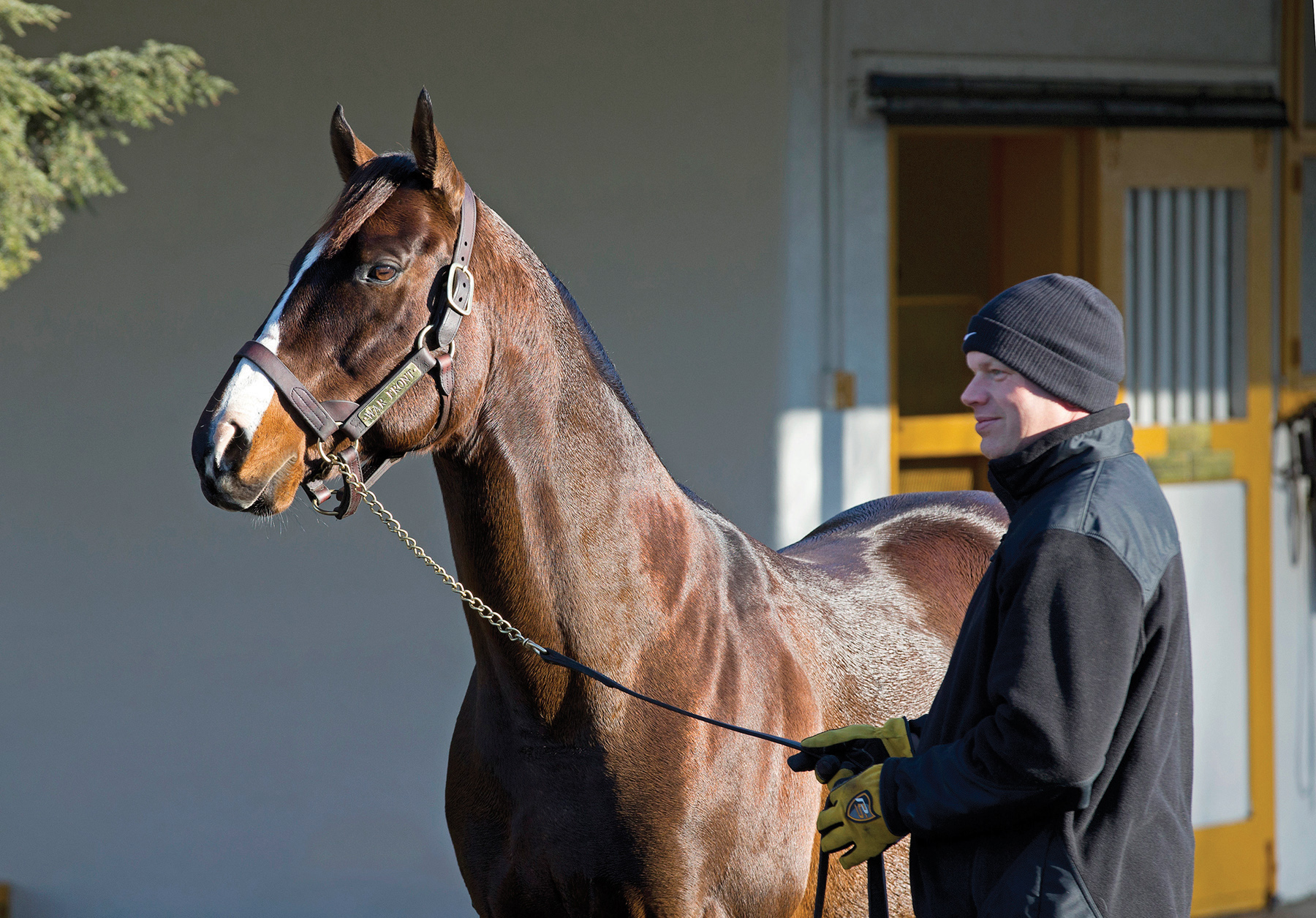
Three horses surpassed the $2 million threshold at the top of that marketplace – a $2.4 million War Front colt sold to Coolmore, a $2.2 million American Pharoah colt sold to Godolphin, and a $2.1 million Medaglia d’Oro colt sold to Phoenix Thoroughbreds.
"What can I say about War Front?" Coolmore's M.V. Magnier said after signing the ticket for the sale-topper, the most expensive yearling on the continent this year. "Over the last couple of years, we've been exceptionally lucky with the horse."
Powered by his sale-topper and four other seven-figure yearlings, War Front, who stands at Claiborne Farm, again was Keeneland September's leading sire by average price. He finished with 18 yearlings sold for $14,085,000, an average price of $782,500. Gainesway’s perennial leading sire Tapit had 25 yearlings sold, two for seven figures, for $15,280,000, an average of $611,200. These two stallions have made up the exacta by Keeneland September average price for four straight years now, with Tapit leading in 2016 and 2017 and War Front leading in 2015 and this year. Tapit also led by average in 2014, with War Front checking in third.
Darley's Medaglia d'Oro, who also had five seven-figure yearlings sold, checked in third by average, with 34 yearlings sold for $20,075,000, an average of $590,441.
The sale-topping War Front colt will head to Ireland and will be trained by Aidan O'Brien at Ballydoyle for Coolmore, Magnier said.
The colt is the second foal out of the Grade 1-winning Smart Strike mare Streaming, a full sister to stakes winner Treasuring and a half-sister to stakes winner Cascading and stakes-placed Distracting and Gifting. Another sibling, Achieving, is the dam of Group 1-placed stakes winner Arabian Hope and stakes winner Counterforce.
Streaming's granddam is blue hen Better Than Honour, the dam of Kentucky Oaks and Belmont Stakes winner Rags to Riches, fellow Belmont Stakes winner Jazil, Breeders' Cup Marathon winner Man of Iron, and Grade 2 winner Casino Drive.
"It's our best pedigree, and I've very proud of the fillies we've developed over time," John Sikura of consignor Hill 'n' Dale Sales Agency said. "We've retained fillies and offered these good colts, so we hope they are hugely successful with the horse.
"[War Front is] a world-class sire, so that's very important," Sikura said. "[This colt is] a great physical horse. He has a lot more length and stride than a lot of War Fronts. He wasn't the Northern Dancer type, he was more the Nijinsky type. Big frame, still immature, great limbs, lots of bone ... really smooth mover, great disposition, and really, a presence about him."
Dubai ruler Sheikh Mohammed al-Maktoum was in attendance at the Keeneland September sale for the first time in several years, and his international Godolphin operation was a major force. Its sizeable group of purchases was led by the $2.2 million American Pharoah colt, who highlighted a strong debut at this marketplace for the 2015 Triple Crown winner.
The colt was consigned by Peter O'Callaghan's Woods Edge Farm as agent. That outfit purchased him for $400,000 as a pinhook prospect out of last fall's Keeneland November breeding stock sale for Cavalier Bloodstock. It proved a profitable turnaround after longtime commercial rivals Godolphin and Coolmore, which stands American Pharoah for its international operation, locked horns in the bidding.
"I knew when [Sheikh Mohammed] saw him, his eyes lit up, and I just had a feeling he was gonna try hard to buy him," O'Callaghan said. "It took a monumental effort to outbid Coolmore, I'd say. That's what [consignors] all dream of - that two of the great racing powers get stuck into your horse and go at it."
The colt is the second foal out of the Indian Charlie mare Kindle, a multiple Grade 2-placed stakes winner. She is a half-sister to Grade 3-placed stakes winner Tonopah and to Grade 1-placed Latigo Shore. It is the family of French champion Play It Safe and Irish highweight Prudent Manner.

Godolphin finished with 27 yearlings purchased for a total of $19,960,000, leading all buyers by gross. Jimmy Bell, president of Godolphin's Darley America, said that decisions on which of Godolphin's purchases would remain in the U.S. and which would be trained in Europe for the international operation would be finalized by Sheikh Mohammed. Four of the youngsters were purchased in the name of Godolphin Japan and are ticketed for that arm of the outfit.
"As you know, he's a very busy man," Bell said of Sheikh Mohammed, who be believes last attended the September sale in 2010. "Everybody, the staff at the farm, we're so excited for him to come over here and have the opportunity to go through the farm, see the yearlings. He just enjoys the horses so much, [and] he loves the sales. ... We're just delighted he's here, and it makes it exciting for everybody."
In keeping with American Pharoah's status on the racetrack, his figures at Keeneland September were unusually high for a first-crop yearling sire. He finished with 47 horses sold for $19,585,000, an average of $416,702, ranking third by gross and fifth by average, all against established sires. No other first-crop stallion cracked the top 10 in either category. For reference, the next-highest average for a first-crop stallion belonged to champion Honor Code, at $228,094.
American Pharoah’s yearling average for the season now sits at $474,755 worldwide. He recorded three seven-figure yearlings at Keeneland September; counting last year’s weanlings, he has eight offspring who have fetched seven-figure price tags. Throughout the sale, buyers continued to note that American Pharoah’s offspring not only resemble him physically but have inherited his famously mellow demeanor.
“Definitely like his dad – cool, calm, collected, smart horse, like a pet,” Justin Zayat, whose family bred and campaigned American Pharoah, said after signing the ticket for an $800,000 colt by the young sire. “That’s the thing about American Pharoah, he was like a pet, and all of his offspring are showing it. You don’t see any of them rearing up in the ring. They’re all very cool, levelheaded horses. They’re selling like hot potatoes. It’s absolutely insane. I knew it was going to be exciting, but to see the averages where they are and all the million-dollar horses, it’s unbelievable.”
While all those fireworks took place in the first week of the sale, a strong market continued into the second week, thanks in part to the competitive action at the top. A number of prominent outfits made major purchases in Books 2 and 3 after being shut out or limited in Book 1.
"This sale has been very strong. I have been very good at getting outbid," Ron Winchell of Winchell Thoroughbreds said after purchasing an $875,000 Uncle Mo colt in partnership with Phoenix Thoroughbreds in the sixth session.
Prominent entities making purchases in Book 3 and beyond included owners Fox Hill Farm, Glen Hill Farm, GMB Racing, Lael Stable, John Oxley, Phoenix Thoroughbreds, Spendthrift Farm, and WinStar Farm's Maverick Racing; the partnerships of Starlight West and SF Bloodstock and Zayat Stables and St. Elias; trainers Ken McPeek, Dale Romans, and Joe Sharp; and prominent bloodstock agents Liz Crow, Ben Glass, Dennis O'Neill, Mike Ryan, partners Alex Solis and Jason Litt, Jacob West, and Steven Young
While exact session-to-session comparisons throughout the auction were difficult, thanks to the format change and the additional session, each day of the sale generally posted strong average and median figures when set against similar sessions from the year prior.
"I think the first week sets the table, and then the second week follows on," Keeneland director of sales operations Geoffrey Russell said. "We had a lot of people here all the way through the first week that then stayed on for Book 3 and even part of Book 4, which was very impressive. [Strong results are due to] the depth and breadth of our buying bench, both domestic and international. People come from South America, Korea, Japan, Russia, as well, to come in to buy in Books 3, 4, 5. They like the American-bred speed horse, and they know they're going to get good quality regardless of price."
The format change at the top of the sale may also have had a trickle-down effect into the middle and lower markets, Russell noted.
"Having less horses in Week 1, obviously the quality does get pushed a little bit further back," Russell said.
"It has to be the horse," Russell continued. "This is a very good crop of horses. Yes, [there are] all the external factors - depreciation, and the new tax laws, a strong stock market. [But] all of those other factors cannot help to raise the bar if the horses aren't top-quality. They're not going to give you extra money just because they have it in their pocket. The credit goes to the breeders and consignors."
The market did show signs of slowing in the final two sessions that made up the lower-market Book 6 portion of the sale, which sent the sale's overall median price down to its final $50,000 figure after it had tracked above the record, at $70,000, through Book 5. The buyback rates for those two sessions finished at 19 percent and 27 percent, compared with 10 percent and 8 percent for the two Book 6 sessions last year; 33 yearlings were marked no-bid. Book 6 was led by a $70,000 colt by Court Vision, sold to Ken and Sarah Ramsey from the consignment of Vinery Sales, agent for Haymarket Farm, on closing day.
Behind War Front, Tapit, and Medaglia d'Oro among the leading sires by average were Curlin ($452,485), American Pharoah, Pioneerof the Nile ($383,467), Empire Maker ($377,286), Uncle Mo ($344,492), Quality Road ($337,125), and Into Mischief ($278,627).
Uncle Mo led all sires by gross sales with $22,392,000 for 65 yearlings sold, followed by Medaglia d'Oro, American Pharoah, Into Mischief ($18,688,000), Tapit, Curlin ($14,932,000), War Front, Quality Road ($13,485,000), Empire Maker ($13,205,000), and Pioneerof the Nile ($11,504,000).
Taylor Made Sales Agency led all consignors by gross at Keeneland September for the 20th time, the fourth straight year, and the sixth time in the last seven years. The Taylor family's operation sold 300 yearlings for revenue of $47,317,400, outpacing Gainesway, which sold 150 horses for $33,692,700. Rounding out the top five consignors were Lane's End Farm ($30,650,400), Denali Stud ($15,201,500), and Hill 'n' Dale Sales ($14,048,000).
Following Godolphin among buyers by gross sales were Shadwell Farm ($12,324,000), the SF Bloodstock/Starlight West partnership ($9,315,000), Phoenix Thoroughbreds ($8,790,000), and Glass ($7,775,000), as agent.
The leading buyer by number of horses was K.O.I.D., a buying arm of the Korean Racing Authority, which purchased 29 yearlings.
For complete results for Keeneland September, click here.
