

Keeneland wraps up robust 2019 renewal of September sale
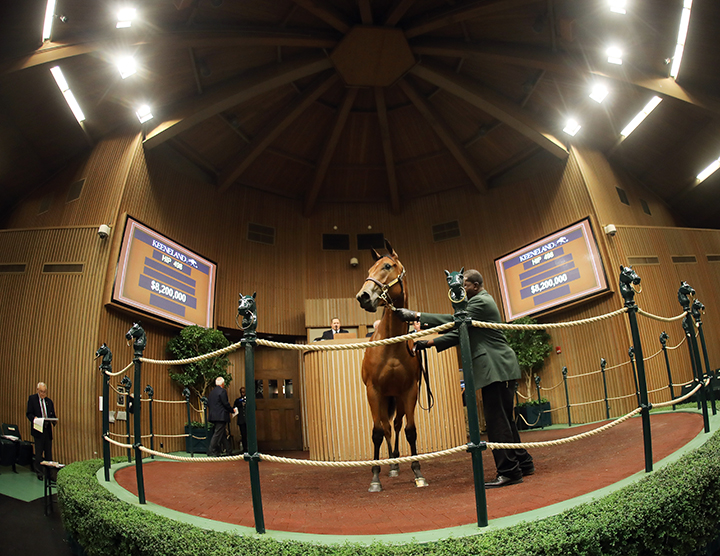
LEXINGTON, Ky. – In a year in which the Thoroughbred racing industry has faced its share of challenges, the Keeneland September yearling sale, considered North America's bellwether for that segment of the market, showed confidence from industry participants. Robust bidding activity – led by a record-priced $8.2 million filly by Triple Crown winner and leading freshman sire American Pharoah and out of Broodmare of the Year Leslie's Lady – helped the auction conclude its 13-session run on Sunday afternoon with some of the best figures in its history.
"It's been very hard to buy, extremely tough to buy – but wonderful for the horse business," bloodstock agent Marette Farrell said. "There are so many different entities here. Three months ago, we were all worried about the horse business, if it was going to survive – and now here we are in September, and I'm thrilled."
The Keeneland September yearling sale finished with 2,855 yearlings sold over 13 sessions, arranged in six books, for total gross revenues of $360,004,700, the fifth-highest figure in the sale's 76-year history. This is the third year in a row that the September sale's gross finished above the $300 million milestone. The 2017 edition of the September sale was the first time that threshold was met since 2008, when the effects of the recession began to be felt late in the sale. With the market recovering, the sale grossed $307,845,400 in 2017 and $377,130,400, the fourth-highest figure all-time, last year when 2,916 horses were sold. The record gross is $399,751,800 from 3,556 sold in 2006.
The September sale's average price finished at $126,096, a slight drop of 3 percent from the record mark of $129,331 established last year, but still high enough to finish second all-time. The median finished at $45,000, a drop of 10 percent from $50,000 last year. That figure is tied for the sixth-highest in sale history, with the record median the $57,000 established in 2017.
The cumulative buyback rate in a selective market was 24 percent, finishing even with 2018's figure.
"I would say we're very pleased with the level of trade that occured in the beginning and continued all the way through to Book 6," Bob Elliston, Keeneland’s vice president of racing and sales, said.

This year's auction did not have to fight with a recovering market, but did occur with the backdrop of the Thoroughbred industry's continued discussion of longstanding horse welfare and safety issues pushed into the national forefront by a spate of equine fatalities at Santa Anita and other occurences this year. Among the issues in the realm of the sales industry is the use of bisphosphonates, a class of drugs that are approved for use in older horses to treat osteoporosis but that also have been rumored to have been abused in young horses headed for the sales ring. Earlier this year, Keeneland, Fasig-Tipton, and the Ocala Breeders Sales Co. announced a joint policy allowing buyers of young horses at their auctions to request purchases be tested for bisphosphonates and to return a horse in the event of a positive test, a move intended to stop off-label use of the drugs.
Meanwhile, in an effort to take a degree of stress off young horses, a growing movement has emerged among consignors and buyers to scale back the number of endoscopic examinations a yearling undergoes, in some cases by making high-quality video of exams available for viewing by potential buyers. Keeneland supported that effort by encouraging consignors and veterinarians to utilize the video capabilities of its repository to upload and view endoscopies.
“In this day and age, any time we can take one step back and consider both animal welfare and the public perception of animal welfare, that is something we need to do,” Gray Lyster, president of the Consigners and Buyers Association, said.
According to Keeneland officials, 70 percent of consignors took advantage of the ability to so list at least part of their consignments online.
"I think clearly on the racing side, Keeneland is very plugged in and focused on the integrity issues that have been primarily centered on the racing product this year," Elliston said. "We're doing things about that, and we'll be preparing ourselves for the racing meet coming up. When you think about that coming into the sale side of it, we were pleased to announce a couple of things, with the ban of the bisphosphonates and the introduction of the video scoping, which I think has been a tremendously positive thing . . . Those kind of positive things, I think we're proud of. It is a continuing issue for us. We will continue to strive for transparency and integrity in our sales, just like we do our racing product."
Keeneland, which continually adjusts the format of its longest sales based on feedback from buyers and sellers, again tweaked the format of the September sale's Book 1 and Book 2 portions, which begin the sale with what are perceived as the highest-quality offerings. Book 1 cataloged 569 horses over three days, compared to four sessions with 989 horses in 2018, and the size of the Book 2 catalog 730 horses compared to 826, both over two days.
"We listen after every sale, and try to respond to asks and comments and feedback we get from our buyers and consignors where there is a commonality, if there really is a consensus," Elliston said. "What we heard from last year was, 'We need fewer horses up front, because we really want to get around and do our due diligence.'"
With the changes, the general consensus was that quality horses, who might in other years have been chosen for an earlier book, were pushed deeper into the catalog, creating a trickle-down effect of high-ticket prices through later books. That was borne out by the results, as most sessions produced higher-priced leaders and higher average prices compared to their corresponding sessions a year prior.
"I thought the new format worked very well," Keeneland director of sales Geoffrey Russell said. "Moving that quality of horses back a little bit . . . I think it helped all the way through."
The competition up front for horses, driving some buyers deep into the catalog in order to fill their orders, was made even stronger thanks to the strong presence in Book 1 of the international Godolphin operation of Dubai ruler Sheikh Mohammed al-Maktoum, who was in attendance at the Keeneland September sale for the second consecutive year, after not attending for several years. Godolphin purchased a total of 10 horses for $16 million during Book 1, leading all buyers by both gross and average for the sale overall.
"You heard rumors that Sheikh Mohammed was coming here, and you can’t be more excited for when he does show up," bloodstock agent Jacob West said. "That man changes people’s lives in the sales ring and he carries this sale. He has an incredible presence here. And as an American, I’m just excited that he is over here supporting us."
Godolphin maintains powerful racing stables in both the U.S. and Europe; has made forays into other jurisdictions, including Australia; and has Northern Hemisphere stallion operations in Kentucky, Europe, and Japan, as well as shuttling stallions for the Southern Hemisphere season. Bloodstock agent Anthony Stroud, one of the team of advisers working for Godolphin, said Sheikh Mohammed will make decisions at a later date as to which of his new purchases would be ticketed for which arm of the operation.
"[He has] the love of horse racing and the hope of finding a champion,” Stroud said of Sheikh Mohammed. “He loves this sport, he loves coming to America and he loves Keeneland – all those things. That’s why he’s doing what he’s doing.”
However, prevailing when the star daughter of American Pharoah and Leslie's Lady stepped into the auction ring was Mandy Pope, who breeds and races under the nom de course Whisper Hill Farm. Pope's lone purchase of the sale was the $8.2 million sale-topping filly, who is a half-sister to four-time Eclipse Award heroine Beholder, Grade 1 winner and leading sire Into Mischief, and globe-trotting Grade 1 winner Mendelssohn. The price tag for the filly, who was bred and consigned by the Mitchell family's Clarkland Farm, surpassed the $4.4 million Shadwell paid for Moon's Whisper in 2000 as the highest price for a yearling filly at Keeneland September. Among the sale's highest prices among all horses, she is tied for fourth, joining a quartet of colts purchased by John Ferguson in the years prior to the recession: $11.7 million Meydan City (2006), $9.7 million Jalil (2005), $9.2 million Plavius (2006), and $8.2 million Act of Diplomacy (2006).
“I don’t have any words,” Clarkland patriarch Fred Mitchell said. “It’s something we haven’t seen in many years, especially for a filly to top the sale, the highest price so far. It’s unreal. But in my opinion, this was the best individual the old mare has ever had.”
With the record-priced filly leading the way, Clarkland was uncatchable as the leading consignor of the sale by average, with six yearlings sold averaging $1,525,333. Perennial leading consignor Taylor Made Sales Agency, which offered horses through all six books of the auction, led all sellers by gross for the sixth year in a row, with 290 yearlings fetching $40,660,900.
Pope, who was seated in the sale pavilion with bloodstock adviser Todd Quast, outdueled representatives from Godolphin and another international outfit, the Coolmore group, to land her standout filly.
"It was a very tough battle, a big battle," said Pope, who said she had predicted the price to be in the $4 million range. "I was persevering. [Quast] was trying to hold my hand down - he was getting pretty adamant about it. But I'm getting older; I'm getting to the final phases of what I'm going to do with my life, and this is what I want to do. I have lots to look forward to.
"She's the only thing in the sale I really wanted," Pope, 64, added. "So this is probably going to put me out of shopping in November. I think I pretty much blew through my broodmare budget."
Pope said the filly will head to Florida this fall for her early training, and said that she has not yet considered a racetrack trainer for her for next year. Some years from now, the filly is likely to reside at Wayne and Cathy Sweezey's Timber Town Farm in Lexington, where Pope boards her star-studded broodmare band, including Horse of the Year Havre de Grace (a $10 million purchase), Eclipse Award champion Songbird ($9.5 million), Kentucky Oaks winner Plum Pretty ($4.2 million), Breeders' Cup Ladies' Classic winner Unrivaled Belle ($3.8 million), and Eclipse champion Groupie Doll ($3.1 million).
"She's got a lot more pedigree than some of them, but she doesn't have the race record yet," Pope said. "So we've got a lot of racing to do . . . She's perfectly balanced, she's gorgeous, not too big, not too small. She certainly has tremendous value should she not make it to the races, for whatever reason. Like everything else, it's a big gamble."
Blue hen Leslie’s Lady was bred in Kentucky by David E. Hager II and was purchased by James T. Hines Jr. for $27,000 out of the 1997 Keeneland September yearling sale. She won 5 of 28 starts in Hines's colors, highlighted by the 1998 Hoosier Debutante Stakes in Indiana, before beginning her broodmare career for him. Her first two foals, Judy B (by Marquetry) and Louis the Bold (Orientate), were winners.
Hines died in February 2006 and his stock was dispersed, with Leslie’s Lady going to the ring at the 2006 Keeneland November breeding stock sale on behalf of his estate. At the time, the mare had a yearling colt by Harlan’s Holiday who was a pinhook prospect. She had delivered a Yankee Victor filly earlier that year, and was carrying an Orientate filly.
Clarkland took home Leslie’s Lady for a relatively modest $100,000, and her stock immediately skyrocketed. The following March, Spendthrift Farm owner B. Wayne Hughes purchased her Harlan’s Holiday colt for $180,000 in Ocala, Fla. That colt was Into Mischief, and by the end of the year a score in the CashCall Futurity had made him a Grade 1 winner. Into Mischief has developed into a perennial leading juvenile sire for Spendthrift, and this year, with Grade 1 winners Covfefe and Mia Mischief and classic-placed Owendale on the track, he is leading the general sire list.
Following Into Mischief, Leslie’s Lady foaled Victory Party and Daisy Mason, both unraced. Clarkland got the winning One World (Rockport Harbor) and the placed Florida Holiday (Harlan’s Holiday) out of Leslie’s Lady. They sent the mare to Henny Hughes in 2009, and she produced a filly whom Spendthrift snapped up for $180,000 at the 2011 Keeneland September yearling sale. That filly was Beholder, who earned Eclipse Awards as the outstanding 2-year-old female of 2012, 3-year-old female of 2013, and older female of 2015 and 2016. She bankrolled $6,156,600 while winning 11 Grade 1 stakes, including a trio of Breeders’ Cup races – the 2012 Juvenile Fillies, 2013 Distaff, and, in a dramatic conclusion to her career, the 2016 Distaff by a nose over Songbird. Other career highlights included an 8 1/4-length victory over males in the 2015 Pacific Classic.
In 2011, Leslie’s Lady delivered Curlin to Mischief (Curlin), who was unraced after injuring himself in a stall accident and now stands in California. Two years later, she produced a full sister, Leslie’s Harmony, who sold for $1.1 million as a yearling but never won. In 2014, she delivered an Eskendereya filly, then was bred to Scat Daddy in what turned out to be the stallion’s penultimate book. The resulting foal, Mendelssohn, sold to Coolmore for a sale-topping $3 million at the 2016 Keeneland September sale. The colt was Group 1-placed in England as a juvenile before making his first trans-Atlantic trip to win the Breeders' Cup Juvenile Turf. He handled a switch to dirt with aplomb as he romped in the Group 2 UAE Derby the following spring, finished second in the Grade 1 Travers Stakes, and third in the Grade 1 Jockey Club Gold Cup.
After getting a year off following Mendelssohn’s delivery, Leslie’s Lady delivered a Medaglia d’Oro colt, who failed to meet his reserve at $60,000 at last year's Keeneland sale, before being bred to American Pharoah in his second season at Coolmore's Ashford Stud in Kentucky. She delivered the filly on April 28, 2018.
“She’s just been special from the time she hit the ground," Fred Mitchell said. "She was born with muscle, she was correct when she was born, and she just has such a mind on her, it’s unreal. When I watch her compared to Beholder and Mendelssohn growing up, it looked like she had Beholder’s sprinting speed in her, because when the other fillies came to her out in the field and were running, she was like ‘I’ll see ya,’ and had another gear. She’s just been special since day one."
Leslie's Lady delivered a filly May 6 by young stallion Not This Time whom the Mitchells have already named Marr Time. She is in foal to Kantharos for what is likely to be her last foal, as she will be 24 when she delivers. Clarkland has plans to retain both those foals.
"The farm has been in the family since 1774 and it’ll be there for the children for the rest of their lives," Fred Mitchell said. "We’re keeping two fillies out of the old mare; [the American Pharoah] is the last one to sell out of her. The fillies will stay there for the kids and grandkids."
In addition to her three Grade 1 winners, Leslie’s Lady is the dam of three daughters who have stakes performers on their own résumés - not only boding well for Beholder, whose first foal is a yearling, but for the potential for the $8.2 million filly to become a part of Pope's broodmare band. Those daughters of Leslie’s Lady are: Daisy Mason, who is the dam of stakes winner Harry’s Holiday and Grade 3-placed Remedy; Victory Party, the dam of Australian Group 2-placed Victory Kingdom; and Judy B, the dam of stakes-placed Sarah Her Highness.
Keyed by his sale-topping filly, American Pharoah, whose eight Grade 1 victories included his sweep of the 2015 Triple Crown and the Breeders' Cup Classic, led all Keeneland September sires by gross sales, with 55 yearlings bringing $24,044,000. The young Coolmore sire, by Pioneerof the Nile, is North America's leading freshman sire by earnings and stakes horses, with seven in the latter category. That septet is made up of French Group 3 winner Maven, stakes winners Another Miracle and Four Wheel Drive, Irish Group 1-placed Monarch of Egypt, and stakes-placed Envied, Saggara King, and Sweet Melania. American Pharoah’s international success helped boost his already high commercial popularity coming to the global marketplace at Keeneland September. In addition to the Leslie's Lady's filly, the stallion was represented by a $1.3 million colt sold to Coolmore and partners, and a $975,000 filly, from the immediate family of 2018 Triple Crown winner Justify, sold to Courtlandt Farm. Coolmore's M.V. Magnier sang the praises of his breakout young stallion.
“We’re absolutely delighted to get [the yearling]," Magnier said. "He’s going to go to Bob Baffert. He was very high on the horse. He’s got a couple of very good American Pharoahs, he bought a couple yesterday. We run Monarch of Egypt in a couple weeks, and hopefully [trainer Aidan O'Brien] is pretty confident in him and American Pharoah is going so well right now at the moment."
Although Godolphin was outslugged for Leslie's Lady's filly, it did land the sale's second-highest-priced horse and its top colt, outdueling familiar commercial rival Coolmore at $4.1 million for a son of Curlin.
“It makes me feel better, because they’re so talented at what they do,” Stroud said of Coolmore. “I think it’s a huge compliment that they liked the horse because they’re a great group of people and they buy wonderful horses.”
The colt was consigned by Eaton Sales, as agent for breeder Stonestreet Farm, which co-campaigned two-time Horse of the Year Curlin and maintains an interest in his stud career. A Smart Strike stallion, Curlin stands at Hill 'n' Dale Farm and is enjoying a monster year in the commercial arena. Curlin was represented by the most expensive 2-year-old sold in North America this year, a $3.65 million colt who topped the Fasig-Tipton Gulfstream sale. Proceeding into the yearling market, he then had three seven-figure colts in a single night at the Fasig-Tipton Saratoga selected yearling sale – with a pair tying for the top price at $1.5 million – before coming to Keeneland September with a strong draft, recording five seven-figure lots, and finishing as the elite Book 1 section's leading sire by gross, with 27 yearlings sold overall for $18,825,000.
Stonestreet owner Barbara Banke said that her major goal is for Curlin to achieve international success as a sire. To that end, Stonestreet, which has made forays into Australian and New Zealand racing under Banke's leadership, purchased the New Zealand champion sprinter Bounding for about $1.3 million out of the 2016 Magic Millions national broodmare sale, and brought her to the U.S. to be paired with Curlin for her first foal, which was then presented to the international marketplace at Keeneland September.
"She was tough as nails," Banke said of Bounding. "She tore down the barn door when she came out. She's just gorgeous, it's a great family.
"I've always been trying to raise an internationally acclaimed Curlin. It's one of my goals in life. This horse has every license to do that. I think that Curlin really deserves to be recognized in Europe as well as here."
Bounding was New Zealand's champion sprinter of 2014, when she won the Group 1 Railway Stakes and Group 3 Mr Tiz Trophy. Those were among her five group stakes victories. She placed in seven group stakes, including runner-up efforts in the Group 1 New Zealand 1000 Guineas and Group 1 Diamond Stakes, both in 2013. The Lonhro mare is out of the Group 3-winning Exceed And Excel mare Believe 'N' Succeed, making her a half-sister to this year's Epsom Derby winner and Irish Derby runner-up Anthony Van Dyck. Bounding's third dam is Grade 1 Alabama and Test Stakes winner November Snow, the pivot point for runners including Grade 1 winner Morning Line.
Godolphin also landed the third-highest overall price of the sale, bidding up to $2.9 million to acquire a War Front colt out of another outstanding racemare, Kentucky Oaks winner Believe You Can.
"They pushed us all the way," said Stroud, who continually evidenced the strength of the top end of the market. "I don't know who the underbidder was, but it was a lot of money. Hopefully, it will prove well worth it, but it was more than we anticipated, yes."
The colt was consigned by the Airdrie Stud of former Kentucky governor Brereton C. Jones, who raced Believe You Can as a homebred. The Proud Citizen mare won 8 of her 14 starts, highlighted by the 2012 Kentucky Oaks. She also won the Grade 3 Tempted Stakes as a juvenile; the Grade 2 Fair Grounds Oaks and the Silverbulletday Stakes prior to the Oaks; and the Tiffany Lass Stakes and New Orleans Ladies as a 4-year-old, retiring with more than $1.2 million in earnings. The mare's first foal, Believe In Royalty, won last year's Ellis Park Derby and was second by a nose to Lone Sailor in the Grade 3 Oklahoma Derby.
Airdrie's Bret Jones said that, while the colt's pedigree and physical appearance made him a standout, the way the youngster took the busy sale atmosphere in stride helped make the difference.
"We brought him up here thinking we had a chance to have a really special Tuesday, and we were fortunate everything worked out," Bret Jones said. "So thankful that the horse handled everything as well as he did, because you never know how they're going to handle it. You can have all the class in the universe back at the farm, but this horse handled it like a really special horse. He showed himself as well as one could."
War Front, who stands at Claiborne Farm and boasted North America's highest stud fee of the past season, again finished as Keeneland September's leading sire by average price among stallions with three or more offspring sold, with his 14 sold averaging $579,643. War Front also led Keeneland September by average in 2015 and 2018, checked in second in 2016 and 2017, and was third in 2014.
Behind War Front by average sale price were Darley's Medaglia d'Oro, with 25 sold for $566,320; Curlin, who finished the overall sale with 41 sold for $551,390; Gainesway's perennial leading sire Tapit, with 24 at $530,208; and American Pharoah, who averaged $437,164.
Behind American Pharoah for gross sales were Into Mischief with 68 sold for $23,438,000; Curlin at $22,607,000; Lane's End's Quality Road, with 52 sold for $17,358,000; and Coolmore's Uncle Mo, with 49 for $16,772,000.
Frosted and Nyquist, both of whom are based in Kentucky for Sheikh Mohammed's international stallion operation, led all first-crop yearling sires by gross and average, respectively. Frosted had 44 yearlings sold for $10,025,000. Nyquist had 24 yearlings sold, but they averaged out to $251,375.
“We have been very impressed with the Nyquist yearlings as we have gone around looking at them,” Stroud said.
Claiborne resident Runhappy finished as the first-crop sire with the second-highest figures for both gross and average, with 39 yearlings bringing $9,472,000, an average of $242,872.
With competition on the buying bench so fierce during Book 1, notable buyers were seen continuing to scout out horses and making multiple purchases in later books. After making relatively few purchases during Book 1, the high-profile partnership of SF Bloodstock, Starlight Racing, and Sol Kumin's Madaket Stables was among the leaders of Book 2, purchasing six horses for a total of $4,625,000 in that span, led by a $1 million Union Rags colt who co-topped the book. The partnership was also active into Book 3, with Starlight, on its own, making purchases in Book 5.
“It’s been a tough week to buy,” SF’s Tom Ryan said. “We bought no horses the first day, three the second day, none the third day, and now here we are in the second book."
Other notable buyers active in the second half of the sale, from Book 4 and beyond, included owners such as the Flaxman Holdings of the Niarchos family, Joel Politi, owner of Kentucky Oaks winner Serengeti Empress, plus Glen Hill Farm, Willis Horton, and Mike Repole. The buying bench in the second week also included trainers Mark Casse, Eddie Kenneally, Ken McPeek, and Dale Romans, and notable bloodstock agents including Donato Lanni, Mike Ryan, the team of Alex Solis and Jason Litt, Josh Stevens, Steven Young, and West.
"We thought we were done [buying], but Donato Lanni found this filly that is a bit small but very athletic," Glen Hill's Craig Bernick said after his outfit purchased a $75,000 Medaglia d'Oro filly out of Book 4. "We have been lucky buying well-bred fillies in Books 3 and 4, so hopefully she turns out to be a runner."
With the storyline at Santa Anita dominating the national conversation on equine welfare, Russell said it was "gratifying" to see owners and agents from California, including Ingordo, Lanni, and others, shopping throughout the sale. SF, Starlight, and Madaket's joint purchases are also intended to be based in California with trainer Bob Baffert.
"They obviously have confidence," Russell said. "To see the California people investing back in the market was very positive."
Along with international outfits such as Godolphin, Coolmore, and the Shadwell Stable operation of Sheikh Hamdan bin Rashid Al Maktoum, other major international entities shopping Keeneland September at a high level included various buyers from Japan. While American bloodstock has always been important in the growth of the Japanese Thoroughbred industry, the market for young horses may have improved in recent years with the advant of the Japan Road to the Kentucky Derby series inaugurated before the 2017 classics.
“The plan is to take him back to Japan, and hopefully run him on the Japan Road to the Kentucky Derby and bring him back over here as a Derby horse," Yuji Hasegawa of Japan said after acquiring a $1.5 million colt who is a full brother to two-time Eclipse Award champion Unique Bella.
Other international shoppers also stated the intent to build stronger stables in the United States as one reason for shopping the Keeneland September sale.
"Sheikh Fahad is upping his interest in racing in America and is spending more time in California," trainer Simon Callaghan said after the Sheikh's Qatar Racing purchased a $1.2 million Medaglia d'Oro colt. "He wants to go after some of these high-end colts and go down the road of the Derby."
Other international interests emerging in the middle and lower markets of the sale were representatives from the Korea Racing Authority, who bought 13 horses under various monikers, and the Russian-affiliated Kazakov, which landed 21 yearlings. Keeneland officials said there were also buyers from China on the grounds – the latest emerging Thoroughbred program joining the global marketplace at Keeneland September
For hip-by-hip results, click here.