

Keeneland September yearling sale a global marketplace
It’s a marathon – not a sprint.
The Keeneland September yearling sale, which this year has 4,644 yearlings in the catalog for the 13-session sale that runs from Sept. 9-22, is considered the bellwether for the market in North America, testing the market at all levels. Not only that, as a sale that reliably attracts global buyers at many levels, the sale can give an indicator of how American sires and the American Thoroughbred are considered worldwide.
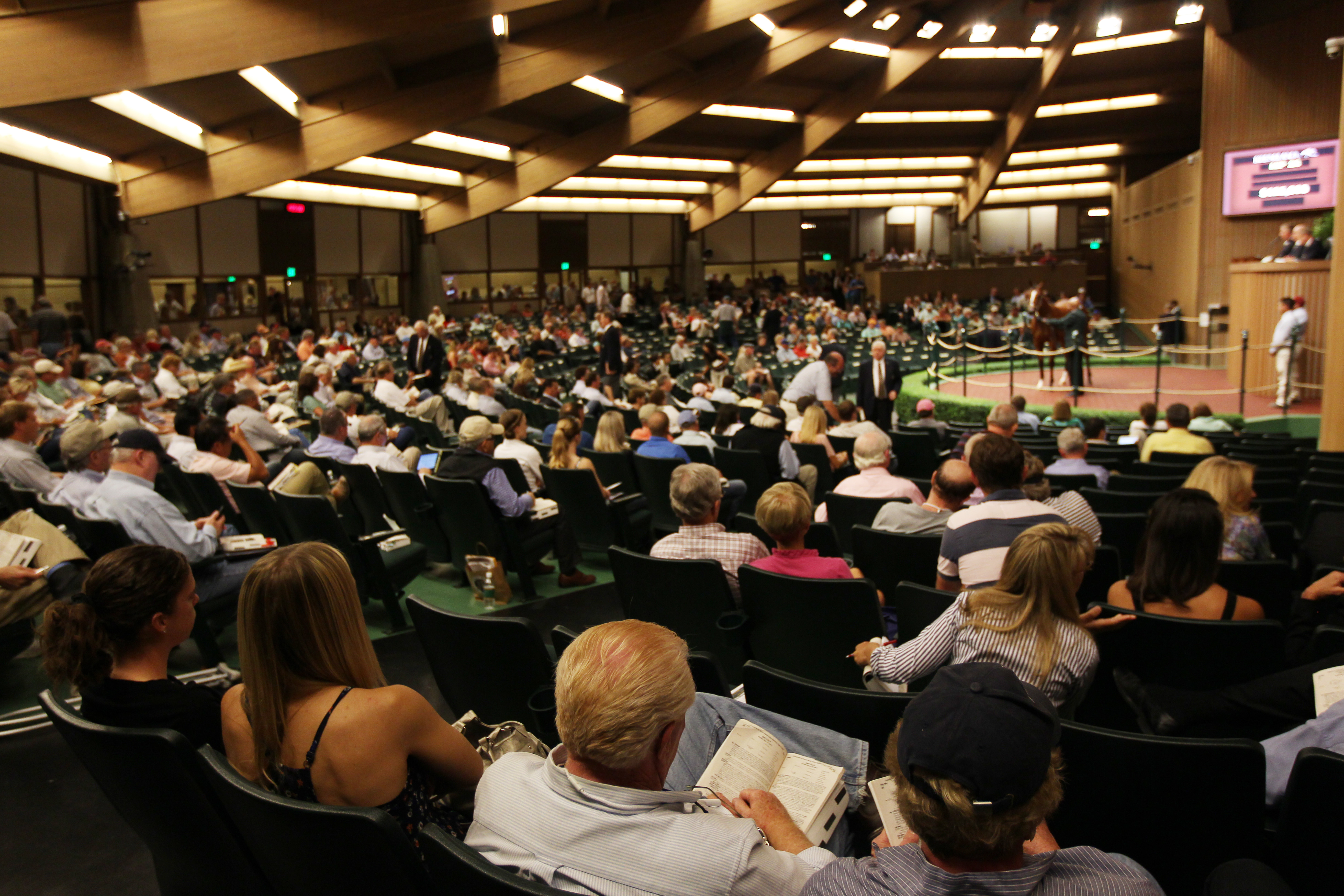
And thus, in the month of September, prominent owners, bloodstock agents, and trainers will descend on Lexington, Ky., from various corners of the country and world and lace up their walking shoes to inspect hundreds of yearlings. Consignors and showpeople will make their pedometers swoon walking literal miles up and down shed rows to showcase their stock. They will all take up semi-permanent residence in the Keeneland barns and sale pavilion as, meanwhile, the seasons slowly change.
In short, there is something for everyone, with plenty of major storylines to follow this year, as always.
“It’s quality in quantity,” Mark Taylor of perennial leading consignor Taylor Made Sales, which will be a presence in all six books as it consigns 542 horses this year, described it. “Everyone gets a fair share at finding a good horse.”
Keeneland is coming off a record renewal of its September sale, wrapping the 2018 sale with a record average price and gross and median figures among the best in its history one decade after the recession that rocked the bloodstock industry.
A total of 2,916 yearlings sold during the 13-session auction for gross receipts of $377,140,400, finishing with year-on-year gains and as the fourth-best in the auction’s history. The 2017 edition of the sale, which sold 2,555 yearlings over 12 sessions, grossed $307,845,400, the first time the sale surpassed $300 million in revenue since 2008, when the effects of the recession began to be felt in the second week of the auction.
The market was led by three horses to surpass the $2 million threshold – a $2.4 million War Front colt sold to Coolmore, a $2.2 million American Pharoah colt sold to Godolphin, and a $2.1 million Medaglia d’Oro colt sold to Phoenix Thoroughbreds. Keeneland September’s average price finished at $129,335, surpassing the 2017 record of $120,487 by 7 percent. The median checked in at $50,000, missing the 2017 record median of $57,000 by 12 percent but tying for the second-highest all time with the 2013, 2014, and 2015 editions of the sale. The cumulative buyback rate finished at 24 percent, relatively steady from 25 percent the previous year.

Off that strong renewal, and with other positive market indicators this year, there is reason for optimism heading into Keeneland September, which is a major market for both end users and pinhookers. This year’s juvenile market was outstanding, surpassing $200 million in aggregate gross sales for the first time, with a number of sales led by record-priced offerings. Pinhookers, perhaps feeling bullish, are now restocking their benches at the yearling sales, hoping to continue their success in 2020.
Earlier-season yearling sales also have shown positive results. August’s Fasig-Tipton Saratoga selected yearling sale, which is similar in quality to Keeneland’s Book 1 portion, finished with record average and median figures. Even more impressive, the sale finished with that record average figure despite the fact that the two colts sold for $1.5 million each at the top of the market were each bought in partnership, perhaps slightly diminishing their final prices.
“We live in a very realistic market where buyers are certainly willing to pay what they consider to be a fair price, and then probably a little bit,” Fasig-Tipton president Boyd Browning said. “There’s tremendous competition at the upper end of the marketplace. . . . But they have limits. They stop bidding. Sometimes they partner up to spread the risk, which has kind of become a way of life amongst the buying group, which tends to minimize the ‘craziness’ at the top end of the market.”
This year, Keeneland has again tweaked the format of its top-market portions in Books 1 and 2. Book 1 will now encompass the auction’s first three days – compared to four sessions last year – with 190, 190, and 189 yearlings cataloged, respectively, each day. After a dark day with no auction on Thursday, Sept. 12, the sale resumes with Book 2 comprising 365 yearlings cataloged in each of the fourth and fifth sessions on Sept. 13 and 14. A total of 569 yearlings are cataloged in this year’s Book 1 compared to 989 in 2018. The size of the Book 2 catalog is 730 horses compared to 826.
“Keeneland is in constant communication with our sales clients, and we work with them to determine the best way to structure the September sale each year to produce the strongest market we can – by enabling consignors to best present their yearlings and giving buyers adequate time to inspect these horses,” said Bob Elliston, Keeneland’s vice president of racing and sales. “We feel the revised format of the 2019 September sale and the other exciting changes at Keeneland will create a successful atmosphere that rewards participants.”
Books 3-6, making up the rest of the sale from Sept. 15 to 22, include a total of 3,345 yearlings.
As always, there is star power on both sides of the catalog pages for these yearlings. War Front, who stands at Claiborne Farm, was the September sale’s leading sire by average price last year, at $782,500, compared to his commercial rival, Gainesway’s perennial leading sire Tapit, at $611,200. These two classic sires, who have made up the exacta by Keeneland September average price for four consecutive years, are represented by 34 and 49 yearlings in this year’s sale, respectively. Curlin, who led the Fasig-Tipton Saratoga sale with three seven-figure lots, has 60 representatives in the catalog; international titan Galileo has three; and Triple Crown winner and leading freshman sire American Pharoah has 90. American Pharoah’s group includes a filly out of Broodmare of the Year Leslie’s Lady, dam of four-time Eclipse Award champion Beholder, Grade 1 winner and leading sire Into Mischief, and Grade 1 winner and Keeneland September topper Mendelssohn.
Leslie’s Lady is just one of several outstanding broodmares represented in this year’s catalog, including another Broodmare of the Year in Stage Magic, whose Pioneerof the Nile colt is a half-brother to unbeaten Triple Crown winner and Keeneland September graduate Justify. Through Aug. 24, with catalog updates from summer racing continuing to come in, there were 69 dams of Grade 1/Group 1 winners with yearlings cataloged, and an additional 40 mares who are Grade 1/Group 1 winners in their own right. Those groups include five mares who are both Grade 1/Group 1 winners and producers.
The yearling sale season in North America began in July as the Thoroughbred racing industry continued to grapple with long-standing horse-welfare and safety issues pushed into the national forefront by the equine fatalities at Santa Anita. Among the issues in the discussion is the use of bisphosphonates, a class of drugs that are approved for use in older horses to treat osteoporosis but that also have been rumored to have been abused in young horses headed for the sales ring. In March, Keeneland, acting jointly with Fasig-Tipton and the Ocala Breeders Sales Co., announced a policy allowing buyers of young horses to request that their purchases be tested for bisphosphonates, a move intended to stop off-label use of the drugs. Buyers who request testing for bisphosphonates will be able to return horses to consignors if a horse younger than 4 tests positive for any drug in the class. The buyer is responsible for the $500 cost of the test if the horse tests negative, but if the horse test positive, the cost shifts to the consignor.
“This is an integrity issue,” the sales companies said in a joint statement: “We all agree that this policy is critical to strengthen buyer confidence in the entire Thoroughbred auction process. As research continues, we will amend our conditions of sale to reflect the advancements in testing science.”
A number of prominent breeders and consignors came out in support of bisphosphonate elimination in sale horses or testing policies. Denali Stud pledged publicly on its social media channels that no horse raised by the farm “has ever or will ever” be treated with bisphosphonates, and that to its best knowledge no horse it sells will have ever been treated with the substances. Woodford Thoroughbreds also took to its channels to state that no horse raised at Woodford as a weanling, yearling, or 2-year-old in training sales prospect has ever received bisphosphonates. Meanwhile, Stonestreet Farm took things a step further by creating its own testing program and blood bank repository for buyers.
Racing regulators have issued concerns about the use of bisphosphonates in young horses, which have reportedly been administered to young horses in order to build bone density. Some medical practitioners believe that this can lead to fractures due to changes in bone remodeling processes.
Other issues that have come to the forefront in racing this year include the race-day use of the anti-bleeding medication furosemide. The Stronach Group, which came under fire this year at Santa Anita after a rash of equine fatalities during its meeting, announced in March that it has plans to phase out the raceday use of furosemide, commonly known as Lasix. In April, a group of racing companies including Churchill Downs, Keeneland, and the New York Racing Association, revealed discussions to phase out raceday Lasix for 2-year-olds in 2020 and for all stakes at the tracks in 2021. This has led to additional promotional angles for stallions like Eclipse Award champion Runhappy, who raced Lasix-free. Runhappy is one of several Eclipse Award champions in this year’s first-crop yearling sire class, along with two-time Horse of the Year California Chrome.
In an effort to take a degree of stress off sale horses, a growing movement has emerged among consignors and buyers to scale back the number of endoscopic examinations of the airway a yearling undergoes, in some cases, by making high-quality video of exams available for viewing by potential buyers. In advance of the September sale, Keeneland is encouraging consignors and veterinarians to utilize the video capabilities of its repository to upload and view endoscopies.
Europe and other jurisdictions race Lasix-free, while the move to limit multiple endoscopies has already gained traction in other countries, notably, Australia, where horses are scoped just once, with videos available via the sale company’s repository. It remains to be seen how the growing initiatives in the North American bloodstock industry will be received by the international buyers who arrive in Lexington from all corners of the globe. Last year, Coolmore was a major force in the marketplace as it bought yearlings for both its Irish and American bases. With Dubai ruler Sheikh Mohammed al-Maktoum in attendance at the Keeneland September sale for the first time in several years, Godolphin also was a major player, purchasing yearlings for the United States, Europe, and its Godolphin Japan operation. While Godolphin dominated the top of the market, the leading buyer by number of horses at the 2018 September sale was K.O.I.D., a buying arm of the Korean Racing Authority, which purchased 29 yearlings.
Strong results are due to “the depth and breadth of our buying bench, both domestic and international,” said Geoffrey Russell, Keeneland’s director of sales operations. “People come from South America, Korea, Japan, Russia, as well, to come in to buy in Books 3, 4, 5. They like the American-bred speed horse, and they know they’re going to get good quality regardless of price.”