

Keeneland September sale looks to build on record-setting format
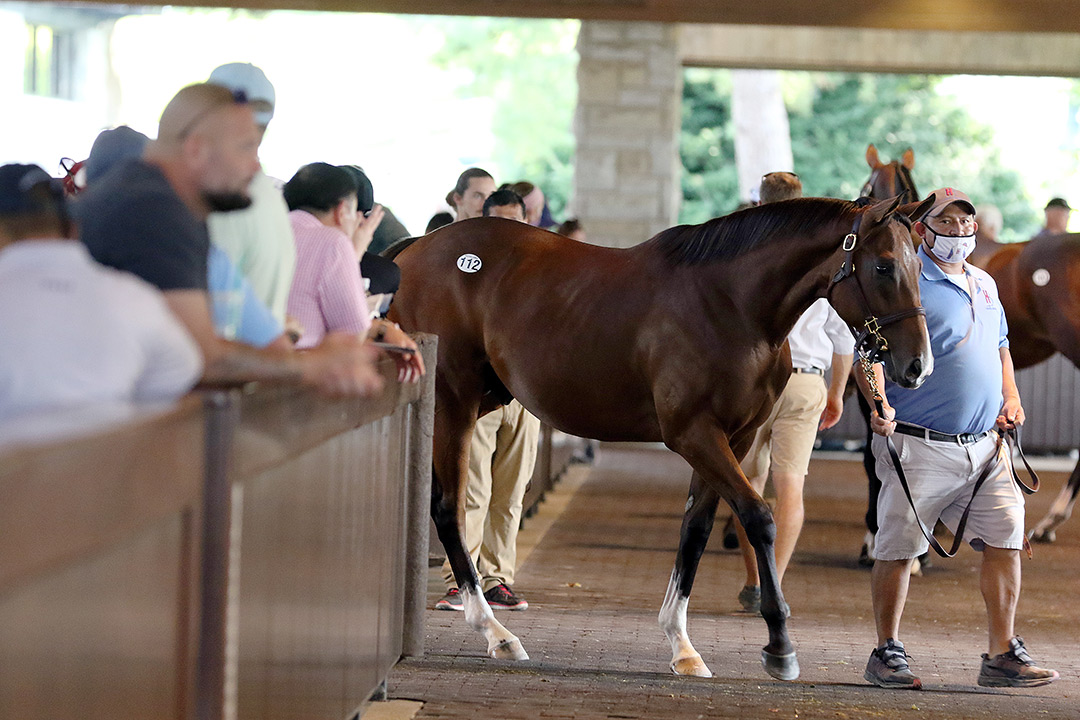
LEXINGTON, Ky. – One constant has been change for the Keeneland September yearling sale, even as it has held its place on the calendar steady through the COVID-19 pandemic upheavals of the past three seasons. Through its recent history, the sale, which typically runs over nearly two weeks, has continually seen tinkering with its format in an effort to place the right horses in front of the right buyers, particularly in the upper marketplace.
But now, consistency will be the watchword for Keeneland September. In their first yearling sale at the head of operations, Tony Lacy, Keeneland’s vice president of sales, and Cormac Breathnach, director of sales operations, led a team that put on a two-session Book 1 and two-session Book 2 prior to the September sale’s traditional dark day, in an effort to put what Lacy called “a critical mass” of horses on the grounds before high-end domestic and international buyers. The result was a 2021 sale that roared out of the starting gate and continued its momentum to finish with record average and median figures.
This year, the Keeneland September yearling sale, to be held for the 79th time from Sept. 12-24, will keep a similar format to last year’s record-setting renewal.
“There’s one thing everyone’s been asking for, and that’s consistency,” Lacy said.

Prominent consignors said they appreciate the consistency as they seek to market their horses to best advantage.
“I think keeping the format is important from a continuity standpoint and giving buyers a sense of stability, and I think that the format works,” Denali Stud’s Conrad Bandoroff said. “At the end of the day, as a seller, what’s good for us is good for Keeneland. We all have the same objective – to maximize the return for our clients and to put a horse in the right spot where it can bring its full value and where we can really showcase it.”
Through Aug. 25, Keeneland had cataloged 4,152 yearlings for the September sale. Those are arranged into six books at the sale, which is considered the bellwether for the North American marketplace. Both end users – buyers who intend to race purchased stock themselves, and perhaps even eventually add them to a breeding program – and pinhookers will be active in the marketplace at a number of levels.
“Keeneland September is really three different markets rolled into one sale,” said Mark Taylor of perennial leading consignor Taylor Made Sales. “In the age of mega stallion books, it can be tricky to separate all the offspring you have by the same sire. We work closely with our clients to determine which book within the September sale will allow their horse to stand out among all horses being offered, and particularly amongst the other offspring by the same sire.”
Heading into the Keeneland sale, summer yearling sales conducted by Fasig-Tipton in Kentucky and New York have posted strong figures, showing market enthusiasm.
“I think we have to be optimistic looking at the markets all through the year so far,” Lacy said. “Obviously, Saratoga was a really strong sale, and we were delighted to see that, because it’s an indicator of the marketplace at the medium to higher end.”
A number of the major domestic buyers at the Fasig-Tipton Saratoga selected yearling sale, which smashed records across the board, will be back in action at Keeneland. Joining them will be a wider cross-section of international buyers. The international marketplace typically plays a major market role at Keeneland, which offers a wide variety of horses who, historically, have gone on to success around the world. Breathnach said that Keeneland September lost about 60 percent of its international grosses in 2020, when the first wave of the coronavirus pandemic strictly limited travel.
“We rebounded about halfway last year, so there is room for more international participation,” Breathnach said. “We’re expecting to see growth in that area. . . . There’s a little pent-up demand from buyers who couldn’t make it last year who really wanted to.”
The sale’s Book 1 will showcase stellar yearlings over two afternoon sessions on Sept. 12 and 13.
“Book 1 sets the tone for the sale,” Breathnach said. “The right energy . . . [is] something that the sale benefited from last year. We’re listening to the industry in a sense that people do want a consistent format – but we do, too. It allows the sale to mature, it allows buyers to know what to expect when they get here, and it allows consignors to know how to place their horses.”
Book 1, as always, has drawn horses with stellar pedigrees. Looking at Eclipse Award honorees alone, and setting aside other racetrack accomplishments, yearlings cataloged in Book 1 include a half-sibling to 2018 Triple Crown winner and Horse of the Year Justify; a half-sibling to 2021 Horse of the Year Knicks Go; a full sibling to 2020 Horse of the Year Authentic; full siblings to Eclipse champions Gamine, Good Magic, and Vino Rosso; half-siblings to Eclipse champions Accelerate, Arrogate, Drefong, and Malathaat; and yearlings out of Eclipse champions Songbird and Untapable.
However, yearlings are not able to walk into the Book 1 barns simply on the basis of a strong catalog page. They had to earn their place in the marquee sessions with their own conformation, movement, and other attributes.
“We were very adamant that it’s not just pedigree, it’s physical,” Lacy said of the inspection and cataloging process. “We were responding to feedback from buyers that they wanted to see good physicals – they weren’t as worried about pedigree as the physicals. The inspection team was moving in that direction even more this year. We did it last year, were very focused on it, but this year, we leaned in even heavier in that direction.”
Following Book 1, the Book 2 section, which last year’s $1.7 million sale-topping colt emerged from, follows on Sept. 14 and 15. The sale’s dark day then takes place on Friday, Sept. 16, offering an opportunity to shift focus to the second week of the sale.
“It flows into where people, with the dark day, are able to get a good head of steam when it comes to looking at Book 3 onward,” Lacy said.
The majority of horses in the catalog will be offered in Books 3, 4, 5, and 6, arranged as two sessions each from Sept. 17-24. The final days of the sale have a slight format shift from last year. The 2021 sale concluded with a three-session Book 5, while this year’s sale finishes with four sessions over the final two books due to the number of horses entered to sell.
“What is fascinating is, normally, people have anxiety over Book 6, but if we’d put on another day last year, we would have had the momentum continue,” Lacy said. “The demand for horses outstripped the supply, and I expect we’ll have a very similar aspect this year.”
The second week of the sale will be crucial to test the middle and lower markets that ultimately make up large segments of the Thoroughbred industry. Those buying at the highest end of the market may be more immune to economic factors such as inflation, with more discretionary income.
“The middle market is always a little more affected with the economic conditions and how the market is,” Bandoroff said. “But it just leads you back to the purses that they’re running for in New York, and Kentucky, and Arkansas, and all these places. I think that the average guy, or couple of buddies that get together and want to buy a horse, they’re there, and they’re optimistic because they can buy a horse for $40,000 or $50,000, and if it breaks its maiden, they’re out their initial investment. So I think it’s changed with how the purses are now, that people feel good about buying a horse and being able to get their money out. And yes, it’s expensive to own horses, it’s expensive to race horses, but with the money they’re throwing out at some of these tracks, I think it gives people confidence.”
Breeders and consignors have stressed throughout the year that the enthusiasm to go racing has been key in the sales marketplace for young Thoroughbreds.
“The math works better for racing horses than I think it ever has, when you look at what the purses are like right now,” Airdrie Stud’s Bret Jones said. “We all know that there are a lot of difficult conditions out there that we in the business can’t control, but I also know that you can find value and that you’re running for an awful lot of money at Kentucky racetracks.”