

Judge denies Baffert's bid for injunction to overturn Churchill ban
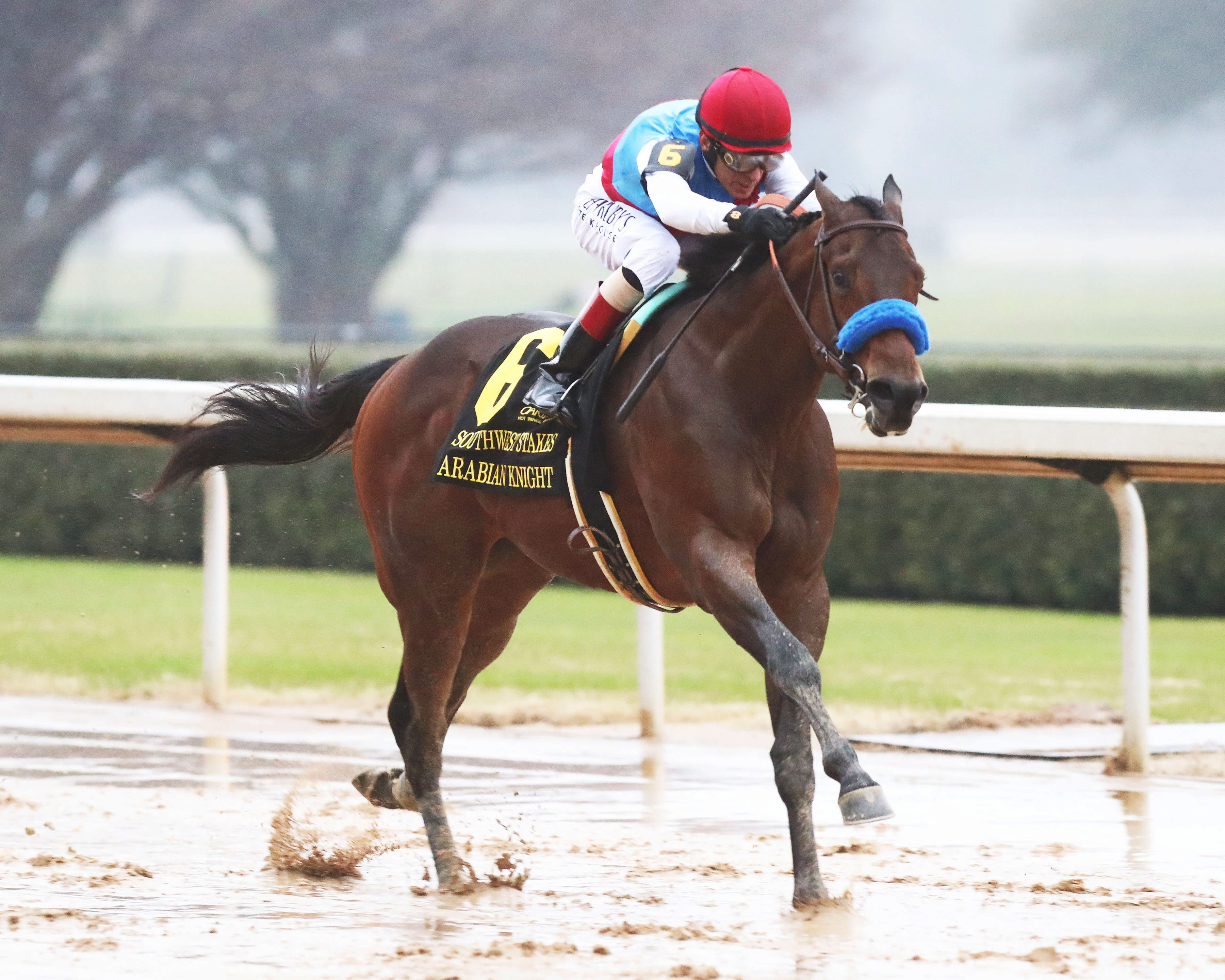
A U.S. District Court judge in Louisville has denied a motion from Bob Baffert that would prevent Churchill Downs from continuing to ban the trainer, a decision that will likely result in Arabian Knight, Baffert’s top 3-year-old, being transferred from his barn to seek a spot in this year’s Kentucky Derby.
Judge Rebecca Grady Jennings denied the motion in a ruling released on Friday afternoon, 11 days prior to a Feb. 28 deadline imposed by Churchill that impacts whether horses can earn points to qualify for a spot in the field of the Derby. Under Churchill’s qualifying system, horses earn points by finishing in the top five positions in dozens of stakes held in the lead-up to the Derby, and any horse trained by Baffert after the Feb. 28 deadline would have been prohibited from earning any points.
Baffert has six horses on Daily Racing Form’s “Derby Watch,” a list of the 20 leading contenders for the race, including Arabian Knight, ranked No. 1, and Cave Rock, ranked sixth. Amr Zedan, owns Arabian Knight and another horse on the list, Hejazi, ranked 15th.
In her ruling, Jennings wrote that an affidavit supplied to the court quoted Zedan as saying that his horses will be moved if Baffert remained banned by Churchill. This year’s Derby is scheduled for May 6.
Jennings released the decision two weeks after a two-day hearing in which legal teams for Baffert and Churchill argued over whether to grant a preliminary injunction. The hearing also delved into Churchill’s own motion to dismiss the case outright.
Churchill banned Baffert indefinitely immediately after the trainer acknowledged that a horse he trained, Medina Spirit, also owned by Zedan, tested positive for the regulated medication betamethasone after winning the 2021 Derby. Nearly a month later, the company announced that it would ban Baffert two years, through the 2023 Derby, citing the Medina Spirit positive and a recent record of multiple positive tests for regulated medications, including a betamethasone positive for Gamine, who finished third in the 2020 Kentucky Oaks, which was held eight months prior to the 2021 Derby.
In the ruling, Jennings wrote that Baffert’s legal team had failed to demonstrate that the continuation of the ban would represent “irreparable harm” to the trainer or that Baffert would have a “likelihood of success” in his claims against Churchill Downs should the case continue to be adjudicated. She also supported Churchill’s claims that the company has the right to ban trainers from its properties, a right that courts have generally upheld in the past.
In pertinent comments, Jennings wrote that “failing to punish trainers whose horses test positive in back-to-back marquee races could harm CDI’s reputation and the integrity of their races,” and, separately, that “there is strong public interest in deterring misconduct on CDI’s tracks.”
On Baffert’s claim that he would suffer “irreparable harm” due to the ban, Jennings used Baffert’s own legal team to provide the rationale. During the hearing two weeks ago, Brewster had said that the damage of the ban to Baffert “is impossible to calculate,” in an effort to demonstrate that a Derby win can sometimes lead to enormous future earnings due to stud valuations. But Jennings wrote instead that the phrase proved a legal point, citing the unpredictable nature of horse racing and precedents that have ruled that “irreparable harm” cannot be due to damages that are “speculative or theoretical.”
“These winnings are impossible to calculate because they are entirely speculative and theoretical,” Jennings wrote.
Jennings also granted five of the six claims made by Churchill in their own motion to dismiss the case. The single claim she said that Baffert could pursue related to his legal team’s argument on whether Churchill was “pervasively entwined with the state” due to the state’s heavy regulation of racing, which could undermine their legal claim of having the right to unilaterally ban licensees.
In a separate motion released on Friday, Jennings denied a motion from Baffert’s legal team to recuse herself from the case. Brewster had argued in a motion filed last Friday, one week after the hearing concluded, that Jennings should withdraw from the case due to recent contractual work her husband performed for The Jockey Club as a lobbyist during Kentucky legislative sessions.
:: Want to learn more about handicapping and wagering? Check out DRF's Handicapping 101 and Wagering 101 pages.