

John Forbes, key figure in New Jersey racing, dies at 73
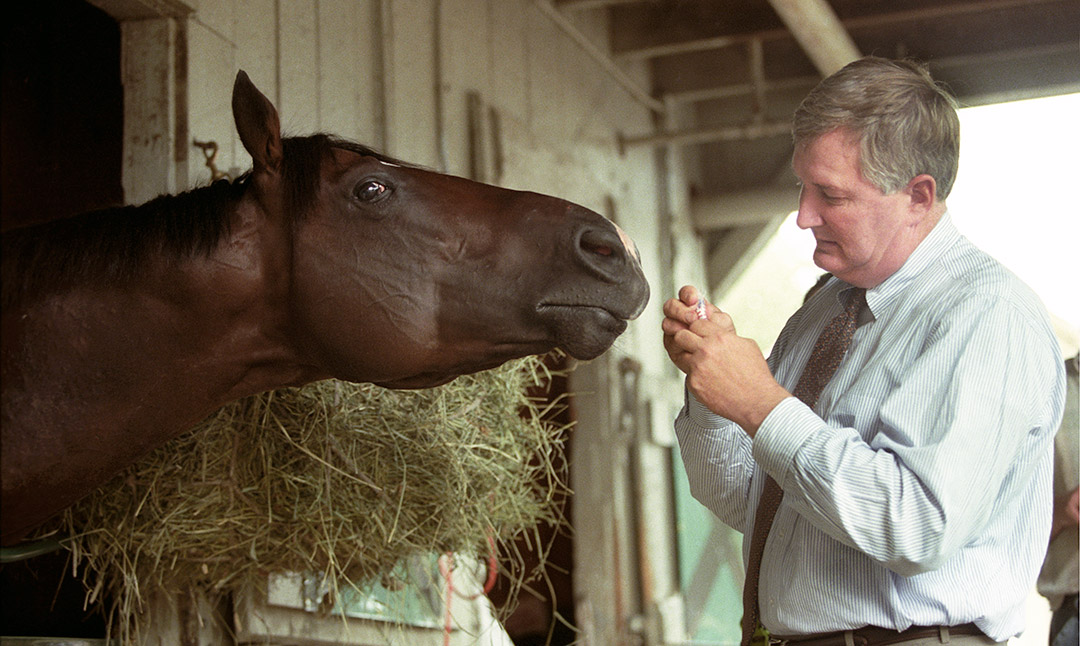
John Forbes, a New Jersey-based trainer who amassed more than 2,100 wins in a 40-year training career while playing a critical role in advocating for horsemen’s concerns and his beloved Monmouth Park, died Sunday of complications of cancer, according to friends of the family. Forbes was 73.
Forbes won more races in New Jersey than any other trainer, but he was most well-known for his efforts to bolster racing in his adopted state. At the time of his death, Forbes was president of the New Jersey Thoroughbred Horsemen’s Association, an organization he helped launch in the 1990s when horsemen’s groups began to splinter off from the National Horsemen’s Benevolent and Protective Association.
Throughout the 1990s until the present-day, Forbes was instrumental in working to protect Monmouth Park, the Oceanport track that opened in 1870 and which is now the sole major Thoroughbred track in New Jersey. Forbes also lobbied hard for Monmouth to host the Breeders’ Cup, and partially through his efforts, the track was approved for the 2007 event.
“John was a guiding light,” said Alan Foreman, founder of the National THA. “I not only lost a dear friend, I lost one of my biggest supporters.”
Forbes was diagnosed with bile-duct cancer several years ago, Foreman said. His condition worsened rapidly on Sunday, the day Forbes died, Foreman said.
Dennis Drazin, the head of the horsemen-led group that operates Monmouth Park under a lease from the state, said that Forbes’s leadership in the early 2010s was invaluable when Gov. Chris Christie began indicating that he was willing to close Monmouth Park in order to address financial difficulties at the New Jersey Sports and Exposition Authority, the state agency that owned the track.
“Without John Forbes this industry would have been over,” Drazin said.
:: Want to get your Past Performances for free? Click to learn more.
A New Jersey native who grew up around the racing industry, Drazin said that he “couldn’t remember a time when I didn’t know John Forbes.
“John was everybody’s friend, and that’s because he wouldn’t just talk, he would listen. He was willing to compromise and exchange views. John wanted to have a free-exchange of ideas so that he could do whatever it took to improve racing here on every level.”
Forbes grew up in Maryland, and his parents were Thoroughbred trainers. He took out his trainer’s license in 1972, basing his operations in his home state. Increasingly, he began shipping his horses to The Meadowlands in New Jersey, and he eventually made New Jersey his home.
Although he was racking up the wins at The Meadowlands (which used to run a significant Thoroughbred meet), he “fell in love with Monmouth,” he told Sports Illustrated in 2014, after he had retired from training to manage Phantom House Farm, a racing partnership.
“Not many of the remaining racetracks in the country have the charm and ambience of this place,” he said, referring to Monmouth. “That’s why we stayed. It’s a little hard to describe how Monmouth captures you. But it’s a step back in time.”
By wins, Forbes had his best training year in 1979, when he sent out 1,261 starters and won with 233 of them, according to Equibase statistics, amassing nearly $2 million in purse earnings for the year. Over the next 16 years, he started more than 400 horses each year, but he began downsizing the operation as his work with the THA and horsemen’s issues began consuming more and more of his time. At the time of his retirement, he had 2,174 wins from 14,681 starts, with total purse earnings of $32.1 million.
Forbes was on a first-name basis with nearly everyone on the backstretch, and he commanded respect among other leaders of horsemen’s groups, even those who disagreed with him. Foreman said that despite Forbes’s opposition to efforts to ban the raceday use of the diuretic Lasix, Forbes volunteered to back Foreman’s appeal for THA affiliates to support a federal bill that will likely lead to the drug being banned on race day in the near future.
“He could have walked away from it, but that wasn’t John,” Foreman said. “He came to me and said, ‘Is it okay if I disagree but still stand behind you?’ That was typical John. He saw the big picture clearly. The industry has lost a giant.”
Forbes is survived by his wife, Vicki; two daughters, Anne and Carrie; and a son, John Jr., along with two grandchildren. In lieu of flowers, his family has requested donations be sent to the Backstretch Community Assistance Program, based at Monmouth Park.