Jim Raftery-Turfotos exhibition to open at National Museum of Racing and Hall of Fame
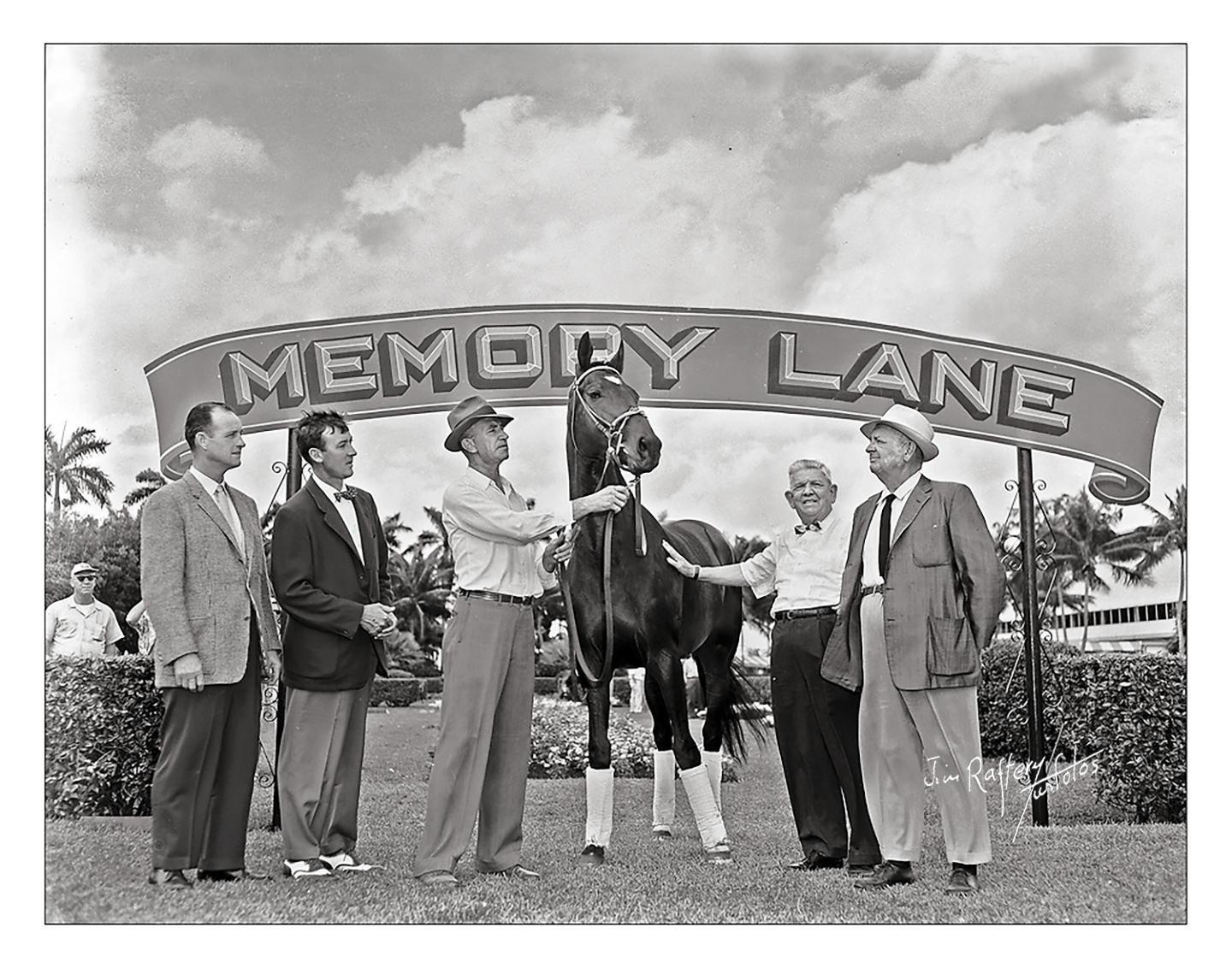
An era of racing gone by will be brought back to life next Thursday with the opening of a new exhibition at the National Museum of Racing and Hall of Fame entitled “Jim Raftery: A Turfotos Retrospective (from the collection of Barbara D. Livingston.)”
The showcase of 60 images from the 1940s through 1980s coincides with the opening of the meet at neighboring Saratoga Race Course in Saratoga Springs, N.Y. The exhibit will be housed in the von Stade Gallery.
Raftery was a longtime track photographer who chronicled the history of the sport along the East Coast. The images making up the exhibit were selected by Livingston, the chief photographer for Daily Racing Form who in 2020 acquired what turned out to be an estimated 2.5 million Raftery negatives from his family in Miami.
“I hope people will love being reintroduced to one of the best racing photographers in history,” Livingston said, “and one of the most vast collections in our history.
“This collection shows not only win photos. It shows the racetracks growing and changing and opening and some closing. It covers jockeys watching the moon landing test, the first female jockey getting a license – he covered social events, societal changes.”
Livingston said Raftery was born in 1915 and in 1944 became the track photographer at Hialeah. She said at various times he also was the track photographer for Gulfstream Park, Tropical Park, Monmouth, Meadowlands, Atlantic City, Garden State Park, Laurel, Pimlico, and Waterford Park. Livingston said Raftery spent a summer in New York in 1946 and his work featured photos from Saratoga.
"Almost every single great horse from the time period Raftery was active raced at one of his tracks in that 50 years, and he shot them,” Livingston said.
Livingston said the exhibit will include an array of images. They include engaging and unexpected photographs of the racing life with individuals like Nashua, Swaps, Bold Ruler, Ruffian, Needles, Grace Kelly, Eddie Arcaro, and Bill Hartack. (There also will be an online showcase of images.)
Livingston hired author and historian Dorothy Ours to write captions for some of the photographs in order to give additional context to those viewing the images during the exhibit.
“The captions are really interesting and in depth and studied,” Livingston said. “You can walk in the room and just look at photos, or learn a lot. It’s just up to the person.
“Photographs with the written word can turn artwork into magic. Putting the two together makes them come to life in a remarkable way that photos wouldn’t on their own, or words wouldn’t on their own.”
Livingston, a racing historian through her Eclipse Award-winning work and the collections she has of other industry photographers, had inquired about Raftery’s collection. She traveled to Miami from her home in New York in 2020 and picked up approximately 300 boxes of negatives with the help of Raftery’s family and “four racetrackers.” It took a large U-Haul, an SUV, and a car to get the boxes back to New York.
“The family kept the negatives safe all those years, including granddaughter Dori Bassing,” Livingston said. “She was in charge of the collection. At one point, her mother, Judy Ann Bassing, decided her father’s talent was too good to just be hidden in boxes. The family was ready to have his name seen again, in a way they were not able to provide, so I acquired the photos. I’m a big Jim Raftery fan.”
Raftery had a large following during a time when racing was front and center in America.
“He used to appear in cartoons, because racing was really big back then,” Livingston said. “He was sort of larger than life, an entertainer. He was a singer, had a clown act, worked with the Shriners. He was hilarious, wrote poetry. Everybody just seemed to absolutely love him. Jimmy Jones, the Hall of Fame trainer for Calumet, called him the poet laureate of Monmouth Park!”
Livingston has scanned about 16,000 to 17,000 of the negatives from Raftery and some of the images also can be seen in a second new exhibition at the National Museum of Racing and Hall of Fame that opens the same day, “Betting on America: The Immigrant Experience and the Hall of Fame.” It will be in the McBean Gallery.
Livingston’s experience with Raftery’s work will no doubt have the same feel for many who visit the exhibits.
“It shows history – from horses I’d never heard of to horses that formed me as a child,” she said.
National Museum of Racing and Hall of Fame members will be able to view the Raftery showing a night earlier than its opening, on Wednesday, July 13.
“We’re excited to share these two new exhibits with everyone,” museum director Cate Masterson said in a press release. “I think our visitors will find them both to be memorable experiences they won’t soon forget. The museum staff has been enthusiastic about telling these incredible stories of Thoroughbred racing with great attention to detail. We’d like to thank everyone in the industry who helped us with these exhibits, especially Barbara Livingston, without whom this amazing Jim Raftery experience would simply not be possible.”
Livingston said she will continue to maintain the Raftery collection and eventually will pass it along to an established entity in order to preserve the historic images for future generations of racing enthusiasts.