

Hovdey: When served up slop, they made a meal of it
Southern Californians do not take rain as well as those living in the more naturally irrigated parts of the country. They tend to panic, spin their tires, and wail to the heavens, “Why are the angels weeping so?”
Horse racing suffers accordingly, as the cancellation of the Thursday program at Santa Anita illustrates. And because there will be more rain coming soon, based upon always reliable weather reports, the Southern California racing community will need to brace for a winter of damp discontent.
In times like these I find comfort in a conversation with Jon White, who depending on the day of the week can answer to journalist, racing official, chart caller, historian, linemaker, horseplayer, and tall forward in a press box over-50 pickup game. For purposes of this exercise, though, White is my Man of the Great Northwest, a Washington State native who has seen enough water pounding down upon racetracks to have earned a mud mark on his driver’s license.
White will tell you that horses will not drown and jockeys do not melt in the rain. He can even cite any number of outstanding performances by Thoroughbreds who rose above the elements to deliver historic moments.
“Inside Information’s Breeders’ Cup Distaff has to be one of the greatest wet-track performances ever,” said White, referring to the filly’s 13 1/2-length victory at Belmont Park in 1995. “I think Inside Information probably would have won the Classic that day if she had been in it. She did get a bigger Beyer Speed Figure than Cigar did for his win in the Classic.”
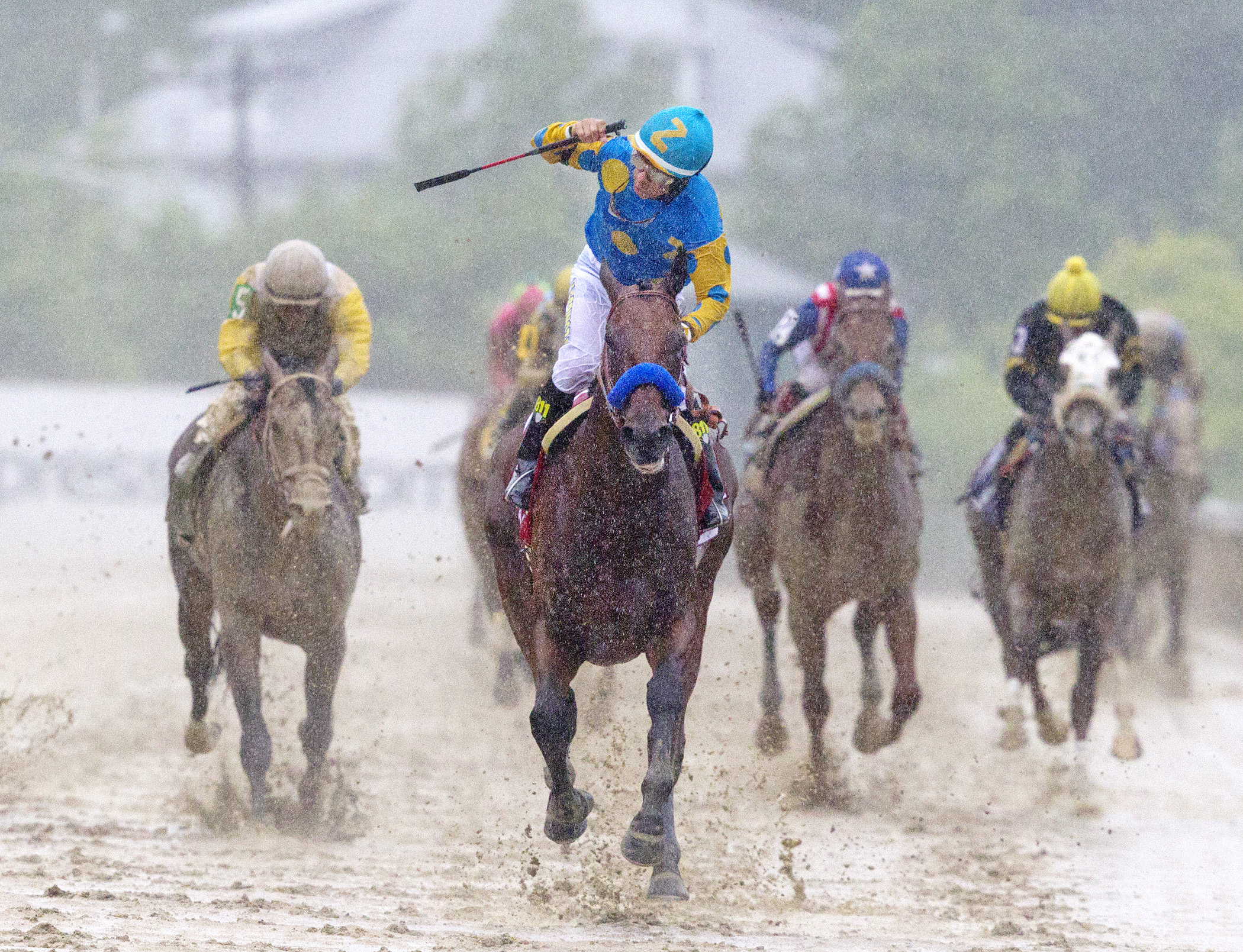
Others examples of more recent vintage come quickly to mind, including American Pharoah’s seven-length cruise through a storm of Biblical proportions in the 2015 Preakness, Exaggerator’s Grade 1 wins over three different soupy tracks in 2016, and Curlin’s dismissal of the wretched elements to win the 2007 Breeders’ Cup Classic over a ravaged Monmouth Park main track.
Historians of a certain age tend to agree that the 1976 Marlboro Cup at Belmont Park set a benchmark for grace in the face of bad conditions. Not only was the track a mess, two-time Horse of the Year Forego also had to carry 137 pounds, highest in his career to that point, and give Travers winner Honest Pleasure 18 pounds in the handicap.
Bill Shoemaker, aboard Forego, thought he was going to lose the race until, suddenly, Forego put his nose on the line a head in from of his younger rival. Covered in a layer of Big Sandy, Shoemaker was stunned at what his big gelding had done.
“This has to be the best horse I’ve ever ridden,” Shoemaker told Steve Cady of The New York Times. “It was one of the greatest races I’ve ever been in or seen.”
To that point, Shoemaker had been the regular rider of Swaps, Damascus, and Ack Ack, but he had yet to meet Spectacular Bid, who provided this eyewitness with my most memorable wet track memory in the 1980 Santa Anita Handicap.
The March day started out pleasant enough, but then, as the races unfolded, a bizarre storm rolled in from the west and brought with it a knifing chill and rain blown sideways. Under Shoemaker and 130 pounds, Spectacular Bid made not one, not two, but three distinct accelerations during the mile and one-quarter for a five-length victory over a dead-game Flying Paster.
There are fans of the sore-legged Conquistador Cielo who remember the turbulent spring of 1982 when their hero won the Met Mile on a Monday and the Belmont Stakes the following Saturday over a surface you wouldn’t wish on your worst enemy. And while sloppy tracks tend to string out the field through sheer lack of enthusiasm, few horses dominated a major race in rotten conditions the way General Assembly did in the 1979 Travers, when he splashed through the leavings of a sudden summer storm to win by 15 lengths in track-record time.
Shoemaker also was aboard Exceller when they edged Seattle Slew and Angel Cordero at the end of a mile and a half in the 1978 Jockey Club Gold Cup over the nastiest of Belmont mud. In the wake of the race, Seattle Slew was hailed in defeat as if he had won, for it was impossible to separate the first two on courage alone.
Jon White had his own Gold Cup moment as a young fan at his hometown Playfair Race Course in Spokane when Turbulator, the star of the Northwest, finished second under 138 pounds in the 1970 Playfair Mile.
“After being 13 lengths behind early, Turbulator was closing with a rush on the far turn when he hit a slick spot on the track and broke stride badly,” White recalled. “I thought he had injured himself. But despite the 138 pounds, he regrouped after a few strides, then ran his heart out all the way down the stretch, only to lose by a neck to Ruler’s Whirl.
“He likely paid a price for such a humongous effort because he did not race again after that for more than a year due to a suspensory injury,” White added. “But that not only was the most impressive wet-track performance I recall from my Northwest days, it’s one of the gamest performances I have ever seen in more than half a century of going to the races.”