

Hovdey: Track superintendents forced to find a balance
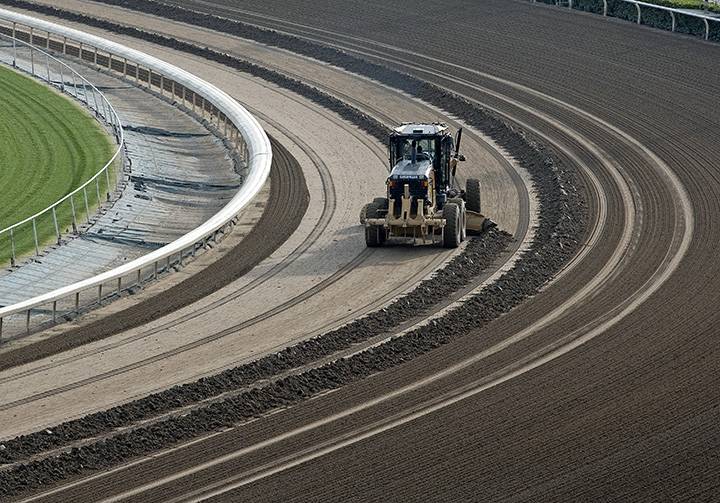
The incidence of equine deaths at Santa Anita Park this winter - specifically the 14 linked to racing and training on the main track through the training of Thursday morning – became intolerable in the last week when four horses were fatally injured in a four-day span, Feb. 22-25.
Splash! went the local headlines and news shows, screaming about the carnage, as if someone had just that day noticed horse racing is a blood sport that requires the highest possible levels of safety precautions and regulation to simply make it through an average afternoon without a tragedy.
Those entrepreneurial souls who operate racetracks and invest in racehorses must face the fact that at any given moment, because of the nature of the animal involved and the intensity of the competition, something terrible could happen. If they do not, they are either irredeemably cold-hearted, or suffering from wishful thinking.
The difficulty in solving mysteries like the gruesome spike in main track fatalities at Santa Anita should be obvious. Anyone who has been paying attention long enough can round up the usual suspects and tick them off by heart: bad step, incipient injury, equipment failure, weakness of the breed, medication camouflage, shoeing, caretaker malpractice, economic pressure.
They all come and go as contributing factors. But the one thing that all horses in a given racetrack population have in common, day-in and day-out, is the ground over which they must race and train.
Every trainer and veterinarian worth their access pass will tell you that nothing is more nerve-wracking than a track that changes week to week, or even day to day. And for horses and riders, nothing is more potentially dangerous than a track that has inconsistencies between the rails, in terms of depth, impact, and traction. With nearly a foot of rain during the meet already (and with more on the way this weekend), Santa Anita management has been faced with challenges on both fronts.
Management reacted to the recent deaths by closing the main track for two days and bringing in consultant Mick Peterson to peel back and thoroughly examine the rain ravaged surface.
“Opening up the surface is the best thing they could do,” said Rich Tedesco, former track superintendent at both Santa Anita and Del Mar. “Unless you do you can get a slick, moldy layer that results in shelving – or uneven spots in the surface where the horse’s foot could slip.”
Management also urged trainers to be especially cautious about the horses they entered, which should go without saying. But it was said.
Bear in mind, Santa Anita management also has been on a nonstop campaign to increase the size of fields and therefore betting handle, employing both carrots – in the form of incentives for horses coming from outside California – and sticks, as each approved horse on the grounds is monetized and stalls allotted in terms of dollars produced.
Such an approach can become scrambled by Mother Nature, when the accepted response to a significant storm is to “seal” the track with heavy rollers, and trainers are understandably leery about aggressive training and racing.
“Once it’s sealed down and smooth, the water from a hard rain will run down the cross slope from the outside to the inside,” said Dennis Moore, track superintendent at Del Mar and Los Alamitos. “If you don’t, you get too much water too deep into the track. You can lose the bottom, and a whole lot of things can happen – none of them good.”
There is a downside to preventative sealing, however. A sealed, compacted track is a harder surface with less bounce, and therefore more stressful on a horse’s feet and limbs.
“True, but the tracks today don’t set up as hard as they did in the 60s and 70s,” Moore said. “And as soon as horses get on it they break the seal, so some water is going to get into it and soften it some anyway. And if it doesn’t rain, you almost have to open up the seal anyway to get some air into it and give it a chance to dry out.”
Santa Anita management lost Moore’s nearly half a century of experience this winter when he left their employ and was replaced by his assistant, Andy LaRocco.
“I haven’t been consulted,” Moore noted. “But I’m sure Andy is doing a good job, and what happened recently was just a lot of tough things coming together.
“Taking care of a track is both art and science,” Moore added. “And I certainly try to see things from the trainers’ side. But I don’t care how fast horses go, or who the leading trainer is. All I care about as a trackman is that all the horses come back safe and sound, because when that happens it’s safe for the riders, too.”