

Hovdey: Stringhalt behind him, Bricks and Mortar ready to take Manhattan
Packaging 10 tradition-rich stakes on a single afternoon is bound to attract a glitzy collection of equine celebrities, if only by accident. Pay them, and they will come.
On Saturday at Belmont Park, the spotlight will shift quickly among several racing divisions – including 3-year-old fillies, turf mares, and monster milers – before landing squarely on the 151st running of the Belmont Stakes. Fans are advised not to blink or else they could miss star turns from the likes of Thunder Snow, Mitole, Disco Partner, Midnight Bisou, and World of Trouble while waiting for War of Will and Tacitus to settle accounts in the final leg of the Triple Crown.
Rising above all the fuss, in a race that would be a major draw on any other day, older grass horses will convene for the $1 million Manhattan at 1 1/4 miles an hour before the Belmont. These are the gatekeepers of the game, throwbacks in terms of stamina and durability. The Belmont 3-year-olds might be getting all the ink, but the game should be so lucky that they end up in a race like the Manhattan someday.
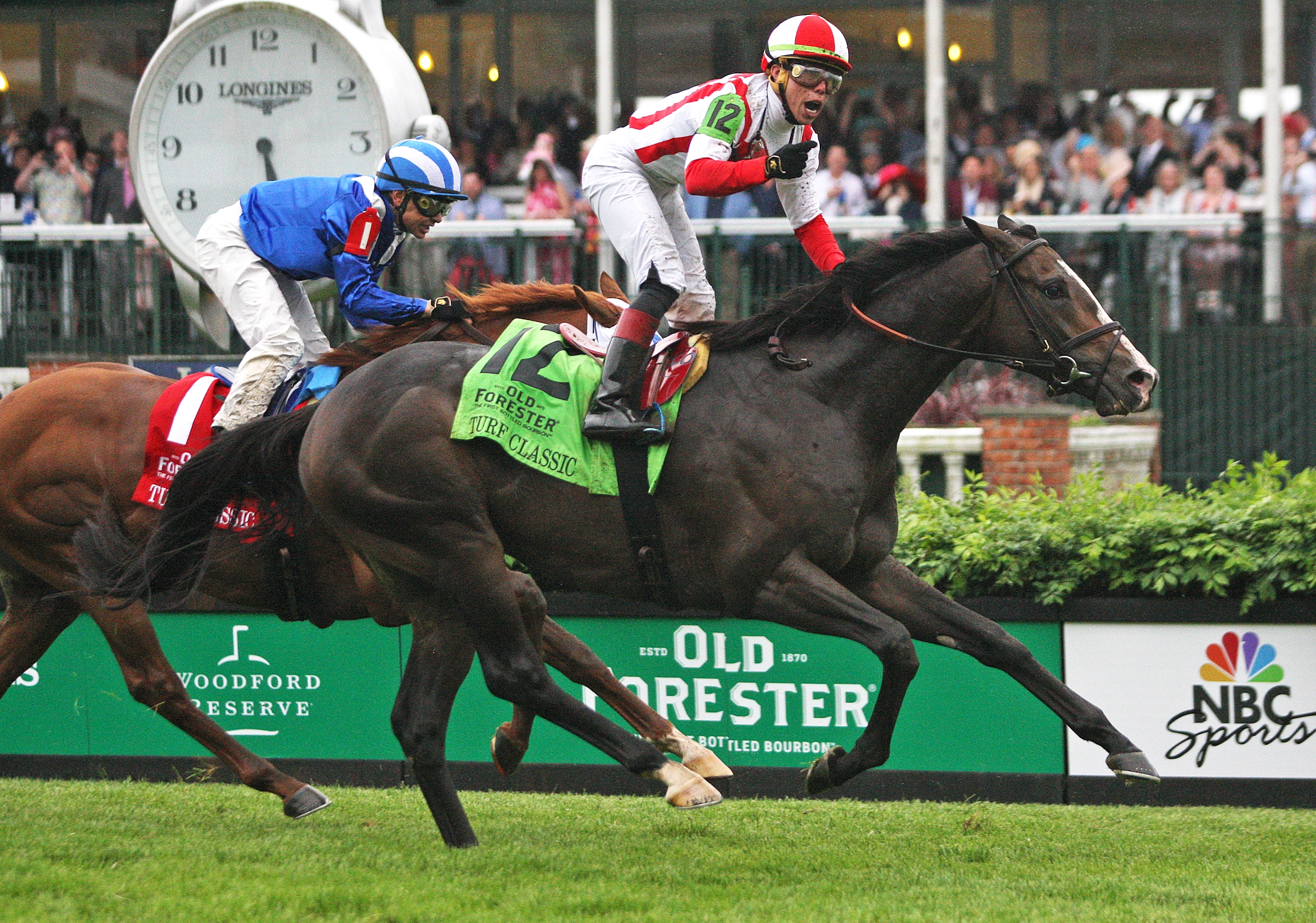
Chad Brown trains four of the entries, but one stands out. Bricks and Mortar, a 5-year-old son of Giant’s Causeway, returned a winner last December after a 14-month absence, then added three major stakes this year in Florida, Louisiana, and Kentucky. His half-length victory last time out in the Turf Classic at Churchill Downs on Derby Day was an all-pro piece of work, as he emerged from the pack, shook off a bump, and then stretched out with long, fluid strides to nail Qurbaan on the line.
He wasn’t always that pretty, at least not in motion. After winning his first four races as a 3-year-old, Bricks and Mortar sustained a couple of narrow losses that, given the tough company, were easily explained. In subsequent training, however, Brown and his staff detected an imbalance in the colt’s stride that was not getting any better. It turned out that Bricks and Mortar was exhibiting symptoms of stringhalt.
:: Belmont Stakes one-stop shop: Get Clocker Reports, PPs, packages, and more
Stringhalt manifests itself most commonly in a horse lifting a hind leg to an exaggerated degree at a walk or a trot. Armchair veterinarians took to social media in the wake of the Preakness Stakes to voice their alarm at the way War of Will walked victoriously into the sunset with a hitch in his hind-end get-along. Trainer Mark Casse, who has been around horses for all of his 58 years, confirmed that War of Will had shown signs of stringhalt since last autumn.
“Stringhalt is a neuromuscular disease, but it’s not a degenerative disease like MS,” said Larry Bramlage, the orthopedic surgeon who was consulted about Bricks and Mortar. “We think that’s it’s caused by some trauma to the neuromuscular junction, which messes up the coordination of the horse. If you take the overall horse population, it’s not very common, but as a disease, it’s been known for a long time. It’s not dangerous to a horse. It’s only a problem when it starts affecting its action.”
Bramlage said the most likely cause of the trauma is a hyperextension of the hind legs.
“It was found that draft horses would get it when they were pulling a load and the ground broke out from under them,” Bramlage said. “They’d go down on their bellies with their legs extended backwards. It’s not a large stretch to think that a racehorse could get that same kind of extension to his hind leg coming out of the gate if the ground breaks away.”
The trauma can corrupt the neural messages sent to muscles that have been basically on autopilot in service of a normal equine stride.
“About 75 percent of the time, it only affects one muscle in a hind leg and the nerve supply to that muscle,” Bramlage said. “Fortunately, that is the less important of the two extensors. You can remove the tendon where it joins that muscle. That eliminates the erroneous input the horse has been getting, and they are able to recoordinate their action behind. Bricks and Mortar certainly regained his.”
It was the good fortune of owners Seth Klarman and William Lawrence that the stringhalt afflicting Bricks and Mortar fell in that fixable 75 percent. Bramlage performed the procedure to remove the tendon with the colt standing, and recovery from surgery was routine.
“You’ll get about 50 percent of coordination back immediately after surgery,” Bramlage said. “After that, it takes roughly two to three months to recoordinate the rest of the action behind.”
Bricks and Mortar was handed off to Ian Brennan at the Stonestreet Farm training center in Ocala, Fla., where the colt had received his lessons as a youngster.
“As soon as I got him from Dr. Bramlage, the stringhalt was all cleaned up,” Brennan said. “He never did anything like that again. But knowing him so well as a 2-year-old, when we did start him back, I just wasn’t happy with the way he was going. It was mostly up front.”
Bricks and Mortar got a healthy dose of the best medicine: time. A few months later, he was back in training, up and down a grass gallop and then onto the Stonestreet training track.
“After that, he never looked back,” Brennan said, which has allowed fans of Bricks and Mortar to look forward to a race like the Manhattan.