

Hovdey: Met Mile regains its spot at center stage
Saturday is Met Mile Day at Belmont Park. Go figure. The Belmont Stakes also will be run for the 151st time, at about 6:37 p.m. And yet patrons will need to be careful not to get trampled by the crowd leaving the grounds once McKinzie, Mitole, Thunder Snow, Coal Front, and Firenze Fire have had their way with each other around one fat turn for $1.2 million.
Both races deserve their own stage, but that’s not the way tracks roll these days. As a result, because this year’s Belmont Stakes is failing to ignite the imagination – unless a loose horse or an agonizing DQ can be promised – Saturday will be considered Met Mile Day at Belmont Park.
This is not a bad thing. Few races boast a more colorful history than the Metropolitan Handicap, first run at Morris Park in 1891. An appreciation of the Met could hopscotch through multiple winners like Mad Hatter in the 1920s, Equipoise in the 1930s, or Devil Diver in the 1940s. There have been heroic winners like Native Dancer in 1954, carrying 130 pounds and nearing the end of the line, and epic battles like the Gallant Man-Bold Ruler showdown of 1958, packing 265 pounds between them.

A healthy share of the jockeys who rode Met Mile winners can be found in the Hall of Fame. John Velazquez, who rides Prince Lucky on Saturday, tops the list with five. Jerry Bailey won four Met Miles, most recently in 2003 with Aldebaran. Eddie Arcaro, Ted Atkinson, Sonny Workman, and Earl Sande each won three, while among those with two Met Mile trophies is Eddie Maple. Both of his were more than memorable.
“The Met Mile is a good race, and it used to fit right into that older horse handicap Triple Crown they had in New York, with the Met, the Suburban at a mile and a quarter, and the Brooklyn at a mile and a half,” said Maple, who runs the equestrian center, some 35 horses strong, at Rosehill Plantation Estates in Bluffton, S.C.
“Nowadays,” he added, “people don’t even know what a handicap means.”
:: Belmont Stakes one-stop shop: Get Clocker Reports, PPs, packages, and more
Maple, still fit at 70, won his first Met Mile in 1974 aboard Arbees Boy for trainer George Weckerle Jr. What a handicap meant that day was the 134 pounds carried by Forego and the 112 pounds on Arbees Boy, a well-beaten fifth to the big horse in their previous encounter. In the Met, Forego took the lead going into the final furlong, but he had no answer as Maple and Arbees Boy swept past the favorite to win by two lengths.
“At first I thought I wasn’t going to get him,” Maple said. “Then things start running through your mind. Forego maybe made the lead too soon. The weight’s catching up to him. At the same time, you still know how tough it would be to get past him, he was such a good horse.”
To do 112 pounds that day, Maple had to sweat off about three pounds. He was back in the box again for the 1982 running of the Met Mile to ride 3-year-old Conquistador Cielo, assigned 110 pounds for the try against his elders. Maple made 111.
Conquistador Cielo did not run in the Derby or the Preakness, but the Metropolitan, on May 31, would be his third race in 23 days for trainer Woody Stephens.
“Woody was in no hurry, but at the same time if they got good he ran ‘em,” Maple said. “That horse had a little saucer fracture we’d been taking care of all winter in Florida. By the time we got to the Met he was sharp as a tack. I kind of thought those other guys would let me alone on the lead, but it didn’t matter.”
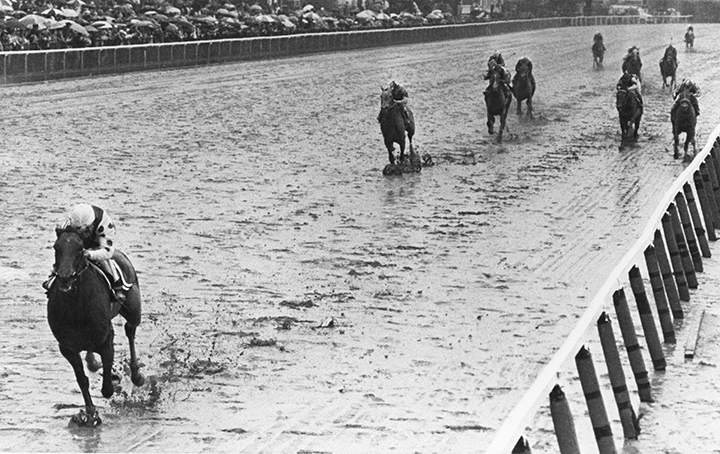
Eminency and Pass the Tab kept Maple company to the head of the Belmont stretch, at which point Conquistador Cielo pulled away to win by 7 1/4 lengths in a track record 1:33.
“I ate well that night,” Maple said. “But five days later it was hospital food.”
Maple suffered cracked ribs and a punctured lung when he went down the day before the Belmont. The next afternoon he was bedridden and watching Laffit Pincay ride Conquistador Cielo to a 14-length Belmont Stakes victory.
“Even hurt, I thought I could have won with him running like that,” Maple said. “Then I tried to move a little.”
Switching the Met to Belmont day in 2014 eliminated the possibility of another Conquistador Cielo coming along to try both races, although there was not much chance of it happening anyway.
It has been 23 years since a 3-year-old won the Met Mile (Honour and Glory), and 32 years since a 3-year-old vaulted from winning a Met Mile into the Belmont. That was horse Gulch, who finished fourth in the Derby, fifth in the Preakness, and won the Met before coming back 13 days later to finish a distant third to Bet Twice in the Belmont.
Sword Dancer parlayed victories the 1959 Met Mile and Belmont Stakes, with two weeks in between. It was Arts and Letters, however, who holds the modern distinction of running second in the 1969 Kentucky Derby and Preakness, winning the Met Mile on Memorial Day, then coming back eight days later to win the Belmont.
Do they make horses like that anymore? No, they do not. It’s hard to believe they ever did.