

Hovdey: In marveling at Bricks and Mortar, one can't ignore Exceller
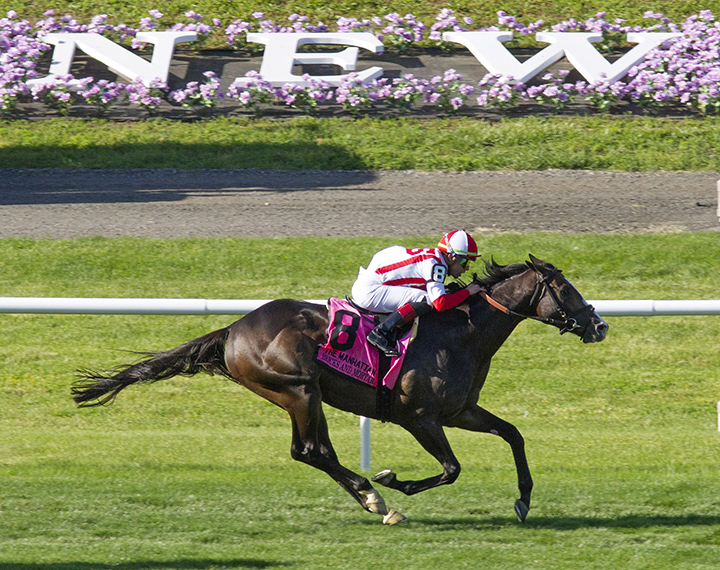
In trying to fathom why Bricks and Mortar has become the finest grass horse in the United States – perhaps the finest racehorse, period – students of pedigree will turn immediately to his sire, Giant’s Causeway, who won five Group 1 races in England and Ireland in 2000 and came within Tiznow’s neck of winning the Breeders’ Cup Classic in Kentucky. The experts also like the fact that Bricks and Mortar is inbred at only the third remove to Storm Bird, a fabulous runner and exceptional stallion who imparted both stamina and speed.
Then again, as Bricks and Mortar walked his beat in the Manhattan last Saturday at Belmont Park, winning his fourth significant turf race of the year, it was impossible not to imagine he was summoning the genetic fuel supplied by the maternal grandsire of his dam, Beyond the Waves.
His name was Exceller.
Just as any number of pro golfers walk around wearing the badge of best player without a major, or Ernie Banks went to his grave without a World Series ring, the shorthand reference to Exceller in the years following his retirement was Best Horse Ignored by the Eclipse Awards. There was good reason.
In 1978, the son of Vaguely Noble started 10 times. He won the San Juan Capistrano, Hollywood Invitational, Sunset Handicap, and Oak Tree Invitational on grass, all Grade 1 events. He defeated Vigors and J.O. Tobin in the Hollywood Gold Cup on the dirt and Seattle Slew and Affirmed in the Jockey Club Gold Cup in the mud. When the awards were announced, Affirmed was Horse of the Year, Seattle Slew was champion older male, and Mac Diarmida was champion turf horse.
Yes, the grapes are still sour, especially for those of us lucky enough to have watched Charlie Whittingham train and campaign Exceller with fearless confidence (he also carried 130 pounds to victory when that was still a thing). He retired in 1979, after an intercontinental career of 33 starts. At stud, it turned out that his 12-furlong pedigree had become unfashionable, providing no chance to taunt the Eclipse Award slight through his offspring. There was barely a flutter of acknowledgement when, in 1991, he took up stallion duties in that most vigorous of horse racing nations, Sweden.
From his 1985 crop of only 13 named foals, Exceller left behind the filly Excedent, who gave birth to Beyond the Waves in 1997. Bricks and Mortar, now age 5, was her seventh foal.
The same year Beyond the Waves was born, the Exceller story turned a sad corner when it was learned that he had been sent to a Swedish slaughterhouse. He was 24, but that was beside the point. His international following rose up in righteous indignation that such a grim fate could befall a Thoroughbred once so highly prized. The anti-slaughter movement in the U.S., in its infancy at the time, suddenly had a handsome, blaze-faced poster boy, and in 2001 the Exceller Fund was established as resource to fund efforts to rescue racehorses from slaughter, or to keep them from the pipeline at all.
Today, through the Thoroughbred Aftercare Alliance, there are 70 organizations across the country that serve the needs of retired racehorses. The Exceller Fund remains among them, one of the first accredited by the TAA, and still doing business through a broad network of foster farms. Exceller Fund executive director Nicole Smith has been with the organization since 2005.
“The good news is that there are a lot more organizations serving the aftercare needs of racehorses these days,” Smith said. “And that is very good news. For our founding members, that has been a huge star. But with so many organizations needing support, we do have a challenge to keep the message of our work out there.”
The Exceller Fund currently targets the support of racehorses who have cranked out upwards of 50 or 100 starts. There still are such creatures, such as Citizen John, a foal of 2005 who made 132 starts, or Mister Dish, a foal of 2007 who made 81 starts.
“We call them our racing warriors,” Smith said. “They’ve earned their retirement. If we can find them an adoptive home, that’s great. But a lot of them have so much wear and tear that adoption is not really an option.”
The Exceller Fund also helped bring Pete’s Fleet, a son of Alfeet Alex with 67 starts who was a refugee from the Puerto Rico hurricane, to safe harbor at a mainland foster home. In addition, several of the veterans supported by the Fund have found a second career in Oklahoma, serving the youth of the Tulsa Boys’ Home in equine therapy and companionship programs.
“We call it Operation Therapeutic Warrior,” Smith said. “These are some of our horses who will not be adopted or ridden, but who are evaluated and retrained for on-the-ground therapy. Pete’s Fleet just went there.”
There is no worse end to any Thoroughbred than a slaughterhouse, and Exceller represented just the high-profile tip of an iceberg that badly needs melting. But at least the grim memory of his fate has been overlayed by the work of the Exceller Fund, and by the blood legacy of a budding champion like Bricks and Mortar.
“You can believe we noticed Exceller in his pedigree from the start,” Smith said. “Every time he runs, our hearts are along for the ride.”