

Hovdey: Harper ready for his close-up at Eclipses
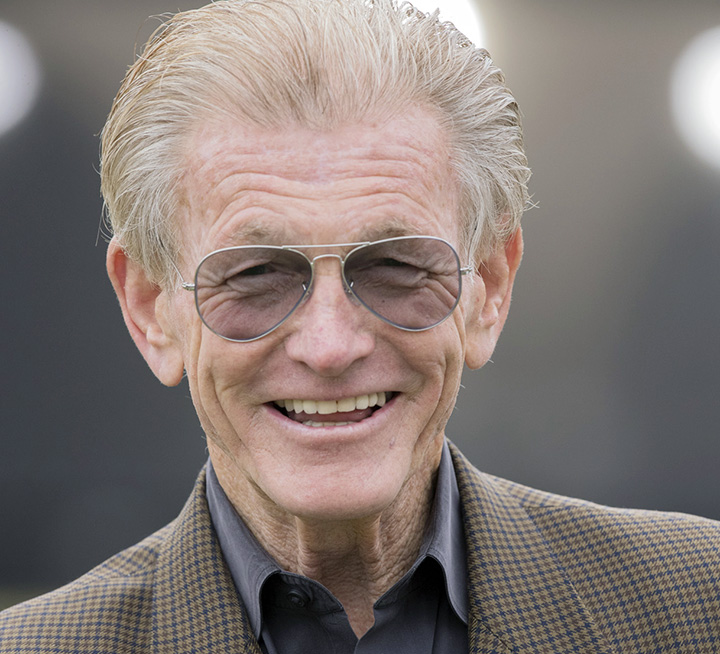
Do something well and do it long enough – say, 40 years or so – and someone’s bound to notice. Joe Harper, the wryly smiling face of Del Mar since 1978, finally gets to step out from behind all that distracting sunshine and sea air on Thursday night when he will become the 44th winner of the Eclipse Award of Merit.
The fact that Harper will be handed the statue at Gulfstream Park matters not. He has always been ecumenical in his approach to the national health of Thoroughbred racing, while fiercely parochial in his dedication to the gospel he has preached at Del Mar. Less is more. Entertainment is paramount. And no, we can’t take credit for the weather or the view, but we can exploit the hell out of nature’s gifts and the laid-back legacy inspired by Bing Crosby and his easy-living Hollywood friends.
A large part of the Del Mar success story is that it is still around at all, existing in the eye of an industry hurricane that swirls with relentless change. Thanks to winning a series of complex lease renewals from the state of California, the not-for-profit Del Mar Thoroughbred Club that Harper represents as CEO stands as an island of stability in a racetrack climate beset by the challenges of casino gaming, property development, and shareholder pressure.
Harper is hardly the first racetrack executive to be honored with the Award of Merit. There has been John D. Schapiro of Laurel, Robert P. Strub of Santa Anita, Richard Duchossois of Arlington Park, and Herman Cohen of Pimlico, among others. Frank Stronach, whose Stronach Group owns Gulfstream and Santa Anita, was honored last year.
Harper is, however, the only Award of Merit honoree to have been terrorized on camera by a tiger in “The Greatest Show on Earth,” winner of the 1952 Oscar for Best Picture and directed by his grandfather Cecil B. DeMille.
“And yes, it was a real tiger,” Harper will tell you. “CGI didn’t come around for a couple decades.”
Harper’s mother, Cecelia DeMille, was a patron of the arts and breeder of admirable Thoroughbreds. His father, Joseph Harper Sr., was head of studio finance, while his aunt Agnes DeMille was a legendary Broadway choreographer. Such a lineage would seem to provide a bounty of employment possibilities beyond the mail room at MGM, where he worked as a teen. But the young Harper found a mentor in film maker Joe Burnham, who would be bursting with pride and sarcastic asides were he around to witness Thursday night’s ceremony.
Burnham, who died in 1994, was the sport’s premier cinematographer in an era when the only stuff being shot at racetracks was stock newsreel footage from the top of the grandstand. Burnham used his camera in ways that provided breadth and depth to the players and the competition – a one-man NFL Films of horse racing. The hiring of Harper gave Burnham a second camera unit in telling his dramatic visual stories.
Burnham was a worldly aesthete who deployed a Mort Sahl level of sardonic wit to cut neither himself nor anyone else much slack. He also was a diehard romantic whose classic racing documentaries give life to an era that grows more golden with each passing year.
By happy coincidence, is was announced a few weeks ago that Burnham was being added to the Joe Hirsch Media Roll of Honor at the National Museum of Racing and Hall of Fame in Saratoga Springs. The convergence is not lost on Harper.
“He probably had the most influence on my life,” Harper said. “I felt comfortable at the track, but when I went to work for Joe his cynical humor and his view on the racing industry gave me a whole new outlook on our sport. He made me realize just how dear it is, what to look for in people, in horses, in life.”
Harper moved to track management in 1971 as executive assistant to Clement Hirsch of the Oak Tree Racing Association, but he still worked with Burnham when asked. In fact, Harper was at the first Eclipse Awards dinner in January of 1972 at the Waldorf Astoria in Manhattan.
“We were putting on the show, getting film and slides for the background,” Harper said.
There will be a pause while some readers Google “film” and “slides.”
Harper promises to keep his acceptance speech short and sweet Thursday night, and his wife, Del Mar’s first lady Barbara Harper, will be front row center to make sure. Still, if he spends more than a few minutes reviewing the highlights of a certain 40-year career, no one will fault his reminiscence. No modern racing executive has had a longer term of service and seen so much change.
“A number of years ago we kind of made the decision to do things like the concerts, the family fun days that were geared toward bringing people to the track that otherwise would have no reason to be there,” Harper said.
“And we want all of California racing to flourish,” he added. “We have to look out for everybody else. When Santa Anita had a great opening day nobody was happier than I was. California needs to build on days like that. It would be tough to be the only guy left standing, but we’re not going to be turning the lights out at Del Mar.”