

Harness: Silver lining develops following Northfield accident
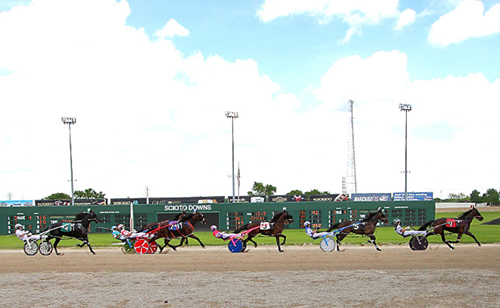
I woke up on January 2 to a social media post saying there had been a horrible wreck at Northfield Park and seven horses were euthanized. The dull throbbing pain at the base of my neck, the result of a fractured vertebrae from a harness racing wreck of my own back in 2004, became stronger as I searched for more information.
Fortunately, the post exaggerated the results, but there had indeed been a bad accident at the northeast Ohio track. I immediately considered dumping my New Year's Resolutions column to write a piece about the accident, but I decided to wait and see what might come of this tragedy. I am glad I waited.
There are several concerns that need to be addressed, but they can be distilled into three major issues. First and foremost is the safety of the horses and horsepeople. Second is fairness to the bettors. Third, but usually ignored, is informing the public.
Here is what happened on New Year's Day. A horse went down in the first turn creating havoc and (eventually) resulting in a loose horse going the wrong way on the track, heading into the remaining racing horses. When all was said and done, several drivers were injured, although only Ryan Stahl was hospitalized, and three horses, including outrider Nadine Habke's mount, Smoken Joe, had to be euthanized. A no-contest was declared and the last race on the card was canceled.
While we have far fewer catastrophic incidents than other racing breeds, they do happen, and we must be prepared for them. My thought has always been that there is no need to automatically cancel/declare a race "no contest" just because a horse goes down. I truly believe it is situational. For instance, if a horse is trailing the field and goes down at the three-quarter pole, he/she is not affecting the race.
Horses are pack animals. Sometimes, a loose horse will follow the pack, not interfering. In my opinion this is an area where the judges should have discretion. But a horse in the middle of the track where the horses will be coming through again (remember, Northfield is a half-mile oval), or a horse going the wrong way MUST result in an immediate declaration of no-contest, and the drivers must be notified to pull up safely.
(Column Aside: The first racehorse I owned, Jef's Rusty Ricky, choked down and died on the racetrack just 120 yards from his first career win, so I've been there, too).
I reached out to Northfield Park horseman's rep Amy Hollar, who suggested I contact OHHA Executive Director Renee Mancino. Not only did Renee provide a statement, but she offered up a draft of proposed procedures that have been presented to the Ohio State Racing Commission. The OHHA statement said:
"The Ohio State Racing Commission is engaged in a process to assess, review, and modernize our statewide safety protocols and procedures. After soliciting and receiving a significant number of comments from drivers, outriders, horsemen, judges, and really anyone concerned about safety and our equine athletes, we provided input. Ultimately, we are confident that the OSRC will develop a common sense 'best practices' standard that can be applied uniformly moving forward."
Mancino also provided the document the OHHA submitted, and the OHHA was very much in agreement with most of my opinions. They advocate establishing a three-light system for all racetracks. Currently, Northfield has red lights which are activated when there is a problem, but that issue could be anything from a loose horse, to a horse down, to a horse scoring in front of the gate. The OHHA suggested:
"With the three-light system the lights are always on when racing officials are there to operate them. The lights are green when there are no known issues on the racetrack. If there is something to be aware of and cautious about, but not a catastrophic "stop everything," the lights are moved to yellow by the Presiding Judge. If there is a "stop everything" in the case of a "no contest" as determined by the judges, they go red, and everyone knows that means, stop immediately and get off the track as quickly and safely as they can."
The document puts most of the power in the hands of the Presiding Judges, as it should, but provides a "handoff" of power if his view is obscured so a starter, paddock judge or even outrider could take charge if needed.
I was surprised to read this: "The suggestion was made repeatedly that any time there is an accident the race should be stopped. However, there was no clear consensus on this point (emphasis mine). There were suggestions around this concept that a black-letter rule could be put into place that always declared a "no contest" if the field of horses would have to pass an accident scene, horse, or driver down on the track while racing. If an accident occurred at the back of the field, or at a position on the racetrack where the horses would not be racing past them again, the suggestion is the no-contest would not be automatic and a race would remain under a yellow caution light unless determined otherwise by the Presiding Judge. In addition to the race being stopped as a "no contest," the suggestion was made in all races that are declared a "no contest," that the purse money be distributed evenly among the starters in the race."
The OHHA document also provides for establishing a protocol for determining when a driver can return to action after an incident. We can only hope that protocol is observed, unlike concussion protocols in so many major sports. Ryan Stahl is out of the hospital and recovering from broken ribs, but the other two drivers affected (Aaron Merriman and Eric Tharps) were back racing the next night.
At an Ohio State Racing Commission Safety Committee meeting on February 1, it was decided to investigate and move forward with a pilot program on the issues of the three-light system, a single-channel hands-free communication system for all racing officials on-site during racing and qualifying, and post-race accident protocol for drivers before they can return to racing.
"It is anticipated the next step from the main discussion points brought forward will be refinement and recommendation by an Ohio State Racing Commission Subcommittee. The subcommittee will refine, recommend policies, and rule changes related to the discussion points," said Mancino in a February 1 statement. "Anticipated roll-out pending refinement and rule revision is optimistic for the Eldorado Scioto Downs May 2022 meet, but not guaranteed. Eldorado has talked to their current warning light vendor, and they have said it is a simple process to add colors to the current warning lights placed around the racetrack and include controls to operate from the Judges' booth."
Two things not addressed by the OHHA document are the health of the horses and informing the public. We are being watched by animal rights activists who would shut us down if they could. The track attending veterinarian MUST have access to euthanasia drugs for the rare occasion when a horse must be put down. We cannot have injured horses standing around in pain for hours, waiting for a vet to show up with appropriate drugs, as we did on January 1. Most of these chemicals are controlled substances, which creates a problem for storage and access, but it is a problem that must be fixed.
The no-contest call protects the bettor, as it should be, but as I said, we are under the eyes of zealots who want to close us down. When there is no official announcement of an accident, it gives the appearance of a cover-up. Having said that, it was a holiday race card and it was a late race (14th of 15 scheduled). I can tell you the last thing track managers want to do at midnight is write a press release about horses dying. I've been there. But it is necessary to get accurate information out, even if there is a delay to get the facts straight. To my knowledge, while the OHHA and even the USTA have made statements, we have heard nothing from Northfield. Again, understandable, but not acceptable.
► Sign up for our FREE DRF Harness Digest Newsletter
Years ago when Barbaro had to be put down, Thistledown, our local Thoroughbred track, had a no comment. Northfield welcomed the TV reporters to discuss the issue and put our sport in the best light possible.
There are many issues and many potential answers, not all of them cut and dried, but let's hope that this horrible incident eventually leads to more discussion and safer racing for all. Now go cash. See you next month.