
Harness: Profile of Western Fair District's Greg Blanchard

What kind of car do you drive?
Dodge Journey.
Favorite dinner meal? Snack?
BBQ steak; shelled peanuts.
What is your favorite all-time track to visit? Why?
Probably Mohawk. I like the location and the layout of the track. It has always represented to me, top-level racing, same as The Meadowlands. As a spectators the views are fantastic. You are close to the action but it is also big track with great racing. It is the whole package.
Do you enjoy handicapping and betting?
Yes, but I don't play as much as I used to. I've always enjoyed the handicapping aspect of the game. It is fun to solve the puzzle and piece together information to get rewarded. I think it makes you a bit sharper when you try to analyze the races to find winners.
What is your favorite big event in racing?
Gold Cup & Saucer. I grew up there and maybe I'm biased, but it is the greatest spectacle of North American harness racing. To be there live with the crowd, and the pomp and pageantry of the night in the smallest province in Canada of Prince Edward Island. It is a unique experience.
As Director of Marketing, Sales and Communications for the Western Fair District, including Western Fair Raceway, how much of your time is spent on racing versus other projects?
Nowadays racing is just one area of my focus. I deal with sports center, show and events, an agro-business hub, the annual 10-day fair which is one of the largest in Canada, the weekend market, and a comedy club. There is a lot going on.
How did you get started in harness racing?
I started as a young kid going to the track with my father. He was more of a fan but he did own a cheap horse once in a while. I just caught the bug. At a young age it was a social thing to go to the track with my buddies. Over time we all became lifelong fans.
How did you get started on the business side of the sport?
I was always fascinated by track announcers. A lot of kids grow up and want to be a driver, and I was certainly interested in the driving and training aspect, but when I was 17 an opportunity came up to call the races at Summerside in Prince Edward Island. They called me and two days later I tried out for the job and got it. I spent nine years in that capacity. I always hoped to make a career in the game and I was able to. My breakthrough in the sport was when Steve Wolf offered me a job at Freehold in 1995. I spent three years there and that gave me a good foundation to work from and get me going in the industry.
What is your favorite sport to watch? Team?
After horse racing, hockey. Unfortunately my favorite team is the Toronto Maple Leafs.
What is one thing about you most fans/bettors don't know?
I used to host karaoke in my younger days.
What is one word that describes harness racing for you?
Thrilling -- I still get excited over big races or events. It doesn't have to be the best horses, it could be a big carryover or whatever.
Do you have a favorite horse from your time in the sport?
From my time in the sport Somebeachsomewhere. Prior to that as a kid it was Niatross.
What is the best advice you've ever gotten about harness racing?
To see both sides of the business. There are the horse people who are working side-by-side with the horses. Then there are the racetrack operators, administrators and people on the regulatory side. I got advice a while back to not to look at things all one way and to think in a holistic manner. It has served me well over the years.
What was your favorite moment in harness racing?
I worked for many years on the broadcast side and probably the highlight for me was to work twice on the CBS broadcast of the Hambletonian with Gary Siebel, who I always looked up to, and Dave Brower and the great team that is involved with that event.
What's the strangest thing to happen to you in harness racing?
This is going back many years to when I was a young announcer. I had the program page turned to the wrong race without knowing it. As the race started the horses weren't coming to me and I was struggling. So I looked down at the program and nothing was matching up. I kept throwing the wrong names out there for about half the race before I figured it out. I flipped the page over and continued to call the race with the proper horses for the final half. I always expected to get a lot of negative feedback but I never heard a comment about it. That was a lesson learned early from another announcer who told me if you ever get stuck in a race just keep talking and avoid any dead air.
You are like a Swiss Army knife, having worked in management, as a broadcaster, announcer, and handicapper. Did I leave anything out?
I've also worked as a mutual clerk and caretaker. That experience has served me well. I have at least some experience in almost every facet of the business. I realized quickly working as a caretaker, as much as I loved being around horses, there was more opportunity on the grandstand side. I still get out to the farms once in a while to see the horses firsthand.
Of the jobs above, what do you think you do best?
It might sound strange but I think I do them all competently. I've really worked hard on being diverse so I can work in the industry and do a lot of things.
Which of the above jobs do you enjoy the most?
What I really wanted to do was on the broadcast side. I've had the chance to do that for a number of years in some capacity. That's probably the thing that I am most proud of and enjoy the most.
You typically cover the North America Cup. Do you have a favorite NA Cup moment?
Definitely Somebeachsomewhere winning. The race itself was anticlimactic in that he went to the front and did what was expected. But that is exactly why it was so special. There was six months of hype and anticipation. To finally see it all come together and see the King crowned was something special. I think of the Jate Lobell-Frugal Gourmet NA Cup. I wasn't there in person, but when I watch that replay I get chills to this day.
Obviously COVID-19 has racing shut down in Canada right now. Do you have any insight on when it may return?
We are totally at the mercy of the government easing restrictions. Right now we are in a provincial lockdown and while we are in that state, racing is unable to operate. Initially it was supposed to be 28 days, but that is coming to an end and there have been no indications it will be lifted. I suspect it will last another month and I'm just hoping that sometime during that period we'll get indications that we can open. It is frustrating because I think we have clearly demonstrated in Ontario over this last summer that we can operate safely, and for an extended period of time. Many in the industry would argue we've been a leader when it comes to COVID protocols.
Where does Western Fair stand now in the landscape of Canadian racing? Do you see it being a mainstay for decades to come?
It is hard to predict that far out, but we hope and intend to be around. We've become more of a significant player in Canadian racing in recent years. We've risen to be the number-two track in Canadian wagering behind Mohawk Park. We have one of the largest number of racing dates with about 125 a year and the hope is to race more because of our significance both geographically and on the racing side. We are in Southwestern Ontario and provide a lot of opportunities for the people in this part of the province.
Handle for Western Fair has come a long way. Are you surprised by the rise in numbers? What do you attribute it to?
That is something I'm really proud of during my time at Western Fair. Prior to my joining the team we had some really good people in place that had the track heading in the right direction and handle had been creeping up a bit. When I joined the team in 2010, along with Ian Fleming, we were able to continue that trend over a number of years and steadily got to the point where we were one of the top wagering signature tracks in the province. Our new team, Greg Gangle and Rob Lumsden, have been able to carry that forward in the last couple of years as well. This last year it culminated in a record handle of $997,000 back in March on the final day before the COVID shutdown. So it was certainly disappointing to shut down on the heels of that. When we started back up last October, handle was up year-over-year and we had good momentum, so it was tremendously disappointing to shut down again.
I think we've been able to carve out a strong brand for ourselves in the racing landscape. I think we are seen as a horseplayer-friendly track. Tracks like Pompano, where Gabe (Prewitt) has done a tremendous job, Scioto, and Northfield, which has always been a leader in that regard. I've very proud that we've been able to get recognition on the North American stage and I think our handle has reflected that.
The Camluck Classic is the signature race at Western Fair. Can you talk about the past and future of the race?
The race has been around for a long time. It was known as the Labatt Invitational, then became the Molson Pace for a number of years and recently we changed it to the Camluck Classic to honor the great Camluck, who at the time was standing at Seelster Farms, which is about 20 minutes north of Western Fair. A lot of great horses have won the race over the years. The who's who of the older division typically makes a stop here. Foiled Again has won the race a couple of times. State Treasurer is a three-time champion. We are anxious to get it back. It is also a strong on-track event for us as the closing night of our meet. It was really disappointing that we couldn't conduct the event last year and we are looking forward to getting it back into the rotation.
Talk a bit about COSA TV. As host you helped launch the virtual show in 2020. Where do you see it going in 2021?
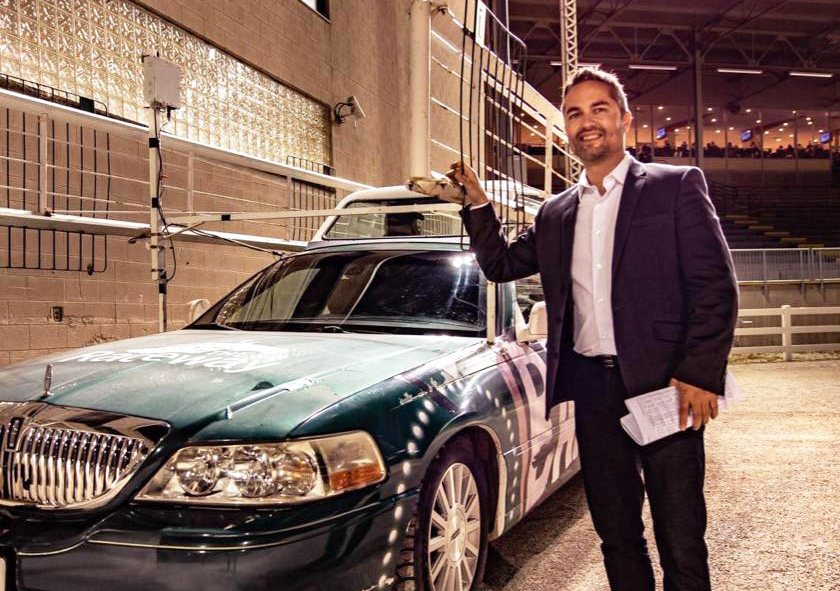
I have to give the credit to COSA (Central Ontario Standardbred Association). They have a marketing budget that had been tied up in trust for a number of years. Once it became available, they were mandated to spend it to market harness racing. They've done a lot of cool things, including the trailer wraps which are basically travelling billboards all over Ontario. COSA chatted with myself and Curtis MacDonald, who operates Cujo Entertainment. It was really just an idea to get some content out there at the time, but it has grown pretty quickly with virtual shows and live racing events during the season. In the last year and a half the brand has really grown. We filled a void last spring when all of North America was down and people in the harness industry were home with nothing to do and needed to get their fix with shows twice a week. We started up again with shows this year and we'll have a schedule of live events once the summer stakes season begins in Ontario. It is a great way to keep Ontario racing in the forefront on social media applications. It keeps us connected and potentially reaches out to a new audience. I have to give full credit to COSA for supporting it and seeing the benefits of it.
If you had the power to change one thing in the sport, what would it be?
Post-time drag. I've done it as a track operator to drive handle and it worked. At the same time as I could see results with handle, I didn't like the trend. I think tracks all over North America really got carried away with it. I'm happy to see that this topic is back on the radar and tracks have finally acknowledged it and are trying to respond, like Gulfstream, which has made an effort to go off on post. Yonkers went from no drag to probably longest drag to a more reasonable drag past post. We need the major tracks to take the lead. One track trying to send a statement by going on post is noble, but it will kill handle. That has been proven. We need a collective effort. I'd love to see a day when starting on post time didn't affect handle.
How do you view the future of harness racing?
I've always been an optimistic person, so I remain optimistic about the future of the sport. You have to be able to adapt and change to survive. Sometimes we live in a bubble and think we are the only industry going through different things, and we are not. Because things are changing so rapidly these days, industries have to find their way, and racing is no different. We need to realize that we are a niche sport, and there is nothing wrong with that. I think niche sports can survive and thrive. We are quick to criticize ourselves, but we've had a lot of good things happen in recent years. COVID showed us that as racing was poised to handle the situation and people were able to bet from home. Tracks have upgraded broadcast signals and productions. That's just one example where we were ready for a challenge when opportunity presented itself.
Time for the stretch drive:
Best Horse You Ever Saw?: Somebeachsomewhere.
Best Driver Ever?: John Campbell.
Best Trainer Ever?: Jimmy Takter.
Favorite TV Show?: Forensic Files
Trotters or Pacers?: Pacers, but I love both.