
Harness: Pesky pylons are always in the way
?q=100)
In harness racing, as well as just about every other facet of daily life, there are many problems. I've often pointed out that at the top of the list sits the lack of cooperation between just about all participants, which leads to a lack of clear focus as an industry. While this no doubt remains an unfortunate fact, coming in a close second in terms of issues facing the sport is a lack of consistency when it comes to rules.
Typically there is a triggering moment for most opinion columns and here it was the Camluck Classic at The Raceway at Western Fair District on May 30, along with a subsequent conversation about what occurred during the race. Let's examine the situation step by step through the stretch:
Ervin Hanover was on the lead and Brue Hanover was in the pocket. Western Fair doesn't have a passing lane, meaning that the only opportunity for James MacDonald to come up the inside with Brue Hanover was if Doug McNair, driving Ervin Hanover, provided a clear path. Here is where it gets a bit tricky. Exactly three pylons prior to the finish, there appears to be enough room for Brue Hanover to slip up the inside - maybe a few inches on either side of the horse's bike. Just after that pylon - without any clear visual contact between the bikes of the two combatants - both horses appear to shift inches to the left. This pattern continues for a few strides as they approached the second-to-last pylon when McNair clearly invades the space of MacDonald's horse, who raced well inside that pylon and jumped the one at the finish as he crossed the line just in front.
Ultimately, Brue Hanover was disqualified for racing inside two consecutive pylons. Technically that is 100% correct, but was he forced inside both pylons? Was there enough room for a long enough period of time for Brue Hanover to come up the inside?
I'm not a paid Judge, but I'd like to think that my 30 years in the sport, along with having watched hundreds of thousands of races, provides me great insight into what is fair and proper. Having examined the video from multiple angles using slow motion (and even a piece of tape on my screen to see how much horses moved side to side in the straightaway), I came away with some facts – there was room for one to two seconds of real time, Brue Hanover was clearly inside the invisible line between pylons two and three, and Ervin Hanover definitely drifted inside maybe as much as a foot between the second and third pylons before going straighter closer to the wire.
► Sign up for our FREE DRF Harness Digest Newsletter
The above facts may have you believe I think the disqualification was unjustified, but I don't. As we are dealing with horses and not machines, it is impossible to expect them to pace or trot an exact straight line. Additionally, there is no visual evidence that McNair did anything purposely or abruptly to impede the path of MacDonald. My reasoning falls in line with this rule that I found from AGCO (Alcohol and Gaming Commission of Ontario), and while it is more referring to a passing lane, I believe it applies in this situation.
Ontario 22.05.02.2: The lead horse in the homestretch shall maintain as straight a course as possible while allowing trailing horses full access to the extended inside lane, and Horses using the open stretch must first have complete clearance of the pylons.
To me, "as straight as possible" provides some leeway for a horse to move slightly left or right. Additionally, the term "complete clearance," which is very common to read in most jurisdictions, implies that there needs to be no doubt whether room exists for the complete maneuver.
While it isn't listed in any rules, I wish Judges would take into consideration what would happen if the hubrail still existed. Could that horse have done what it did if there was a rail and not pylons separated by 40 to 60 feet? If the answer is no and if the horse gained any advantage, that horse should be disqualified.
Somewhat ironically, Brue Hanover certainly appeared to cause interference to Chase H Hanover on the first turn when making a break. Driver Tyler Borth clearly had to take a hold of his horse due to the miscue. If the Judges deemed that enough of an infraction to place Brue Hanover behind Chase H Hanover, none of the stretch shenanigans would've mattered.
In what was clearly a long preamble to the point, let's circle back to the lack of consistency when it comes to the rules of the sport, specifically as it relates to pylon violations. I spent some time on Google searching for the pylon rules of most regions and came away with more than 2,000 words of regulations that I won't bore you with. Instead I asked Chat GPT to provide a summary in graph form and then checked it for accuracy while making a few updates. Below are the results:
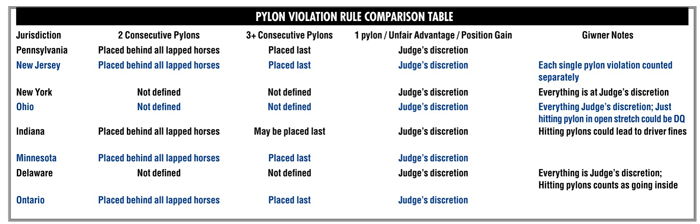
The only consistent rule across all eight jurisdictions is that when a horse goes inside just one pylon it is up to the Judges to decide whether the horse gained an unfair advantage. After that the waters get murky. New York, Ohio and Delaware leave everything up to the Judges to decide. With all due respect to them, that is way too much gray area. Pennsylvania, New Jersey, Minnesota and Ontario are all aligned and probably do the best job of having clearly defined rules. Indiana differs slightly in that running over three straight pylons doesn't mean you automatically get placed last. It is up to the Judges.
Notice in my notes that some regions count hitting the pylons as going inside while others require you to be completely inside to be found guilty. It's amazing that regions can't even agree where the invisible line you can't cross sits. That would be like having an NBA game in Indiana where the three-point line is 22 feet at the corners but in New York it is 21 feet, or maybe having NFL games in Minnesota where the field is 102 yards instead of the typical 100.
For what it's worth, the official USTA rulebook agrees with Pennsylvania, New Jersey, Minnesota and Ontario. Could it be that the other states don’t know that the USTA has a set of industry standards? Could it be that the Racing Commissions don't care? Maybe some of them feel strongly that they have the right way.
This all comes full circle back to the same point I mentioned above and have said 1,000 times – cooperation. If the governing bodies in each region can't work together to have one set of common rules that every track follows, how can it ever move forward to another level? How do you explain to someone playing tracks in multiple states that their horse made a legal move one place but the same maneuver is against the rules somewhere else?
I don't even have to agree with the rules. Just make them the same, so if a horse goes inside the pylons in Delaware we get the same final result as if it happens in New Jersey. Rant over!