
Harness: Natural speed doesn’t necessarily translate from track to track
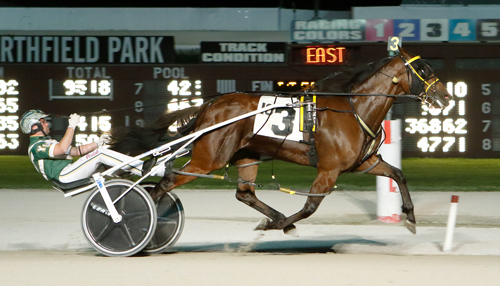
When you sit down to handicap a race, what factors do you consider? There are many angles from troubled trips, to driver and trainer changes, to hidden form, etc. Regardless of your preferred handicapping method, at some point pure speed has to come into play.
Simply put, a slow horse is going to have a hard time winning a race against faster competition. Of course there are mitigating factors which could lessen the speed discrepancy between two horses, including weather, track conditions and even track size, but often enough speed is king.
As high as natural speed is on the scale when measuring the ability of horses, there is a common misconception that larger tracks automatically produce more speed. This is 100% false!
Certainly someone is reading this right now thinking my statement above is insane. After all, the fastest pacing mile in history on a half-mile track is 1:47 3/5 (This Is The Plan -- Northfield -- 2021) while the slightly larger five-eighths track is 1:47 (Sweet Lou -- 2014 and Always B Miki -- 2016, both at Pocono) and the mile record is 1:46 (Always B Miki -- 2016 -- Red Mile and Lather Up -- 2019 -- Meadowlands). Clearly there is a natural progression here from each size track which proves that bigger tracks are faster, right? Well, not so fast!
Speed is not track-specific, it is horse-specific. Yes, some horses are faster on a mile track, but other horses only reach a certain speed regardless of track. There are many factors at play here: natural talent, ability to get around turns, gait, etc.
While it wasn't the initial plan when I started writing this column, This Is The Plan is the perfect horse to prove the theory. As stated, he owns the North American record as the fastest pacer in history over a half-mile track. That 1:47 3/5 time is also the fastest of his career by almost a full second despite his appearing upwards of 30 times (a third of his total starts) on mile tracks and many more on seven-eighths ovals. How is it possible that he can be faster on a half-mile track than a mile surface?
"That is probably accurate for This Is The Plan," said driver Yannick Gingras on whether some horses simply have a top speed regardless of track size. "He can go 27, 27, 27, 27 [quarter-mile times in seconds] or 26 4/5, 26 4/5 all day long. He can leave as fast as any horse, but he can't sustain that all day. Some other horses, like Always B Miki can go 26 all day, but he was a freak. Some horses can only go so many of those quarters in a row. They can go the 27 or 28 quarters all day long but they don't have the 26. They don't have the extreme speed that others have.
► Sign up for our FREE DRF Harness Digest Newsletter
"At The Meadowlands you have to go four quarters and not all horses can do it. They need a breather somewhere. At The Meadowlands it is go, go, go. On a five-eighths, usually the second quarter is slower and then you speed up the third quarter. On a half, from the quarter to the five-eighths, usually you get a good breather there. That is the biggest factor; some horses can handle going four quarters and some can't."
One of the greatest horses in history also owns a faster mark on a smaller track. Foiled Again, a 109-time winner in 331 career starts, set his lifetime mark of 1:48 at Pocono. Even his fastest beaten time of 1:47 1/5 was at Pocono.
"Foiled Again always ran out, so he never struggled on the turns," said Gingras about why Foiled Again paced quicker on the five-eighths.
Stepping away from the sport's elite, Galactic Galleon N is a 13-year-old son of Art Major that is 251 starts into his career. His lifetime best of 1:52 1/5 came as a 6-year-old at Yonkers Raceway despite having nearly 20 starts at The Meadowlands since arriving on these shores in 2015.
Another example is Barbados. His fastest time of 1:51 1/5 came at Harrah's Philadelphia. That is despite having almost 30 of his 110 starts at The Meadowlands.
Getting back to handicapping . . . it is way too common for someone to look at the past performances and assume that a horse moving from a half-mile track to a mile track will automatically improve one to four seconds. Going back to my younger years of 'capping I'd do it all the time. It's just logical to think that going around fewer turns and racing on longer straightaways will produce faster times.
Luckily, at least with older horses, there is usually an indicator in the program which can help you avoid getting fooled by times. Check out the lifetime mark of a horse moving to a mile or seven-eighths track from a smaller oval. If the horse is age 6 or older and the listed time is on a smaller track, it is somewhat likely that they are not going to get any faster this week. Of course it is possible they have never raced on a larger track, but that too is an indicator because it likely means that the connections don't think it will help the horses' chances of winning.
Similarly, there are some horses that will always pick up their game on a bigger track. They ship in to a track like The Meadowlands with somewhat sketchy PP lines and all of a sudden pop up with a huge mile. It is always good to keep records of these horses so you can take advantage when they arrive with bad form and win at a price. Or check out the DRF Harness Eye PPs since they include each horses' recent record at the track they are competing that day/night.
A horse that comes to mind is City Hall. Seemingly countless times he would show up at The Meadowlands off a dull line out of town and win. Looking back, five times he finished fifth or worse in his previous start and came to The Meadowlands to win. A number of other times he finished in-the-money and won the following start at The Big M. He loved it in East Rutherford!
So, the next time you cozy up to your favorite past performances and find a shipper that needs to be evaluated, ask yourself the question: Will THIS track make him faster? Then proceed accordingly.