

Harness: Keeping horses at the top of their game is no easy task
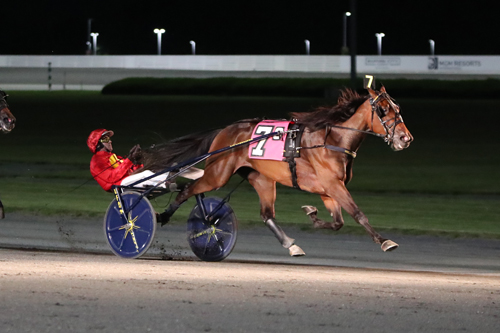
There was a moment after Joviality S had captured the Yonkers Trot this past Friday (July 1) when her trainer Marcus Melander revealed some of his thoughts leading up to the race.
"You know you have to be concerned about her racing three consecutive weeks," Melander said. "It was the second straight week racing over the half-mile track."
For Melander, who celebrated his 30th birthday on the night in style, it was candid conversation of what goes through the mind of even the most confident of trainers.
What if?
Joviality S beat the boys in the Yonkers Trot, but anyone who watched her three consecutive races on successive weeks saw the margin of victory shrink over time and reveal something that Melander perhaps had good reason to be concerned with as the year progresses. A 1:51 near-six-length victory in the Empire Breeders Classic at Vernon Downs on June 17 appeared to be well within the Chapter Seven-sired filly's capabilities. Even so, when Joviality S returned a week later at Yonkers for the eliminations to the Yonkers Trot, she was keyed up and shot to the front like a bullet to command. Driver Brian Sears was able to back her off nicely, and for a time, she appeared to be in a one-horse race. Yet, following a slow opening-half, Joviality S picked up the bit under some pressure down the backstretch and responded when called upon by Sears to roll to a decisive score.
In the Yonkers Trot final Sears was a bit more measured, gaining control of the race from post seven as runner-up Double Deceiver showed more initiative with the money riding for David Miller and took the lead on the first turn. Joviality S went faster fractions and scored in a Yonkers Trot record of 1:53 1/5, but the winning margin was just a length.
That Joviality S went off as the 1-5 favorite was not a surprise. That her trainer was concerned she would be as effective in her third straight week of racing, even in hindsight, is indicative of the stress and strain of any horse in this era needing to go at full speed three times in 21 days. Joviality S's 1:51 victory at Vernon Downs was extraordinary, but should bettors or trainers expect any horse to be able to sustain this form going as fast as needed for three consecutive weeks?
That's the feeling I got just one night later when a horse many, including myself, considered the best trotter in North America currently in training went behind the gate at the Meadowlands in the $147,000 Crawford Farms Trot. We're speaking specifically about the 1-10 favorite Ecurie D. One night earlier I spoke with his driver Ake Svanstedt about the October $1 million International Trot.
"He can get around the half-mile track fine," Svanstedt said while clearly looking a few months down the road for a major payday for last year's Breeders Crown champion.
So, when Ecurie D got control of the pace in the Crawford and marched around in what had to be pedestrian fractions on a night when horses were pacing in 1:46, and then got steamrolled by his stablemate Alrajah One, and then was passed late by Lovedbythemasses, a level of his invincibility was removed. That Ecurie D had not raced for more than a month didn't dissuade the public from sending him off as the 1-10 betting choice since he had already trotted a sub-1:50 mile this year in his 2022 debut in the Cutler.
With the benefit of hindsight, it could have been a tough first quarter that softened Ecurie D up or perhaps going too slowly during the middle-half, inviting a vicious sprint by the race winner to pull off the upset. Those excuses may be fair to ponder, but Ecurie D was also beaten out of the pocket late, something quite unimaginable to those who witnessed his 1:49 1/5 effort in the Cutler on May 21.
For the most part Svanstedt and Melander were in the same boat on different sides of the Hudson River. Svanstedt had raced Ecurie D sparingly since his arrival on these shores last year with success. His ability to prepare horses and have them sharp despite layoffs has been quite remarkable. Few questioned whether Ecurie D would be fit entering the Crawford and those bettors who thought he was a lock at 1-10 accepted the risk with complete confidence in the conditioner. At Yonkers, Melander wondered aloud if he might have chewed off more than necessary by putting his filly through three straight weeks of racing. He told me that she's kind of laid-back in training and just does what she needs to, then becomes a bit more aggressive once race day arrives. His obvious worry, not just after the Yonkers Trot but over the next few weeks, is to have her sharp yet not over-raced. That may be easier said than done considering next Saturday's (July 16) Del Miller Memorial may prove a tougher contest than her meeting the boys in the Yonkers Trot.
► Sign up for our FREE DRF Harness Digest Newsletter
As far as a decision on whether to race Joviality S in the Hambletonian against the boys, Melander remained cautious.
"Let's see how the colts race over the next few weeks," Melander said. "I don't have a colt that's better than her."
That last statement may be an indication still, with races like the Zweig on Saturday (July 9) and then the Dancer Memorial (July 16) at the Meadowlands, there's an excellent chance one or more colts may arise with an air of superiority.
While trotting trainers must be wary of timing and use, bettors should also pay close attention to the stress and strain these horses must have to go through week-in and week-out while considering there's always the possibility of a sub-par performance no matter how the public sees it.
"He's the best right now," said Noel Daley following Pebble Beach's victory in the North America Cup last month.
It was that quote that struck a nerve in that it suggested Daley, much like many other trainers in North America, recognizes the stress and strain of maintaining an edge over the course of months of traveling and racing. He pointed Pebble Beach for the North America Cup, and the plan worked out splendidly in the end. The rest of the road for 3-year-old pacing colts and geldings could prove rather bumpy, but Daley already knows his job won't be easy, especially when races will go in the 1:47-1:48 range on most occasions.
It's a new era for both trotters and pacers, with few easy spots when racing on the Grand Circuit. Keeping a horse healthy is always important but managing to get them to race at top speed for more than two consecutive weeks is a new challenge. Even not racing a horse poses concerns when up against battle-tested horses that can take the sting out of any foe.
In the past 1-10 odds generally meant a horse could not lose.
Not anymore.