

Harness: Ins and outs of the newly banked turns at The Meadowlands
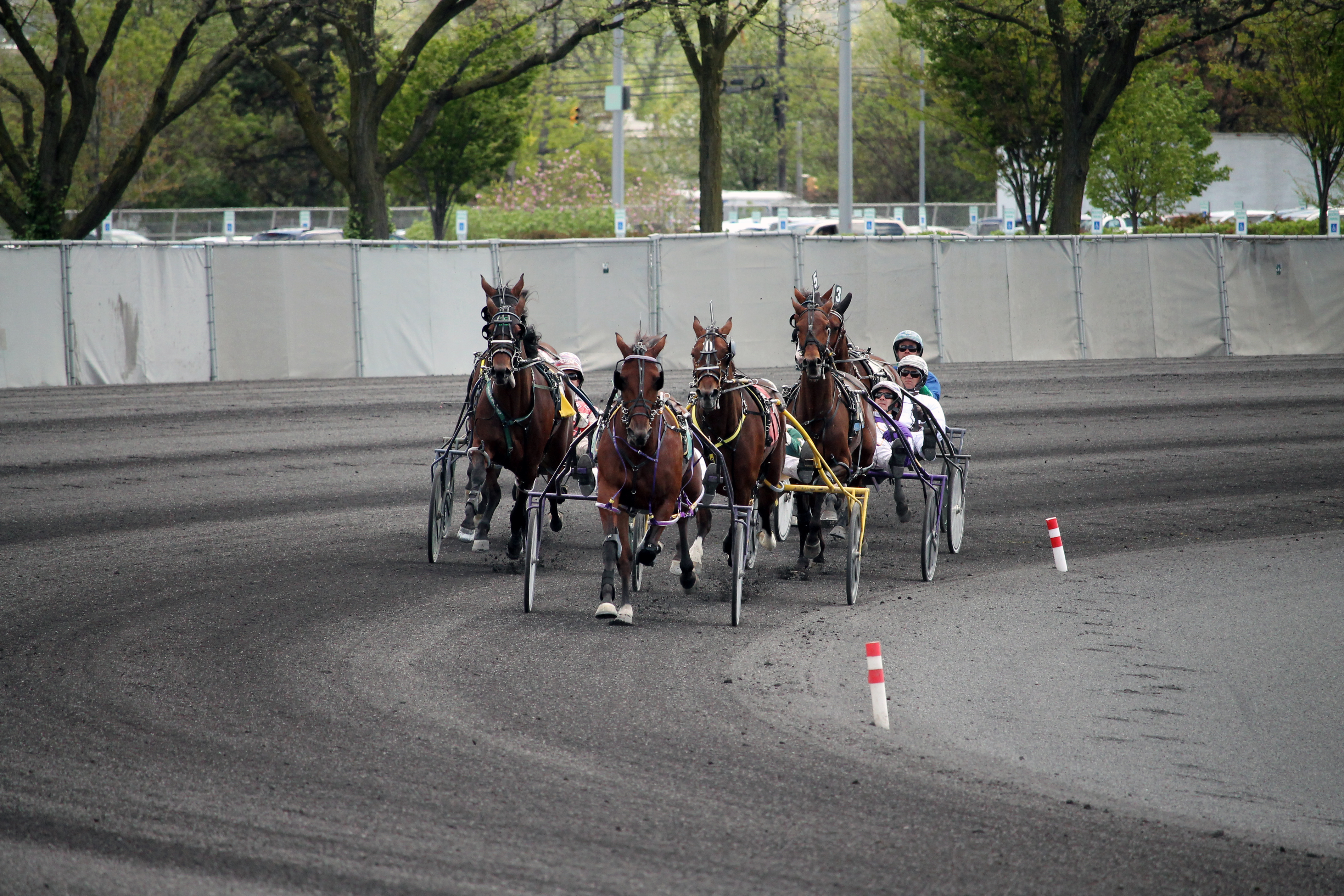
When The Meadowlands announced on Monday (8/12) that it would be increasing the bank on the turns in order to promote more competitive racing, it sparked some interesting debate as to whether the adjusted surface would make an impact.
Before diving into the potential positives and negatives of steeper turns at The Meadowlands, let’s review a bit of history. During the fall months of 2011, track officials began to bank the turns after a decade of a flatter surface to accommodate Thoroughbred racing over the New Jersey track. A 10 percent bank (about 6 degrees) was incorporated to produce a downhill effect to allow horses from second- and third-over to maintain momentum while racing off the inside portion of the track.
Here is where it gets tricky as the differences between percentages and degrees can make the head of any non-mathematician spin.
According to Meadowlands Director of Racing Properties and Track Ryan Napierala, the original banking will increase to between 10 and 12 degrees when harness racing resumes at The Meadowlands on October 11.
Of course, due to weather issues on the east coast, the amount of banking can fluctuate as the track is cleared of snow or storms with wind and rain play havoc on the surface.
“The whole turn itself is up one-and-a-half to two feet,” said Napierala, who said the process started the Monday after Hambletonian Day on August 5. “On a normal month you would spread about 15 loads of material. In the past four days we’ve spread 120 loads, mostly just in the turns.
“To the public you may not see the difference because they are not on the track, but if you stand down where the pylons are on the turn and then look up, there is a huge difference.”
Even at the new 10 to 12 degree incline (Napierala has yet to measure the new banking), The Meadowlands will come in well short of the 15.7 average in Sweden or 17.5 bank at Solvalla where the Elitloppet is held. That is assuming those numbers are in degrees and not percent, as a 17.5% incline, which is what officials at Solvalla state is the banking on the turns, is only 10.02 degrees.
The one fact everyone agrees upon is that the banking at Solvalla far exceeds where The Meadowlands was during the previous meet, likely by about a 2 to 1 ratio, which will be partially reduced by the revised banking being fine-tuned at this moment.
While the banking change at The Meadowlands seems tiny from the perspective of hard numbers, the increase in terms of percentages should produce a 25-50 percent greater incline on the turns.
One of the main proponents of banking the turns is five-time Meadowlands leading driver Yannick Gingras, who said all of the regular drivers were on board with the decision, but he would have preferred a more drastic bank.
“If you increase the banking by 1-3 percent, it will make zero difference,” said Gingras. “If you look at the tracks in Europe versus the tracks in New Jersey, it is a huge difference. I’m not saying you can go to the European bank because it is a mile track versus a five-eighths, but we need to make a big difference.
“I’ve raced horses (in Europe) parked the whole mile, or a mile and a half, and the horses don’t feel it. The difference is huge. It isn’t that big of a deal being on the outside over there.”
To his credit, Napierala admits that the process of banking the track will require some trial and error. Additionally, the current banking is far from set in stone. If after a period of time a greater incline is required to produce the desired results, he’ll get to work on it.
“You have to do it gradually. I don’t see why you would jump right to 17 or 18,” said Napierala, who added that it would take months to get the track to that number. “Right now it is at about 10 to 12 and in the next year or two we can get it to 14 or 15, or whatever amount works best.
“We are hoping that it will help the second-over horses get a decent trip. A lot of the drivers have said they don’t like coming three-wide in the last turn. If they can keep their speed better, maybe they won’t mind coming wide on the turn.”
After a quick Google review of high school science and mathematics, the key to the banked turns appear to involve inertia. In layman’s terms, the tendency of an object is to keep moving in a straight line unless another force acts upon that object. So when a horse leaves the backstretch and enters the turn, the laws of science say that going straight is more natural, but when the turns are banked, there is a downward force pulling them inward, thus making it easier for outside horses to maintain momentum.
“Think about Nascar, it is the aero-dynamic part of it. If you go on the flat turns and try to go wide you lose ground and momentum. If you have banked turns, you can gain speed. You can be on the outside and keep your momentum,” said Gingras.
Comparing harness racing to Nascar makes sense because obviously we both go around in circles. Interestingly, one of the flattest tracks in Nascar is the New Hampshire Motor Speedway with a 7-degree banking. On the other end of the spectrum is Bristol Motor Speedway with a 36-degree incline.
Unlike at many Nascar tracks, the banking at standardbred tracks is hardly visible to the eyes and according to Gingras, not very noticeable during the races.
“You don’t really feel it on the track racing-wise. But if after the post parade you want to turn a horse, like at Solvalla you have to wait until the straightaways to turn them because on the turn you feel like you are going to fall out of the bike, that is how banked they are’” said Gingras.
Since horses never swing more than four or five wide on the turns, the banking only goes out a certain distance. The first 35 to 40 feet would be at the desired 10- to 12-degree banking but that will level to a lesser number at the crown and then fall off on the far side with a dipping effect.
Throwing a curve into the banking situation is the track hosting a Motorcycle event over the surface a couple of weeks before opening day of the Fall meet. That means much of the work being completed now could immediately be undone in a matter of a few hours. That said, Napierala believes that he’ll have the track back to the desired level and in racing shape in plenty of time.
It is worth noting that since horses no longer train over the surface on a regular basis, the track could be very loose during the opening sessions as it takes time to set. When the banking was last completed in 2011, three qualifying sessions were held in the first week prior to the first live card on January 6, 2012. Even with that hoof-pounded packing of the track, the results were unpredictable, which adds to the handicapping puzzle. Nine of the 25 races were won by the horse leading at three-quarters while eight races were won by horses sitting fifth or further back at that call.
One of the benefits of banking the turns is that it is better for the horses according to Veterinarian and Novelist Sid Gustafson, who chimed in to the conversation via Twitter.
“It is easier on their legs. Less stress due to the minimization of untoward torque on the moving legs and joints,” said Gustafson.
Regardless of the results at The Meadowlands from the increased banking, there doesn’t seem to be any downside to the experiment. Yes, standardbred racing is a speed game where horses that make the front can carry their speed further than ever before, but there is no harm in attempting to find ways to level the playing field for horses coming from off the pace.
Gingras felt that other feasible ideas included making the track deeper to tire-out horses which are used hard early in the mile and using a slanted starting gate to help horses with outside posts get into the race at the onset.
“These are just some of the ideas we’ve (the drivers) had, but I’m sure there are other good ones out there,” said Gingras.
We will have to wait a couple of months to see if the new banking has any effect on the racing at The Meadowlands, but let’s at least give track management credit for trying to deliver the best product possible to the racing public.