

Harness: Barefoot on the track
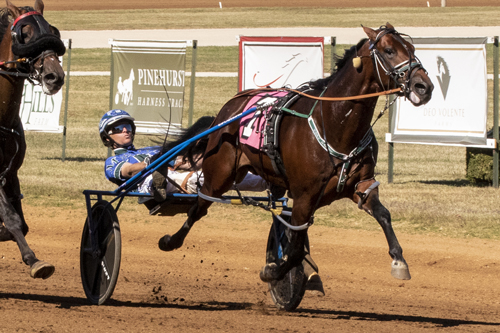
No hoof, no horse. We don't know who said it first, but every horseman, racing fan and gambler has heard it dozens of times. Or maybe the incorrect variation, no foot, no horse. Nobody disagrees with the concept.
Secretariat, arguably the greatest race horse of any breed, had to be put down after being diagnosed with laminitis, a debilitating, incurable condition that affects the soft tissue of the hoof. But how do we protect the hoof?
You're saying, "With horseshoes, you imbecile." But that isn't necessarily so. In the old days, heavy steel shoes were the norm. Then we went to aluminum and even to plastic. The shoe used in the 1950s had as much in common with the shoes used today as a Converse Fred Taylor has to a Nike Air Jordan. As horsemen looked to balance their horses, adding toe weights, grabs, trailers, and generally making the shoe look like a geometry project gone badly, they actually often did more damage to the foot than they would have if they did nothing. Hooves were trimmed to unnatural lengths and at awkward angles in order to improve the horse's gait. As the breed got better, the shoes got lighter. And there is nothing lighter than racing barefoot.
Column Aside: Did you know there is an International Horseshoeing Hall of Fame? It's located on the second floor of the Kentucky Derby Museum, adjacent to Churchill Downs. (Don't confuse it with the National Horseshoe Museum, which is in Wentzville, Missouri, and deals with ringers and leaners, not shoes on hooves). As part of the just concluded International Hoof Care Summit in Cincinnati, Ohio, five farriers and one vet were inducted into the Kentucky-based hall.
But barefoot racing? That has to tear up the foot, not help it, right? Especially at year-round raceways, especially those with hard surfaces like Northfield Park. That's true. An informal survey of Northfield trainers failed to turn up anyone who was racing barefoot right now. But if the surface is right, barefoot makes a lot of sense.
"Unless a horse has an issue with his hooves, a quarter crack or something, most of them will race better barefoot," explained the sport's perennial top trainer Ron Burke. "Most horses are fine. It depends on the surface, but even a hard track like Northfield, in certain situations. I think it excites them a bit and they push themselves a little more. They grip the track better because they are landing on their whole foot, not just a metal rim."
Burke raced the World Champion trotter Atlanta barefoot just once, and that resulted in a world record effort.
"I felt she might need an edge to get the record. I've raced probably over a hundred horses barefoot, easily, but it's a decision I make - I won't leave that to an assistant trainer," he continued. "Sometimes it's based on training or gait; other times it's a spur of the moment thing."
Northfield Park trainer and farrier Nick Clegg is not a big fan of the practice, saying, "It's fine at Lexington or Pocono or Delaware. On a hard track, a trotter will go cleaner, but eventually they are going to tear up the hoof. They pull the shoes when they are in the paddock, and the next day I am trying to nail them back on to nothing. I have to spend two hours rebuilding the hoof. If you do it all the time, eventually the horse is going to need to miss a week."
► Sign up for our FREE DRF Harness Digest Newsletter
As the Equine Podiatry Association points out (Yes, Virginia, there really is an Equine Podiatry Association. No word on whether they have a Hall of Fame), "The development and formation of the hoof have been studied by scientists in detail, and it was found that hoof defects are rarely congenital. Horses rarely experience hoof problems in nature, as they have strong hoof horns, thick soles, and an extremely well-developed hoof pad."
Horses who race barefoot get more flexion in their feet. They hit the ground more naturally, relieving stress on the foot. Shoes reduce blood flow by contracting the foot, making foot problems more likely. More and more Thoroughbred trainers are keeping the shoes off their young horses, and it is a popular practice among European trotters. As we see more and more European horsemen and horses make their mark here, the practice seems to be growing more and more popular.
Although "farrier" is defined as "A blacksmith who specializes in shoeing horses," many farriers are no longer truly blacksmiths since they are working with materials that are not fired. This is clearly true with the barefoot racehorse. And yet, the farrier is perhaps even more important to these horses than those that are shod. The hoof must be trimmed to the proper length and angle. A trotter will normally carry a 3 1/2 inch toe and a 48-degree angle in front, and a 3 1/4 inch toe and 54-degree angle in his hind feet. An ideal pacer would wear a 3 1/4 inch toe and 50-degree angle in front, with a 3 1/8-inch toe and 54-degree angle behind. But there is no such thing as an ideal pacer or normal trotter, so the farrier, in collaboration with the trainer, must determine if the gait needs to be adjusted with a longer toe, or perhaps a different angle. This is why it seems we see so many barefoot Standardbreds, generally trotters, coming from barns where the trainer does at least some of their own shoeing.
Fifteen of the sixteen starters in last month's Prix d'Amerique were barefoot. Among other notable barefoot horses in our sport (Although I must mention Barefoot Hanover, who won a 1989 Jug elimination and was second in the final behind Goalie Jeff for Dave Rankin, while earning over half a million dollars. But he DID wear shoes) are 2021 Hambletonian winner Captain Corey and (it seems like) nearly every horse in the Ake Svanstedt stable. Credit Winner and the great Sebastian K also raced shoeless. It's not as common on the pacing side, but in 2016 Western Fame won a Jug elim with no front shoes.
"I don't think it helps a pacer as much, although when I've done it I've always been happy with the result," said Burke. "I think it especially helps a horse who cross-fires or hits a knee. It gets him off of that, and if he does hit himself, he's hitting with the hoof instead of a hunk of metal."
As the science of hoof structure becomes more established (keep in mind it did not exist in the 50s), we may see continued advances. And if track surfaces continue to improve, we may see more and more horses racing barefoot. But don't worry. It won't put the farriers out of business.
That's it for this month. Now cash. On a barefooted trotter, or even a pacer. See you next month.