

Handicapping the Kentucky Oaks using TimeformUS's Pace Projector
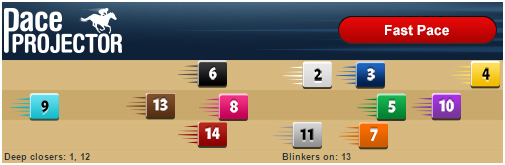
How does the Projector work? The TimeformUS Pace Projector attempts to predict how a race will unfold early. It displays the horses ranked by the TimeformUS Early Speed Rating -- fastest in the front, slowest in the rear. The image shows where the horses are projected to be after the first half-mile of a route race. The front is displayed to the right. It also attempts to determine if the pace of the race is likely to be fast, average, or slow for the field.
What is the Pace Projector saying about this particular race? This race is likely to have a fast pace according to the Pace Projector. This is based on the number of horses with a preference for racing on or near the lead and how closely those horses are rated on the aforementioned early speed rating. Of the 14 horses drawn into the main field, nine have been designated with TimeformUS Running Styles of Leader, Speed, or Tracker. Paradise Woods (#4) is the 5-2 morning line favorite and also expected to lead the field early. She won the Grade 1 Santa Anita Oaks in wire-to-wire fashion last out in her first try around two turns. Her closest challenger should be Miss Sky Warrior (#10). She has won five races in a row, including four grades stakes races, and has won both of her two-turn races in wire-to-wire fashion.
Are there any quirks to this particular distance or surface or field size that the algorithm adjusts for? The large field size is taken into account by the Pace Projector when assessing if the pace is likely to be fast, average, or slow. It is definitely part of the reason the “Fast Pace” designation is displayed. Abel Tasman (#13) is adding blinkers and though she still isn’t predicted to be part of the early pace, she is shown closer to the leader than she otherwise would be if not adding blinkers. All of the horses have been running primarily on dirt so surface isn’t much of a factor.

Based on a more nuanced, granular look at the PPs from watching the races, knowing the jockeys and trainers tendencies, etc., which horses do you think are likely to show more or less early speed than in this Projector? Lockdown (#2) could be closer than predicted. She drew inside, has shown good tactical speed in all her starts, and the rider probably won’t want to get shuffled back too far. The rest look solid with the given data.
Does any horse stand out as exceptional on TimeformUS Late Pace Figures, if the pace turns out to be hot? Abel Tasman is the top-rated late pace horse with a 106. Ever So Clever (#1) and Daddys Lil Darling (#12) are next with 103 and 101, respectively. Neither of those horses is actually displayed on the Pace Projector. They are predicted to be too far behind early and are noted as “Deep Closers.” Abel Tasman not only has the best late pace rating, she is faster than the other later runners early and has better TimeformUS Speed Figures, too. She would be the one most likely to capitalize on a fast pace.
How have recent Kentucky Oaks developed from a pace standpoint? TimeformUS has designated four of the last eight Oaks as having been run at a fast clip early. None have been flagged as slow early. The race is not going to be stolen by a filly going slow or even moderate fractions early.
In those last eight editions, three winners were second after the opening quarter-mile and three more sat within striking position in fourth. The two winners from well off the pace both benefited from good setups in races that featured a fast pace. These are designated in the TimeformUS Past Performances by coding the pace figures and fractions in red.