

Goldfeder: What Was I Thinking - Travers Day
The Saratoga meet has been a series of starts and stops for me. I started off slow, made a nice move to come back, and then was called out of town regarding a family matter. I returned home after a five-day layoff, and it took me about a week to get my rhythm back. Then I had to leave town again for business. This time upon my return, I did not find my mojo. I was handicapping and wagering based more on memory than from solid preparation. The breaks had broken my rhythm, and I began to press. Going into Travers weekend, I found myself on a mini losing streak. I had to get the mojo back.
I did a lot of things right to set myself up for a winning day but just enough wrong to prevent me from making a score.
I waited for the stakes races before making my first wager. The all-stakes pick four looked pretty chalky on paper, but with two to three standouts it would only take one or two mild upsets to give the play value as a lot of the money would lean heavily on the favorites. With a little creativity, it would be possible to make something out this pick four.
Race 8
Contenders: A’s
(11) Runhappy (11-1): Races had been freakishly good, including his much talked about maiden win. Well posted on the outside, he was a clear overlay. If he ran his race without getting caught in a speed duel, he had the look of a player. Low-profile connections a big help to the odds.
(3) Competitive Edge (9-2): Opened career with four straight impressive wins before disappointing in the Woody Stephens at odds of 1-2. Given the previous efforts, I was willing to forgive that race since he came back and ran respectably against American Pharoah in the Haskell at a distance that was likely too far for him. Now back at his preferred distance, 9-2 seemed a fair price.
(7) Holy Boss (5-2): Coming off a sharp win in the Amsterdam, he was the now horse in this field. Given the recent form and the fact that it was second off a layoff, he was a must use in the exotics.
Contenders: B’s
(2) Grand Bili (10-1): Improved dramatically in previous two starts. After some time off, he seemed to working well and if he was able to reproduce either of those two previous efforts would be capable of taking this race at a good price.
(4) Watershed (7-2): Impressive well-bred maiden winner moving up in class for a good barn. A lot to ask at a short price. Best chance would be if the race broke down where he could pick up the pieces. I really did not like the horse in this spot and used defensively. In retrospect, I shouldn’t have used him, but with the money he was taking, if something happened to the big-time favorites, I wanted to get paid. Greedy play – not a wise choice.
(5) Mr Z (9-1): Danced every dance and always tried. Although not that reliable when it came to winning, the cutback to seven furlongs seemed to suit him. Pace factor for sure, and the odds made him easy to include on the ticket.
(8) Classy Class (23-1): I’ve always been something of a fan of this horse and did not want him to beat me. Two of his best races had come sprinting, and although unlikely, was not impossible.
In retrospect, the 4 and 8 should have been used as C’s at best.
Race 9
Contenders: A’s
(1) Private Zone (3-1 ML): One of my favorite horses, he always shows up. In a race where he looked like the speed if he got loose, he wasn’t going to be caught. Sharp works coming into the race were a plus.
(5) The Big Beast (5-2 ML): Coming off a contested loss to top division contender Rock Fall, this 4-year-old looked to be coming into his own. Clearly talented and owned two wins over the surface. Only question was how much did the previous race take out of him.
(10) Salutos Amigos (6-1 ML): Reliable veteran who possessed the best closing kick if a speed duel were to develop. Didn’t seem to be on many people’s radar, despite the high figs he’d been running. I felt he merited respect.
Contenders: B’s
(1) Race Day (6-1 ML): Although not an accomplished sprinter, the cutback from a mile to seven furlongs was intriguing. He had tactical speed and the rail, which meant he would likely try to stalk. He figured to get a good trip.
(3) Bourbon Courage (12-1 ML): Second time for Graham Motion, this 6-year-old seemed a good value at what promised to be long odds. Had back class and races sprinting, which made him a candidate to pick up the pieces given the right trip.
(6) Tamarkuz (5-1 ML): Winner of the Godolphin Mile for white-hot McLaughlin barn cutting back to seven furlongs after a poor break in U.S. debut in Met Mile. Seemed a logical contender.
Race 10
Contenders: A’s
(2) Flintshire (8-5 ML): Ranked as the seventh best horse in the world and laid over the field on paper. In his only North American start, he lost a tough decision in the Breeders’ Cup Turf to a fast-closing Main Sequence. Far and away, the horse to beat.
Contenders: C’s
(1) Imagining (8-1 ML): With tactical speed and sporting wins over the track and at the distance, he is an alternative at a good price in the event the favorite does not show up.
(5) Twilight Eclipse (7-2 ML): This 6-year-old gelding may not get to the winner’s circle as often as he should, but he always shows up. A game competitor who could handle the class and distance.
(6) Messi (10-1 ML): Visually impressive in both U.S. starts for Graham Motion. Light on figures, but seemed to have upside. If the 10-1 odds reflected what we’d get in the exotics, he is worth including as a C in the event he freaks and moves up enough to upset the apple cart.
Race 11
Contenders: A’s
(2) American Pharoah (1-5 ML): Triple Crown winner has done nothing wrong since losing his first start. Has made more money than the rest of the field combined. Horse of the Year in waiting. Only question would be how he would handle two cross country trips within the last month.
Contenders: C’s
(1) Upstart (15-1 ML): A top Triple Crown contender throughout the spring, he seems distance challenged, but if the pace is slow enough it might help him pull the upset at a big price
(4) Texas Red (5-1 ML): BC Juvenile winner finally gets his chance to face the Triple Crown winner. Showed tactical speed in prep for this and poses main threat.
(6) Frosted (6-1 ML): Solid 3-year-old takes another shot at the champ. Pedigree to get the distance, and the ability to press the pace make him dangerous. Second off a layoff and third start over the surface, he should be ready to fire his best shot.
The Play:
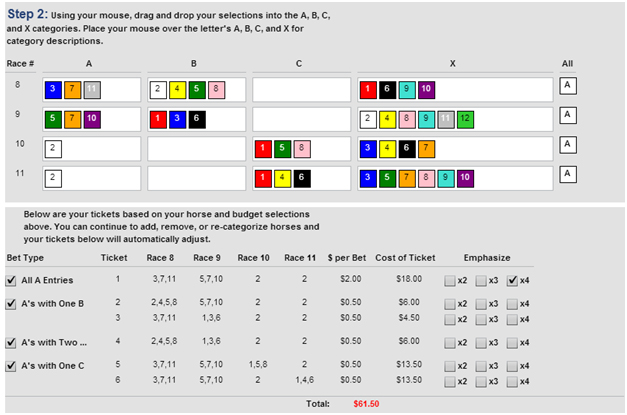
In addition, I had a straight 11/7/2/2 for 50 cents, making the total cost of the ticket $62.
When the 11 horse won the first leg, I was feeling pretty good about my ticket. What I wasn’t feeling good about was not betting him to win at 11-1. That misplay could be chalked up to the mini slump I was in, which caused me to pull back and play more conservatively.
After Private Zone did his thing, I felt if I got past the Flintshire race I would be okay. After all, what I really was trying to do was to get some value out of betting American Pharoah. When Flintshire won, I felt good. I was live for $2.50 to American Pharoah and 50 cents to Upstart, Frosted, and Texas Red.
No need to go over the Travers. I was upset when Keen Ice won, but I had to go back and ask myself where I went wrong, so I looked at my notes. The mistake I made was obvious. I didn’t really handicap the Travers. I looked at the horses I liked and just put them on the ticket. It was one of the few races on the card for which I did not bother to create an odds line. When I went back and calculated the factors I use in making my line, Keen Ice was a co-second choice, which meant he should have been a no-brainer C. I drank the Kool-Aid and choked on the hype.
Don’t get me wrong, American Pharoah ran an excellent race, but when trying to cover the bases with C’s, you need to follow through and not take anything for granted. More often than not, you are not going to beat a super horse, but when you try if you do your homework completely you won’t be asking yourself, “What was I thinking.”
After the feature race, my day was not done. In fact, based on my history on big days like this, I shouldn’t even think of playing until after the main event has been run.
Race 13
(1) Foxhall Drive (9-1): In his last two efforts, including one over this course, he was forwardly placed and game late not giving in and quitting when he could have. In this race, he figured to get a good trip, and if the fractions were not too taxing, I felt he had a great shot at a win.
(3) Ode to the Hunt (7-2): Class dropper coming off a long layoff for Rick Violette. If he could run back to the numbers he ran before the break, he would be a serious contender.
(7) Oklahoma Den (5-1): A plodder with back numbers that potentially would crush this field. Although he seemed pace challenged, he looked like a good exotic use.
(12) Jax Heritage (5-2): Lightly raced with good Beyer Speed Figures, he looked like the horse to beat on paper. A closer look showed him as probably being rated and therefore somewhat pace compromised while breaking from a tough post.
(6) Memories of Peter (5-1): I had been chasing this horse since his second start when he ran a good second at Aqueduct in November 2014. In his last two races, including his maiden win, he was more forwardly placed, and that involvement made him a player. He fit well in this spot.
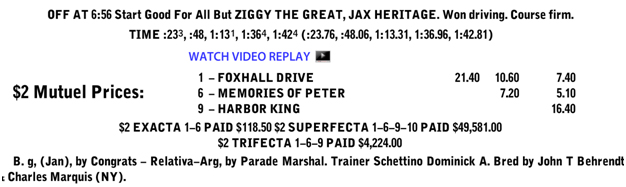
Foxhall Drive took no money and went off at 9-1. Given the open nature of the race, I bet him to win and place and then hooked him up in exactas with the 3-6-7-12. I also put together trifecta plays, and this is where I made what was probably the biggest mistake of my day.
I typed in this ticket:
50-cent trifecta: 1/3-6-7-12/All
Cost: $20
I then thought about it again and changed it to:
50-cent trifecta: 1/2-3-4-6-7-11-12/2-3-4-6-7-11-12
Cost: $21
50-cent trifecta: 1/3-6-7-12/2-3-4-6-7-11-12
Cost: $10
I left off two horses. Of course, they finished third and fourth, and the trifecta paid $1,056 for 50 cents.
What did I learn?
The lesson from the pick four is take nothing for granted. Follow through and handicap every race as completely as you can.
The lesson I learned from the finale was when playing into chaos, use the All button.
When your top choice is 7-1 or better and you choose to single him on top with the horses you keyed in exactas, using the All button for third may actually be a good play at a reasonably small cost:
A/BCDE/All for 50 cents in a full field would have cost just $20.
I still made a good profit on the race, but I did just enough not to make a score.