

Flameaway's first yearlings proving popular
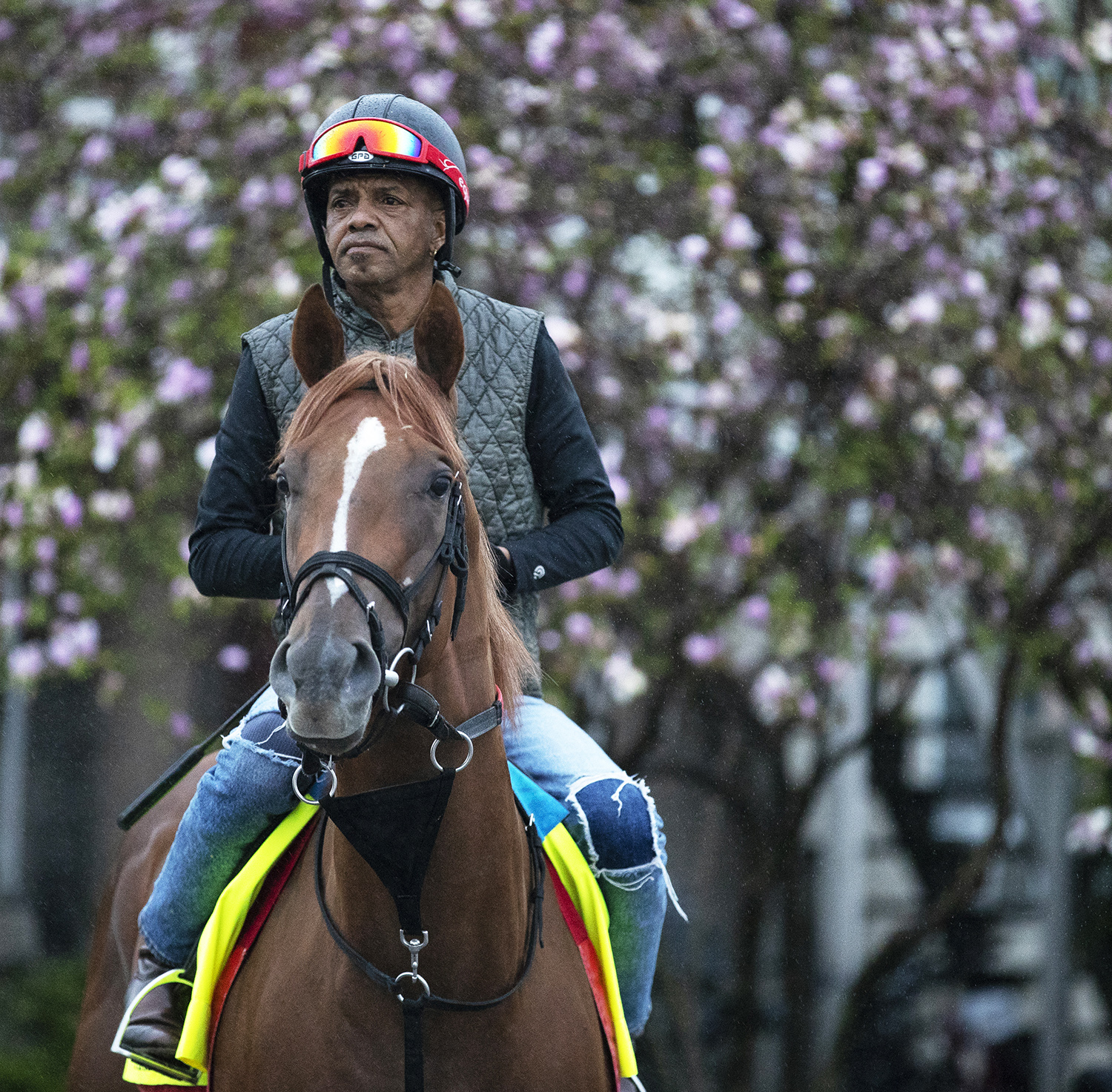
The versatile runner Flameaway flew a bit under the radar among the sons of the late Scat Daddy retiring to stud in recent years. After all, just the year before, unbeaten Triple Crown winner Justify and the globe-trotting Mendelssohn had retired to take up their sire’s legacy, and other retirees from the line recently have included the talented Sioux Nation in Europe.
But Flameaway, who entered stud at Darby Dan Farm in Lexington, Ky., in 2020, is now striking a spark with his own first-crop yearlings. He was represented by one yearling chosen for the Fasig-Tipton Saratoga selected yearling sale, a strong endorsement of the conformation and other traits passed on to that colt by his sire. That Flameaway colt then sold for a healthy $425,000 to trainer Kenny McPeek, as agent for Harold Lerner. Overall, Flameaway’s yearling average stands at $60,268 from 28 sold – more than eight times his introductory stud fee of $7,500.
Flameaway’s Saratoga success was consigned by Gainesway as agent for breeders John and Debby Oxley, who had purchased Flameaway at the same sale in 2016 and campaigned him through three seasons of racing in which he was a stakes winner each year.
“We’re really thrilled about the sale,” Debby Oxley said. “We were hoping – and it exceeded our expectations, totally. He’s a magnificent-looking colt, and I’m happy that Kenny McPeek bought him, because I’ll get to see him run. That’s exciting.”
Ontario-bred Flameaway won his debut on the synthetic main track at Woodbine. He then won a pair of stakes taken off the turf as a juvenile, winning the Skidmore sprinting at Saratoga and then the Grade 3 Bourbon around two turns at Keeneland. Early in his 3-year-old season, he won the Kitten’s Joy on the Gulfstream turf before moving back to dirt for a run at the spring classics, winning the Grade 3 Sam F. Davis and finishing second in both the Grade 2 Tampa Bay Derby and Grade 2 Blue Grass. After finishing 13th in the Kentucky Derby, Flameaway continued to compete on dirt the rest of the year, with his best effort a second in the Grade 2 Jim Dandy. He returned to action as a 4-year-old in 2019, winning the Challenger at Tampa and finishing third in the Grade 3 Mineshaft Handicap.
Flameaway attracted a solid book of 183 mares in his first season, according to The Jockey Club’s Report of Mares Bred. The Oxleys strongly supported the stallion, with the mares they sent to him including Grade 1-placed stakes winner Darling My Darling, dam of Grade 1 winner Heavenly Love, and Darling’s Darling, a daughter of that prominent producer who is herself the dam of Grade 3-placed On Alert. Darling’s Darling is the dam of Flameaway’s colt sold at the Saratoga selected sale.
The Oxleys also sent to Flameaway graded stakes winners Dancinginherdreams and Funny Proposition, who is the dam of Grade 1-placed Distinctlypossible; graded stakes-placed Sky Dreamer, the dam of group stakes winner Kimbear; Delightful Melody, the dam of graded stakes winner Arzak; graded-placed Appreciating; and stakes winner Sky High Lady.
“We love Flameaway,” John Oxley said. “The foal crops that we’re getting by Flameaway are outstanding. They just seem to be better than any of the other stallions we’ve used, by and large.”
From other breeders, the mares Flameaway attracted included Holy Bubbette, the dam of graded stakes winner and successful sire Cairo Prince. The quality of his first book is seen in his offerings at the upcoming Keeneland September yearling sale as well. His 35 yearlings cataloged include the half-siblings to Arzak and Kimbear, as well as a half-sister to graded stakes winner Sittin On Go and a half-sister to Grade 1-placed Nasreddine.

Grade 1 win isn’t everything
Flameaway is one of several first-crop yearling sires this year who retired to stud without a Grade 1 victory, often seen as a key factor in promoting and attracting mares to a new stallion. However, history shows that Grade 1 success on the track is not the sole indicator of a stallion’s ability to produce top progeny. Two shining examples are legendary stallions Danzig, who never started in a stakes race, and Mr. Prospector. Classic sires Malibu Moon, who died last year, and Distorted Humor, who is pensioned in Kentucky, also did not win Grade 1 races. Prime examples currently standing in Kentucky include the internationally popular War Front (Claiborne Farm), along with successful stallions Cairo Prince (Airdrie Stud), Kantharos (Hill ‘n’ Dale), Maclean’s Music (Hill ‘n’ Dale), Munnings (Coolmore’s Ashford Stud), Not This Time (Taylor Made Stallions), and Tapiture (Darby Dan).
Stallions who entered stud in Kentucky in 2020 without a Grade 1 win were Grade 2/Group 2 winners Catalina Cruiser (Lane’s End Farm), Coal Front (Spendthrift Farm), Copper Bullet (Darby Dan), Enticed (Darley), Maximus Mischief (Spendthrift), and Qurbaan (Shadwell Stud); Grade 3 winners Demarchelier (Claiborne Farm) and Flameaway; and Group 3-placed Lost Treasure (Hill ‘n’ Dale).
David Ingordo, bloodstock agent for Lane’s End, noted the success of stallions without a Grade 1 win in discussing Catalina Cruiser, a five-time Grade 2 winner who finished off the board in a pair of Breeders’ Cup races in his only attempts at the Grade 1 level.
“Cruiser is missing a Grade 1, that’s there,” Ingordo said. “But we were talking about War Front and Distorted Humor, two leading sires that were brilliantly fast. Cruiser is fast, and what stallions need is speed. He has the looks to go with it and he has a great pedigree.”
Catalina Cruiser attracted solid support in his first book of 148 mares. Those sent to his court included Private Feeling, dam of classic winner, two-time Eclipse Award champion, and successful sire Lookin At Lucky, as well as graded/group stakes winners Kensei and Shahama. Private Feeling’s colt was selected for the Fasig-Tipton Saratoga catalog and was ultimately a buyback with a high final bid of $575,000 – which would have been the top price for a first-crop sire, if sold.
Catalina Cruiser has 54 yearlings cataloged at Keeneland September, with several on offer in the Book 2 portion, including half-siblings to graded stakes winners Causeforcommotion, Tommy Macho, and Slipstream, and to stakes winner Our Super Freak.
“He was really well supported in his first year, and I think that’s a testament to a couple of different things – one being the talent that he had,” said Allaire Ryan, Lane’s End’s director of sales. “And also, where he was priced – he was priced very fairly in the market. He’s a very good-looking stallion, from Day 1 a very forward individual. He was so correct, a lot of size, a lot of substance. He filled your eye whether you were looking at him as a foal, as a weanling, as a yearling. That’s the other thing. I think breeders were really taken by him.”
Ryan did note that breeders may be “critical” of a stallion without a Grade 1, but a horse’s attributes in other areas may help outweigh that.
“I think when horses have a good physical and are as consistent as he was, people can appreciate it,” Ryan said. “The same with those other stallions [this year]. He just doesn’t have that ‘G1’ next to his name – he doesn’t know that. I think the other qualities can kind of outweigh, and that’s where you’re seeing support from people who are willing to give horses like him a chance.”
In order to attract mares to new stallions, particularly those with lighter racetrack credentials, in an intensely competitive marketplace, many farms have adopted incentive programs. Spendthrift Farm, which counted the aforementioned Coal Front and Maximus Mischief among five new stallions in 2020, pioneered a number of programs such as “Share the Upside,” in which breeders could earn lifetime rights to young stallions after supporting them in early seasons; and “Breed Secure,” which eliminated some risks for breeders who did not profit with their sale yearlings. Several other farms have adopted variations on those programs, including Darby Dan. The farm offered Flameaway under a Share the Upside banner, and he sold out in his first season. He also was offered in two other incentive programs to help him amass that strong first book of mares – “Black Type Bonanza,” in which mares who are black-type performers or producers were eligible for a reduced stud fee; and “Goldmine 20/20,” offering incentives to mares who match the stallion based on hypo-mating patterns that have produced superior racehorses.
Darby Dan’s other new stallion that season was Copper Bullet, owned during his racing career by Winchell Thoroughbreds and Willis Horton. Ron Winchell developed his own incentive program by teaming up with David Lambert’s Equine Analysis Systems to establish three qualifications for mares to be considered for the new stallion’s book. Mares were analyzed based on their race record, pedigree, and production; had their pedigrees and conformation assessed by Lambert’s team; and also were analyzed via an algorithm that took biomechanical measurements of the mare. If the mares were approved through all three steps, their owners received a free season to Copper Bullet and also earned a $5,000 bonus when the mare reached 45 days’ gestation.