

A fitting month to honor the late, great Ben's Cat
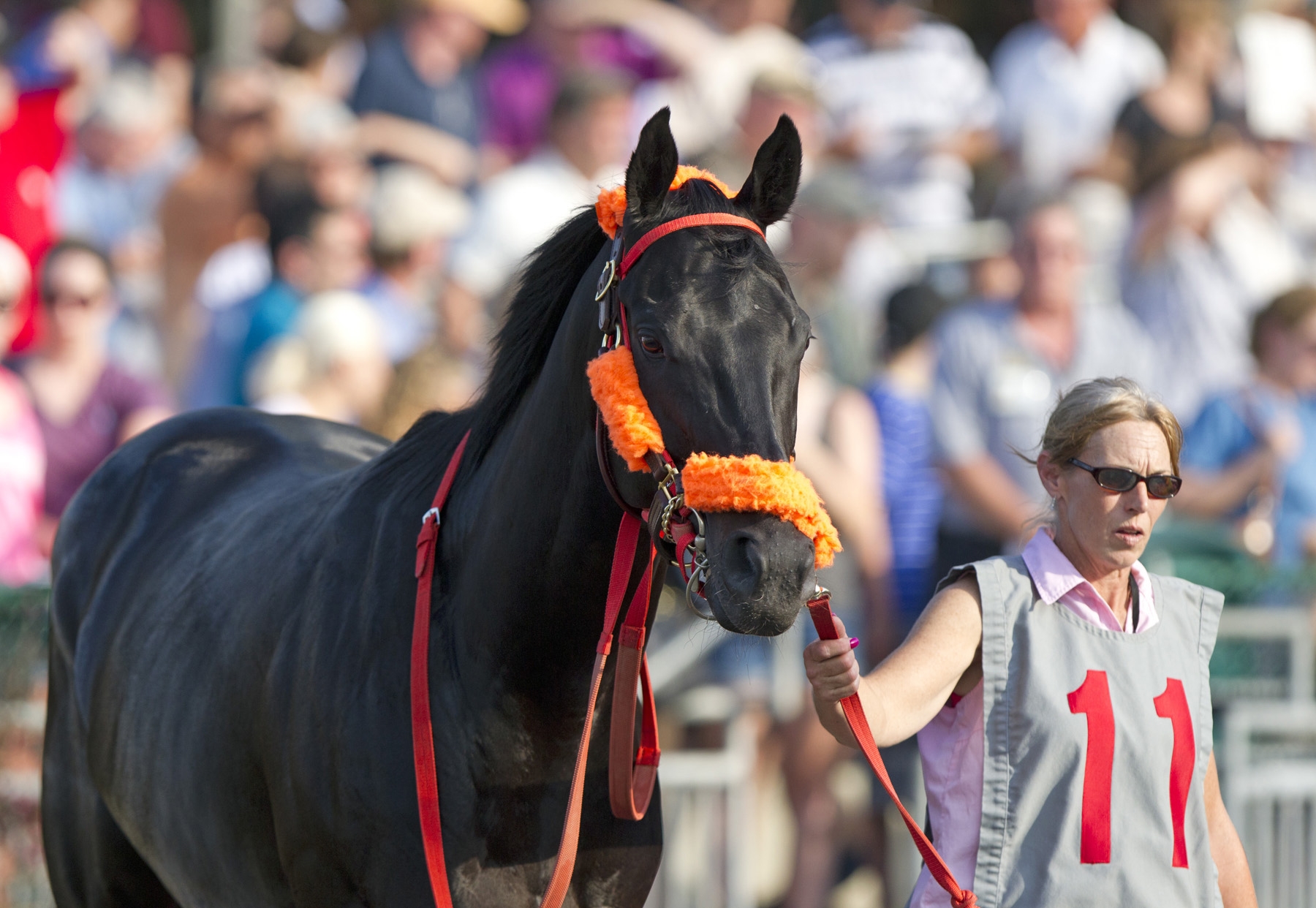
November. Ben’s Cat raced in six of them.
Nov. 24, 2010 was the first. The start came in a Laurel Park allowance race. Ben’s Cat, still never beaten, won his eighth race.
Nov. 23, 2011, Ben’s Cat was third, beaten a neck, in the $200,000 Six Bits Handicap at Penn National.
November 2012, November 2013, and November 2014 – those were the years Ben went back-to-back-to-back in the $200,000 Fabulous Strike Handicap at Penn, his three biggest dirt wins.
“That did surprise me,” said King Leatherbury, the man who bred, principally owned, and trained Ben’s Cat. “I considered him a turf horse, basically.”
The surprise Nov. 25, 2015, was Ben’s Cat finishing seventh in the Fabulous Strike, his worst placing in 53 starts to that point.
By November 2016, Ben’s Cat already had gone on winter holiday.
:: Get bonus PPs for Saturday's Ben's Cat Day card at Laurel Park
Now, Ben has passed like the late-afternoon November daylight into darkness. Retired by Leatherbury in June, Ben’s Cat went to live out his remaining days at Chris Welker’s Spring Ridge Farm in Versailles, Ky. Less than two weeks later, Ben got a rare and terrible form of colic and was euthanized after surgery failed to heal his legendarily willing body.
Seven Novembers following his first on the racetrack, Ben’s Cat is to be honored Saturday at Laurel. His ashes will be buried adjacent to the paddock. Fans, if they want to memorialize wistfulness and lingering sadness, can pick up Ben’s Cat bobbleheads, Ben’s Cat posters, a Ben’s Cat cocktail in a memorial glass.
Leatherbury requested the horse’s remains be laid to rest at Laurel, where Ben spent much of his career. Leatherbury, a Maryland-bred like Ben’s Cat, is 84. Through decades training thousands of horses have passed through his outfit. This one stands out.
“I still get very sad because he was a special horse. People come up to me all the time and tell me how much he meant to them. It’s a darn shame,” Leatherbury said.
Ben’s Cat is by Parker’s Storm Cat and out of the Thirty Eight Paces mare Twofox. You’re excused your unfamiliarity with the pedigree. Leatherbury long has played the claiming game, and Ben’s Cat ran in two claimers to start his career. Never again.
“I thought more and more of the horse as he went along, but I never thought he’d be as good as he turned out,” said Leatherbury.
He turned out pretty good: Four times Maryland Horse of the Year, a final record of 63-32-9-7 with earnings of $2,643,782, and a mass following. Maryland-bred turf-sprint stakes aren’t typically show-stoppers, but when Ben was running in them, action at simulcast centers and racetracks across the country stood still.
The retirement, from the outside, seemed sticky. In 2016, as a 10-year-old, Ben’s Cat won his first two starts, then was third three times, and thudded home fifth and sixth to conclude his campaign. From outside Camp Leatherbury, voices started talking retirement. Inside, the picture looked different, even when Ben finished fifth, eighth, and ninth in his trio of 11-year-old starts this year.
“It was tough because he came back so well this year,” Leatherbury said. “He had the same exercise boy, who had a good feel and knew the horse well. I was going by what he said, and he said the horse was good. Trevor McCarthy worked him and said he was as good as ever. I was going into this year feeling optimistic.”
Ben’s Cat broke from the rail in his 11-year-old debut and never found clear running, losing by less than a length. Two more losses came with subtler excuses, if any, but still Leatherbury wondered.
“All three races he didn’t get good trips, so I hesitated,” Leatherbury said. “If he could get one good trip, then I could see. But after he got beat those three races, I felt bad for him. He was not used to that, and I’m saying, ‘You know, this is it.’”
Welker, the Ben’s Cat fan in Kentucky, told Leatherbury in 2015 that Ben had a home at her farm when his racing days ended. Leatherbury picked up the phone.
“The lady in Kentucky fell in love with him, basically,” Leatherbury said. “She told me she wanted him, but that she wouldn’t call me and bother me. So, I called her and said, ‘This is the call you’ve been waiting for two years.”
That was supposed to be the beginning of the happy ending. Instead, it was just the end.
Leatherbury didn’t need to hear the whispers. He knew, especially after Ben’s sudden tragic end, that people questioned his handling of the horse.
“Other people would have their opinions – that I went too far, didn’t go far enough, let down too fast after the last race,” he said. “You can’t blame it on anything. [Welker] sent me a picture his first day in the pasture. She had an old friend and he immediately liked that horse and acted like he’d been there a hundred years. You second-guess yourself, but the vets at the surgery said it wasn’t anything to do with changing time, feed, atmosphere. It was a rare kind of colic he got, and there was nothing we could do. What [Welker] said was maybe God only intended him to be a racehorse.”
An old racetracker would be the last person to attribute human characteristics to a horse. Yet to Leatherbury, Ben’s Cat had the sort of will and heart that soars above the apparent limitations of the species.
“Ben had it,” he said. “He knew it was his job to win. The first time he ever got beat at Laurel, he was going back to the barn. Our barn is on the left, but the barn the winner goes to is on the right. Ben went right.”