

Fasig-Tipton Saratoga: Sellers hope years of work pay off with minutes in the ring
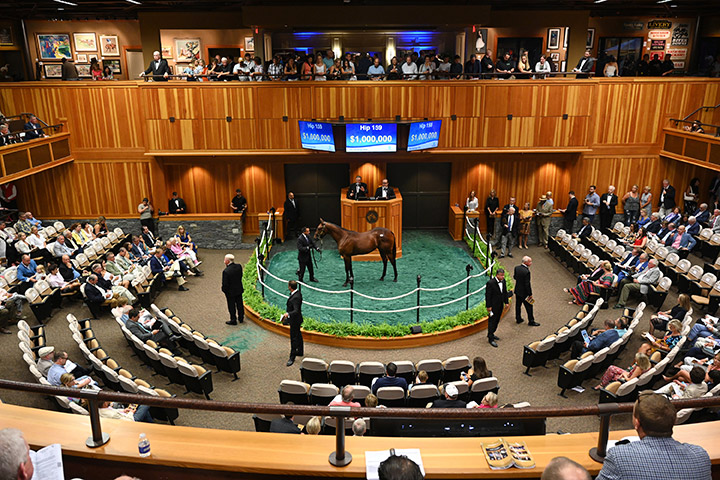
The yearlings for the Fasig-Tipton Saratoga selected yearling sale will arrive on the sale grounds, just down the block from Saratoga Race Course, only a few days prior to the sale to be examined by potential buyers. Their ensuing time in the sales ring on the evenings of Aug. 8 or 9, will be brief. It took multiple graded stakes winner First Captain less than three minutes in the ring to bring the hammer down at a sale-topping $1.5 million at this sale in 2019. At the same sale, multiple Grade 1 winner Flightline also took less than three minutes to sell, for $1 million.
By Wednesday, the sale grounds will be briefly emptied out, with all the offerings off to their new homes and futures.
But while the sale process seems brief on the surface, the process of preparing for the Saratoga sale, a boutique auction that offers some of the cream of the North American yearling crop, is a process years in the making. The Fasig-Tipton team works throughout the year to recruit and assemble the catalog for the two sales it will host in Saratoga in August – the select sale is followed by a New York-bred yearling sale – as well as to recruit buyers from around the world for its annual slate of auctions.
Those buyers also have been putting in a massive amount of homework to parse through thousands of offerings for gems that suit various clients’ racing programs. Meanwhile, consignors have been preparing the yearlings for months for their time in the ring, which will be the culmination of two-plus years of work on the part of their breeders in planning matings, caring for the mare, and delivering and raising the foal. They’ll be hoping for a good reward on that work and overhead, with sellers optimistic following a strong start to this year’s yearling marketplace.
At one of the nation’s leading consignors, Taylor Made Farm in Nicholasville, Ky., the formal sales prep process began on Memorial Day weekend for horses who were targeting that season kickoff, the Fasig-Tipton July sale in Kentucky. The Saratoga-targeted yearlings began the process a week later, with horses slated for the Keeneland September yearling sale waiting until later in June.
Before the yearlings arrive on the sales grounds attractive, fit, and well mannered, their schedules must be changed from a life based around turnout and playtime to a more structured routine, with additional time indoors for handling and for cosmetic reasons, such as preventing bleached coats. Their nutritional plan also is shifted, with all changes being made gradually.
“Horses are creatures of habit, and one thing some may not realize is how stressful it can be to switch a young horse’s schedule from being outside 21 hours a day to being in the stall 12 hours and outside 12 hours,” Mark Taylor said. “We make the schedule switch gradually over a week. We increase the amount of time they are inside a few hours each day until they end up being inside from 7 a.m. to 7 p.m.”

Consignors have to walk the line of developing and preparing young stock while not over-preparing, or, colloquially, “hot housing” horses. Taylor said his family’s operation takes pride in raising horses in natural settings, in groups, up until they absolutely need to add more structure to the schedule to meet the sale timelines.
“Overall, we were raised that the worst thing you ever did for a horse was build a barn for it,” Logan Payne, farm manager for Taylor Made, said at a recent panel discussion for the Consignors and Commercial Breeders Association. “We don’t like to bubble-wrap them. We don’t like to raise them in a stall. We like to keep them outside and be true racehorses.”
Andy Howard, yearling manager for Lane’s End Farm in Versailles, Ky., also spoke to the principle of not over-protecting horses, noting that bone remodeling at these stages leads to stronger athletes down the line.
“We’re not babying these horses, because when you baby them, the bones become porous and then they become weaker,” Howard said. “We’re building strong horses that we want to go on and become a good product at the end of the day.”
As part of the sales prep process, yearlings also undertake a light exercise program. Not yet ready for strenuous work, the programs are typically built around walking, either in hand or in a free walker, to begin defining their muscles and build stamina for the long days of showing at the sales. Some farms also walk their young horses over poles on the ground, to add variety and to encourage youngsters to stride out with bigger steps.
“We customize a plan for each yearling depending on their weight, body type, and any conformation issues they may have. . . . Some horses are taken off-site for swimming, if needed,” Taylor added. “Swimming is a tool we use for horses that may be too heavy or just need less stress on their joints at the stage they are in developmentally.”
Sale yearlings also practice the process of being shown to prospective buyers, who ask to see a horse both standing still and at the walk on the sales grounds. Standing square without fidgeting to show themselves to best advantage is both a physical and mental skill for young horses.
Yearlings also may get a bit of a dress rehearsal when bloodstock agents come calling, beginning the process of zeroing in on sales prospects before hundreds of horses – or thousands, in the case of Keeneland September – fill the sales grounds. Taylor said this practice has seen a bit of a resurgence in recent years due to the coronavirus pandemic, with agents scouting horses in a more socially distanced setting to do additional research for far-flung client bases who may not be able to attend a sale.
“We try to accommodate the agents in any way possible, as we know they have a very difficult job at the sales, [but] it is quite difficult for our staff, as the farm show days limit the amount of time you can spend actually exercising the yearlings,” Taylor said. “If you miss too many days, you will not get your yearling in top shape by move-in day. The people behind the scenes on the farms never get enough credit. . . . We are blessed with an amazing group of people who take pride in their role in raising these amazing animals.”
Meanwhile, behind-the-scenes work also is taking place in the offices of the sale companies, with executives and recruitment staff scheduling farm visits. In addition to its July season kickoff in Kentucky, and its two sales in Saratoga in August, Fasig-Tipton hosts fall yearling sales in California, Maryland, and Kentucky that it must recruit suitable horses for, placing them in front of their best marketplace, which, in some cases, is a regional marketplace. Keeneland only hosts the September yearling sale, but that auction is arranged into five catalog books, based on perceived quality of stock, meaning that the company’s staff also has to recruit and successfully place horses.
Fasig-Tipton president Boyd Browning Jr. often jokes that the work on an upcoming sale begins the day after the previous edition ends. It is not that far off the mark. Browning and the Fasig-Tipton staff make dozens of visits to breeding and consignment facilities.
“The responsibility when you walk on a farm and ask people to bring you their horse, we take it personally,” Browning said. “It’s not just some glib thing where we go in there and we say, ‘Ah, we like these, which ones do you want to bring in there? We’ll be happy with whatever we get.’ No, we go in there, and we tell them which ones we like and we tell them why we like them.”
Browning stressed that the inspections are a mutually beneficial process. The success of Fasig-Tipton sales, and the success of sellers, depend on placing horses before the right marketplace, at the right time. The company has honed its reputation for selectivity.
“It’s our livelihood, and it’s the people who are selling our horses’ livelihood,” Browning said. “There’s a time and a place where you can maximize where you sell your horse. . . . It’s part of our culture. … Bill Graves started [it] and came in and preached and preached and preached. And it’s become part of our culture, and continues as part of our culture, and I hope that 30 years from now, it’s still part of the culture of Fasig-Tipton to say we’re gonna find damn good individuals and horses that people are gonna like, and we’re gonna tell you the truth when we come on the farm.
“Now we’re gonna make mistakes – goodness gracious, we make mistakes. But we’re human. And horses change. And they change both physically and veterinary-wise. So sometimes you think you’re in a great spot in April or May, and you come in in July or Saratoga and you say, ‘What happened there?’ Sometimes we make a mistake, or sometimes they don’t prep up. There’s a lot of variables in horses.”
Breeder and consignor Carrie Brogden of Machmer Hall said that timing plays a huge part in the sale inspection and selection process.
“No one has a crystal ball, but you work with the sales companies,” Brogden said. “We had a couple re-looks for the Saratoga sale where we had the first looks and [we all were] not sure if this horse fits. And then six weeks later, you re-look at them and say, ‘Holy crap, this horse has gone the right way, it’s a no-brainer,’ or, ‘Well, this horse has kind of not matured, he’s better in September, let’s give him some more time.’ ”
Ultimately, the yearlings targeting Saratoga must be able to stand up to intense scrutiny, both mentally and physically. A smaller catalog for a sale geared toward the upper end of a highly selective marketplace means that interested buyers will likely want to inspect their targeted horses multiple times. For popular horses possessing the right blend of pedigree, conformation, and athleticism, that can translate to a long day out of the stall, testing the stamina they developed in prep as they show off their walk and testing their mental patience as they repeat the routine multiple times.
“In Saratoga, the average horse could be inspected six or seven times by the ultimate buyer,” Taylor said. “This intense scrutiny can lead the buyer to fall in love, or walk away after a flaw is discussed one too many times. Saratoga horses need to be able to cover some ground on the show ring. Buyers look at them a lot, and the horse’s movement is on full display, whether it’s good or bad.”
Brogden said a key to success in Saratoga is to have a horse that can present itself well throughout the day.
“For both July and Saratoga, we try to target the horses that the more you look at them, the more you like them,” she said. “It’s one of those things where if you don’t feel that way about a horse, it’s harder to have it be successful in a select sale.”
When all was said and done, Fasig-Tipton assembled a catalog of 216 yearlings for the two-day Saratoga selected sale, the 101st edition of the boutique auction. Major sire power in the catalog is led by three-time reigning leading sire and commercial juggernaut Into Mischief, whose yearlings include a colt out of reigning Broodmare of the Year Indian Miss, dam of champion Mitole and Grade 1 winner Hot Rod Charlie, and a filly out of Grade 1 winner Paola Queen who is a full sister to last year’s sale-topping $2.6 million colt.
Other major sires represented in the catalog include Curlin, whose lots include a full sister to sale-topper First Captain; the white-hot Horse of the Year Gun Runner; and stars such as Bernardini, Candy Ride, Distorted Humor, Kitten’s Joy, Malibu Moon, More Than Ready, Munnings, Not This Time, Speightstown, Tapit, Uncle Mo, and War Front.
The yearlings on offer include half- or full siblings to Eclipse Award champions Improbable and Lookin At Lucky; Sovereign Award champion Noholdingback Bear; Breeders’ Cup Juvenile Turf Sprint winner Four Wheel Drive; and Grade 1 winners Drill, Mia Mischief, Paola Queen, Power Broker, Sporting Chance, and Sweet Loretta. There are also yearlings out of Eclipse champion My Miss Aurelia; Breeders’ Cup Filly and Mare Sprint winner Bar of Gold; Canadian classic winner Unspurned; and Grade 1 winners Angela Renee, Heavenly Love, It Tiz Well, Life At Ten, Marley’s Freedom, and Rosalind.
Last year’s centennial edition of the Saratoga selected sale made a splashy return after being canceled in 2020 due to the pandemic. Led by the $2.6 million Into Mischief colt, 135 yearlings changed hands at the auction for gross receipts of $55,155,000, finishing as the fourth-highest gross all-time. The average and median prices finished at $408,556 and $350,000, respectively. The average just missed – by less than 1 percent – the record figure of $411,459 established in 2019, and is easily the sale’s second highest. The median tied the record figure established in 2019. The sale’s overall buyback rate finished at 25 percent, improving a tick from 26 percent in 2019.
This year’s Saratoga sale comes on the heels of a strong start to the season at Fasig-Tipton July in Kentucky. While bringing a different type of horse and buyer to the table, the sale finished with a gross that was near even to 2021, despite last year’s sale trading more horses. A $600,000 Curlin colt topped the action and the sale finished with an 11 percent gain in average price. The median jumped 13 percent.
The double-digit gains bore out cautious optimism from consignors, who noted the dueling factors of enthusiasm to race for strong purses even as the economy remains uncertain.
“I think there’s less concern about anything horse-related than there is about the world, the economy,” Brogden said. “People need to pay rent, and they need to have food and shelter and health care – but they don’t need racehorses. But the purse structures – I mean, what’s happening in Kentucky is beyond thrilling to me, having a Kentucky farm. With the breeders’ awards, and then, when you have $120,000 maidens, I mean, that’s a big chunk of change to get back on your initial purchase right as you break your maiden.”
Now that the catalog is published and yearlings are in their final stages of preparation for their moments in the spotlight, Fasig-Tipton’s job shifts to wooing buyers.
“We try to provide customer service from the time we schedule the [yearling] inspection to the time that horse leaves the grounds, with both buyer and seller,” Browning said. “We take our responsibly pretty seriously – and fortunately, most of us love coming to work.”