

Fair Odds for the Kentucky Derby: Looking beyond the two favorites
DRF handicapper/linemaker David Aragona provides his opinion of what constitutes fair win value for each runner in the Kentucky Derby. The goal is to bypass standard ordinal selections, instead developing price-based opinions around every horse in the field for the purpose of informing sound wagering decisions.
Much of the narrative around Kentucky Derby 150 revolves around the two favorites, Fierceness (No. 17) and Sierra Leone (No. 2). They are dominating the conversation as the clear first and second choices, but are they the two most likely winners? Or is this a more competitive edition of the Derby than the tote board might suggest?
Let’s start with Fierceness. I have significant doubts about this favorite, but given the kind of horse that Fierceness is – an inconsistent one – I find it difficult to assign a win percentage to him, something I’ve done for all the runners in the chart below. I agree with the popular sentiment that he’s the most naturally gifted horse in the field, but I would frame it a different way. If the Kentucky Derby were run as a series of individual time trials, Fierceness would be a massive favorite to record the fastest clocking. However, this is a horse race with a lot of variables – the 20-horse start, pace, kickback, contact, added distance – so the best horse doesn’t always win. I’m just very concerned that Fierceness is not the type of horse that can stand up to the rigors of the Kentucky Derby.
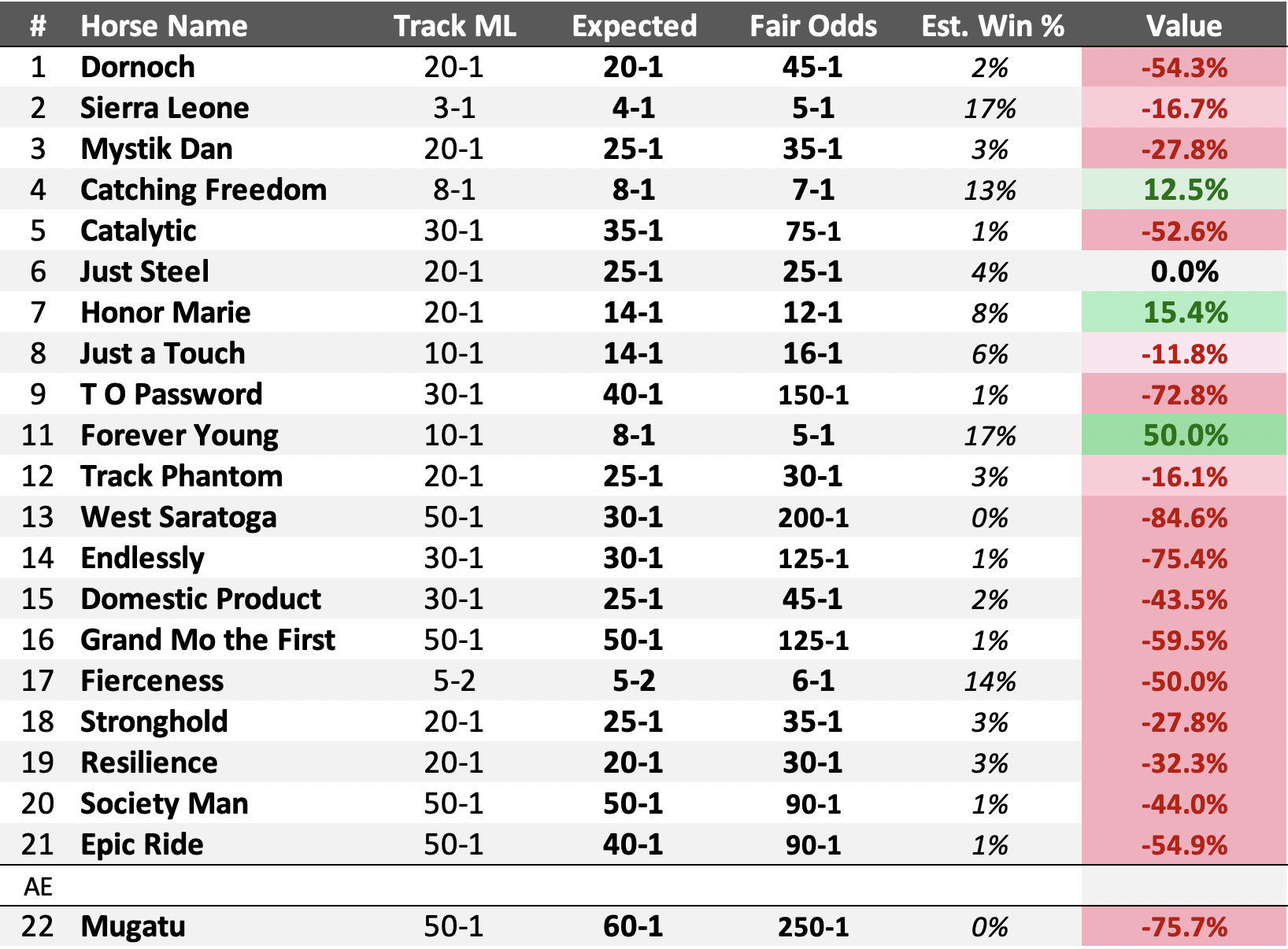
As I contemplate what constitutes a fair price on Fierceness, it should be said that making a fair odds line is often little more than an educated guess. That’s especially true when you’re a mere human working without a sophisticated computer algorithm. Yet that shouldn’t discourage any ordinary handicappers from taking up the task. The process of assigning fair values to each horse stimulates the brain to start thinking about each race from alternative angles and perspectives. When I go about setting a fair odds line, I often come away from the process with an opinion that is slightly altered from where I started. At the end of the day, the goal is to let perceived value inform your wagering, and if your odds line suggests you’re not getting the value you expected, it’s probably a good idea to modify your opinion.
I think Fierceness has approximately a 14 percent chance to win this Kentucky Derby, which might seem like a low number to some. I just feel that the variables that could affect him are so numerous they outweigh his advantage in talent. He’s the third-most likely winner on my fair odds line, and given his status as the favorite, that makes him a horse to significantly downgrade.
Sierra Leone (No. 2) is a little easier to assess. He’s reliable, appearing to have the constitution and foundation that should set him up for success in the Derby, but lacking the same speed figure advantage as Fierceness. The only major concern is his running style, since he launches from so far back in the pack and may be susceptible to traffic. Given that combination of factors, he’s my co-likeliest winner at 5-1 (or about 17 percent to win).
I believe there are two more main players in this race whose probability of success can be rated at greater than 10 percent. One of those is Catching Freedom (No. 4), who possesses many similar attributes to Sierra Leone. He hasn’t run quite as fast in his prep races, but he does appear to be slightly more handy in the early stages, which could lead to him getting first run on that rival around the far turn. I think he has many of the attributes that make a Derby winner, but I still have some doubt about his overall talent relative to the other short prices. I pegged fair odds on him at 7-1 (13 percent chance of success).
The obvious horse to bet based on my fair odds line is Forever Young (No. 11). I believe he is just as likely to win this race as Sierra Leone and I have him at twice the price of that foe on my expected line (which is my best guess at the final odds, based on my early line and the early wagering).
Forever Young is another horse that is difficult to peg with great confidence, since he lacks common form lines with most of the field and is trying to accomplish something that’s never been done before, both winning for Japanese connections and doing so after prepping overseas. Yet most handicapping ultimately comes down to gut feeling ¬– a term that goes far beyond mere whim, rather calling upon years of experience and intuition – and mine says that this horse is the real deal.
Unlike the favorite, Forever Young has overcome adversity. He did so in his second start at Mombetsu in Japan, where he obviously resented the sandy kickback being flung at him, running the majority of the race with his head cocked high, preventing him from striding out. Yet, rather than giving up, he worked his way into the clear and unleashed a terrific stretch kick to overcome his immaturity and win in spite of adversity. That’s just the kind of horse Forever Young is.
We saw that same attribute in the Saudi Derby, run at a pace that was slightly outside of his comfort zone, especially going a distance that was too short for him off the layoff. He came off the bridle earlier than is typical for him, but still put in that relentless rally through deep stretch to nail the classy American Book’em Danno on the wire. And that Saudi Derby was a fast race. While most reputable figuremakers would rather not commit to assigning a speed figure to the race, the consensus among them is that it might have been one of the fastest prep races run by any of the horses in this year’s field. The U.A.E. Derby wasn’t a slow race either, and Forever Young was perhaps even better than the final time indicates, coming home his final 400 meters ¬– about a quarter-mile ¬– in just a tick more than 24 seconds.
My fair odds on Forever Young are 5-1, which should represent significant value, so that makes him the key to most of my wagers on this year’s Derby.
Any discussion of wagering strategy would not be complete without at least mentioning some of the bigger prices on my fair odds line, who should be used to fill out exotics. He’s not as likely to win as my top pick, but I will be prominently using Honor Marie (No. 7), who might still go off at double-digit odds despite his status as this year’s “buzz horse.” I’ll be using him in most of my exacta and trifecta wagers, since his running style lends itself to picking up the pieces, especially if the pace develops as expected.
I also want to throw horses like Just Steel (No. 6), Just a Touch (No. 8), and Track Phantom (No. 12) into the mix when crafting my exotic plays. None are among my likeliest winners, but any one of them could easily offer decent value if their odds shift marginally. I’m aware that most of the runners I’m using in this year’s race are closing types, and I would be remiss to reject the idea that a classy horse with forward position may hang around long enough to be a part of the exotics. If I’m right that it’s a better strategy to use that trio of runners rather than Fierceness, we should get paid handsomely.