

Crist: Materiality may have enough talent to meet challenge
On paper, this is the best Kentucky Derby field in years. The five favorites (American Pharoah, Dortmund, Carpe Diem, International Star, and Materiality) are a combined 13 for 13 this year. Three of those horses, and five other entrants, have recorded a Beyer Speed Figure of 100 or more, which may be a record. All five of the Grade 1 races for the division this year have been won by daylight.
It’s a big cut above last year’s Derby field, where California Chrome proved to be in a league of his own, Commanding Curve was second, and no one but the winner ran well. Yet here’s the irony worth remembering, regardless of how this Derby turns out: By year’s end, the 3-year-olds of 2014 had gone from being a terrible group with one standout to being rightfully considered one of the strongest crops in recent years, beating their older rivals in virtually every important race of the summer and fall, including the Pacific Classic, Awesome Again, Jockey Club Gold Cup, and Breeders’ Cup Classic.
California Chrome’s Derby and Preakness triumphs carried him to a victory in the unusually contentious 3-year-old and Horse of the Year voting, but the three whom he edged (Bayern, Shared Belief, and Tonalist) accomplished as much as many a 3-year-old champion. None of those three even ran in the Derby last year. So, despite the gaudy résumés of this year’s Derby runners, there might be even more really good ones out there who didn’t make the big dance but could make a strong group even stronger.
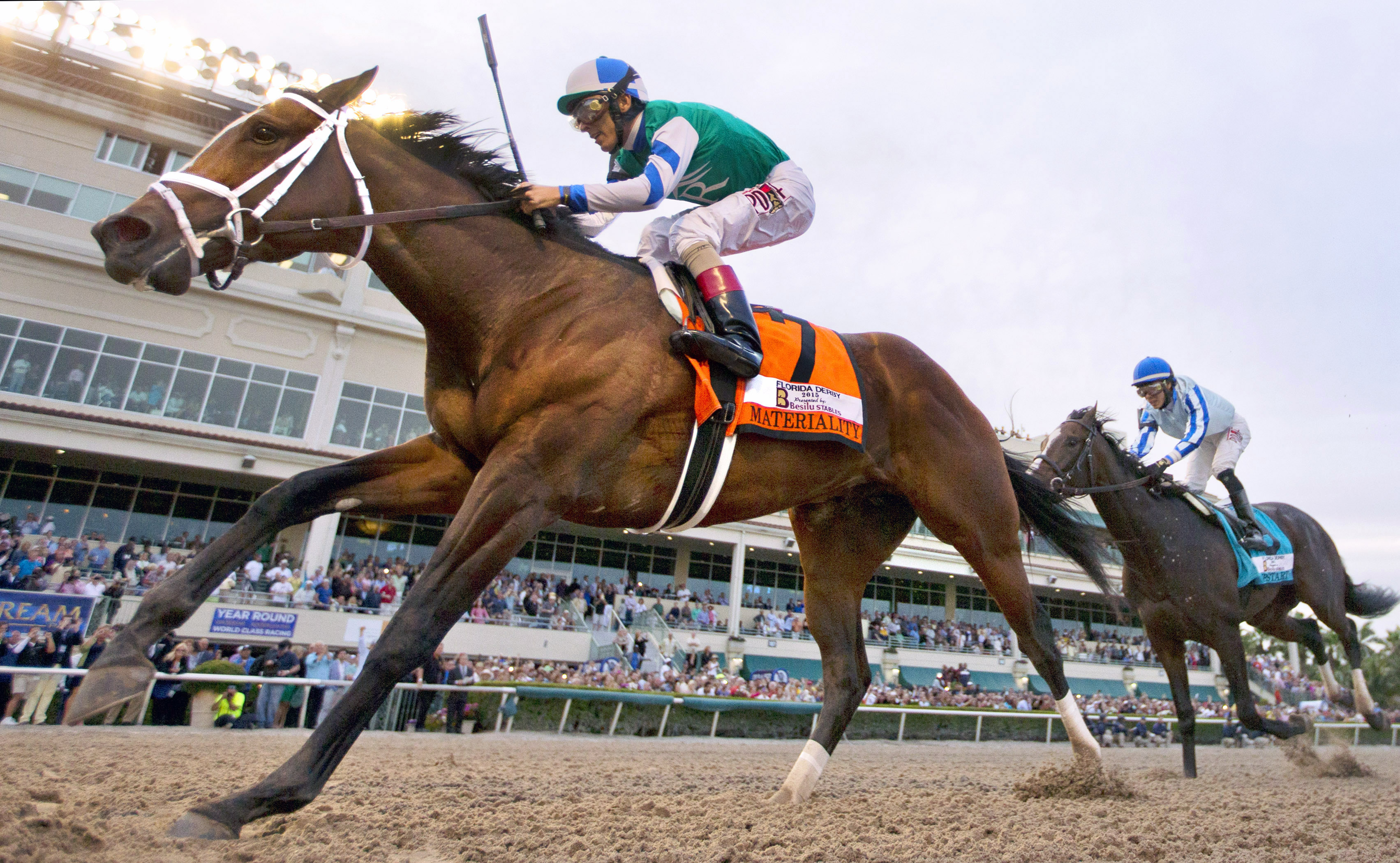
I suppose you want a pick. I find it impossible to draw the very fine lines needed to separate American Pharoah from Dortmund and the other top contenders, so I’ll take the one who could be just as good as the two favorites and at a much bigger price: Materiality, whose winning Florida Derby Beyer of 110 is the highest in the field.
What is more remarkable than the big figure is that Materiality did it in just his third career start. The good news is that this suggests he has even further room to improve. The bad news is that all three of those starts came this year, so he would (all together now) become the first horse since Apollo in 1882 to win the Derby without racing as a 2-year-old.
Eight years ago, another horse went into the Derby undefeated in three big-figure starts. The bad news is that he was shuffled back in his first effort against a big field and could finish only third. The good news is that his name was Curlin, and by the time he was done, he had two Horse of the Year titles and a first-ballot election to the Hall of Fame. It’s asking a lot for Materiality to do something even Curlin couldn’t, but I’ll happily take 8-1 on such a spectacular talent.
If you like Materiality, you have to like Upstart, the Florida Derby runner-up, who fires every time and has the versatility to work out a good trip however the race develops. My plan is to try to get both Materiality and Upstart into the trifecta and superfecta.
Flawed system
The obvious shortcomings of the Kentucky Derby and Oaks points system, as discussed in this space two weeks ago, did not affect this year’s Derby field. The Oaks draw, however, where Peace and War was ranked 15th and thus eligible to start only if there were a scratch, provided a perfect illustration of the system’s flaws.
Peace and War won the Grade 1 Alcibiades last fall but earned only a few token points for that important victory because Churchill gives 2-year-old races such scant weight – 10 points as opposed to 50 points for the Grade 3 Bourbonette Oaks and 100 points for the Grade 2 Gazelle. So, Money’soncharlotte, who finished a distant third at 59-1 in the Gazelle, got 20 points for that middling effort and thus edged a Grade 1 winner out of the field.
Maybe Peace and War drew into the field by the time you’re reading this, but that’s not the point. A system that says a mediocre, clunk-up third in the Gazelle is more important than winning a Grade 1 race is a bad system. Let’s not wait for a winner of the Breeders’ Cup Juvenile to be excluded from the Kentucky Derby to fix it.