

Closing arguments made at Baffert hearing
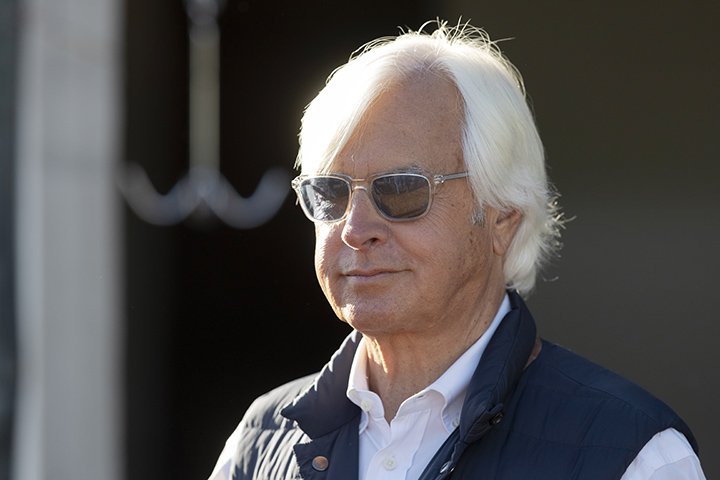
FRANKFORT, KY. -- Attorneys for Bob Baffert on Tuesday wrapped up their side of an appeal of a 90-day suspension the trainer has already served by reiterating that a horse Baffert trained, the 2021 Kentucky Derby winner Medina Spirit, was never injected with a regulated corticosteroid and that rules applying to the drug should not have been used to punish him.
The conclusion of the case followed 5 1/2 days of testimony in which Baffert appealed a 90-day suspension handed down in February by Kentucky stewards and the disqualification of Medina Spirit from last year’s Derby. Baffert served the appeal earlier this year, from April to July, and Medina Spirit died of a suspected heart attack at the conclusion of a workout in December at Santa Anita.
Nevertheless, Baffert and Medina Spirit’s owner, Amr Zedan, appeared on the final day of the hearing to contend that the penalty served by Baffert and the disqualification of Medina Spirit was the result of a mistaken application of Kentucky’s rules, which regulate betamethasone use and prohibit a finding of the drug in a post-race sample. The pair’s legal team contends that the rules should not apply to a finding of betamethasone as the result of the daily application of an ointment containing the drug to treat a skin disease.
:: DRF Bets members get FREE DRF Past Performances - Formulator or Classic. Join now!
In his closing argument, Clark Brewster, a lawyer who represented Medina Spirit’s connections, claimed that “the real focus” of betamethasone regulations promulgated by the Kentucky Horse Racing Commission dealt with injections of the drug into horses’ joints, which is the most common use of the medication in equine sports. He also claimed that the KHRC failed in multiple ways to provide “guidance” to horsemen on other uses of the medication.
“What we have here is an agency that has made no rule, has made no consideration, has made no decision whatsoever as to a topical ointment containing betamethasone valerate,” Brewster said. Betamethasone valerate is an ingredient in the ointment, as opposed to betamethasone acetate, which is the form of the injectable.
Jennifer Wolsing, the general counsel for the KHRC, rebutted that claim in her own closing, telling the hearing officer, Clay Patrick, a Frankfort attorney, that the case rested on the fact that KHRC regulations cite “betamethasone” in its list of substances that are prohibited from appearing in a horse’s system on raceday, and that the route of administration does not matter.
“If we had to list every possible route of administration the list would be 100 pages long and we would still probably miss some,” Wolsing said.
Brewster also spent a large portion of his closing conducting a technical analysis of a large portion of KHRC rules in an attempt to portray the rules as a hodgepodge of conflicts and legal shortcomings. The brunt of that analysis was not covered in much detail during the examination of the case.
But he ended his conclusion by saying that Clay should use “common sense” in determining whether to recommend to accept or reject the stewards’ decision in the case, contending that the stewards reached their decision only because of the stature of the Derby and a willingness to make an exception out of Baffert.
“In this instance, they disregarded common sense because it was the Derby,” Brewster said. “No one would sit down and have a discussion and say, ‘Hey, this is not what we thought it was.’ ” Brewster then addressed Patrick. “And so shouldn’t you.”
Ironically, Wolsing also pleaded for common sense in the final part of her closing argument.
“Don’t get distracted,” she told Patrick. “Let’s use common sense. Betamethasone is a Class C medication at level of detection no matter how it is administered.”
Prior to the closing arguments, the only two witnesses called on Tuesday were Baffert and Zedan, both speaking by video conference. Their attorneys focused most of their initial questions on establishing the bona fides of both of their careers before segueing into queries about the incident in question.
Baffert recounted how he had been told about the positive the Saturday after the Derby and how he had been “shocked” by the news. Baffert has contended that the horse was never administered an injection of betamethasone, and that he was unaware that the ointment being administered to Medina Spirit contained betamethasone.
“My mind was going 100 miles per hour trying to figure out how this could have happened,” Baffert said.
For his part, Zedan said in his testimony that Baffert is a “clear-cut, straight-up gentleman,” and that the trainer’s operation was, to him, “the gold standard of horse racing.” But when challenged on Baffert’s reputation by Luke Morgan, an attorney working for the KHRC, Zedan said he wanted to “say something to make myself clear.”
“There’s no upside for anyone here,” Zedan said. “The sport we all love has been punished. Bob Baffert has served his punishment. He’s been humiliated, his reputation, his family has been dragged through the gutter for this. … It’s hurtful to me. … And the horse, the horse, for god’s sake, died, let’s not hurt the horse anymore.
“I just want everyone here to think about what’s best for the horse here and everyone involved. Everyone’s been punished.”
Patrick will have 60 days after he receives the transcript of the hearing to issue his report. At the close of the hearing, he gave both sides 30 days after receipt of the transcript to submit their “findings of fact and conclusions of law.” Patrick’s report will then be presented to the KHRC, which can vote to accept, reject, or modify his recommendation.
Meanwhile, Baffert remains banned through the 2023 Kentucky Derby by Churchill Downs. Baffert’s lawyers challenged Churchill’s decision in a lawsuit filed early this year, but it was withdrawn several months later.
In addition, Baffert is presently banned at all tracks operated by the New York Racing Association through nearly the end of January, a result of an internal hearing conducted by the association earlier this year. Although the hearing officer initially recommended a two-year ban, a panel that reviewed the recommendation reduced the penalty to one year and gave Baffert credit for the time that he had already been banned by NYRA.
The result of the Kentucky appeal will have no direct bearing on those bans, though a decision in Baffert’s favor could be used as a factor in any potential litigation challenging the Churchill and NYRA decisions.