
CHRB seeks to correct, clarify gate scratch issues
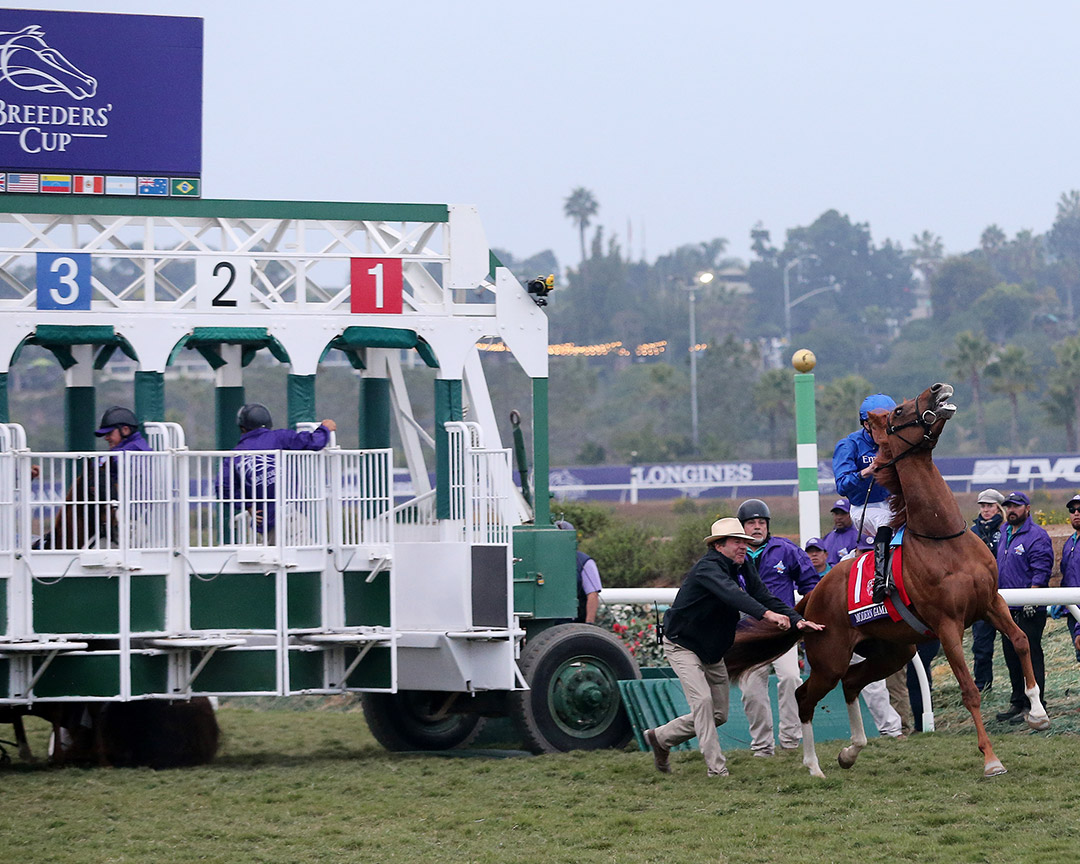
The California Horse Racing Board on Thursday issued a series of recommendations to avoid the confusion and controversy that surrounded the running of the $1 million Breeders’ Cup Juvenile Turf last Nov. 5 at Del Mar, including the designation of a single veterinarian to communicate gate scratches to the stewards.
The report, which was prepared by the CHRB’s supervising investigator, Michael Barker, delves into the chaotic moments surrounding the Juvenile Turf, which was won by a horse, Modern Games, who was removed from the pari-mutuel pools after an incident at the starting gate. The decision to allow the horse to run led to an outcry among bettors who had backed Modern Games in both the race’s pari-mutuel pools and in the multi-race bets ending in the Juvenile Turf, which was the final race of the day.
Citing confusion among veterinarians near the gate that day, the report recommended that only one veterinarian be given the responsibility of calling a scratch into the stewards. Another recommendation calls for each track to designate one person within its pari-mutuel department and another working at the track’s bet-processing partner who would be responsible for scratching a horse or designating the horse as a “purse money only” runner.
“Both must agree before either action can take place,” the report said.
The report said that veterinarians working at the gate mistakenly believed that Modern Games had broken through the starting gate after a horse next to him, his stablemate Albahr, had reared over and flipped in his stall. In reality, Modern Games had been let out of the front of the stall by the gate crew, who feared that the horse might injure himself as racing personnel worked to free Albahr.
Meanwhile, the veterinarians at the gate called in scratches to the stewards of both Albahr and Modern Games. Moments later, the report said, the veterinarians were told by the gate crew that Modern Games was let out of his stall and was uninjured. By then, the stewards had already called the tote room to remove both horses from the wagering, the report said.
The report suggests that communication among racing officials during this time was haphazard and uneven, and that there were no clear chains of command among the various racing personnel who could order scratches or remove a horse from the pari-mutuel pools.
“During the investigation it was clear that inconsistent radio communication affected the events that transpired,” the report said. “Various witnesses indicated that they made calls over the radio that were not heard or received by the intended recipients. At some points witnesses resorted to cell phone communication to ensure their messages were relayed. The investigation noted that the regulatory veterinarians’ hurried recommendation to scratch Modern Games could have potentially been avoided if a protocol requiring one person on the veterinary staff and one person in the pari-mutuel department be in charge of scratches had been in place.”
As a result of that assessment, the CHRB recommended that racetracks, “particularly on days when there are large crowds and competing bandwidth, must provide an adequate communication system for racing officials,” the report said.
After Albahr and Modern Games were removed from the pools, the stewards were told that Modern Games had been examined and was fit to race, the report said. “The stewards then asked the tote room [the pari-mutuel department] to inform them what was occurring and requested that the tote room hold off on the scratch of Modern Games,” the report said.
“Modern Games was then placed back into the pari-mutuel pool,” according to the report.
Just after that call, the stewards determined that an existing rule did not allow for a horse to be put back into the pools after the horse was ordered scratched. Modern Games was then allowed to run for purse-money only.
The report said that the CHRB considered filing complaints against regulatory veterinarians involved in the incident under a rule that says that “any horse which breaks through the gate or runs off without effective control shall be examined by the racing veterinarian and determined to be fit to compete before being permitted to start.” That examination clearly did not happen before the veterinarians called the scratch of Modern Games in to the stewards.
However, the report said that the CHRB’s executive director, Scott Chaney, “declined” to file complaints for two reasons, citing first the rule’s specific language, which references a horse “which breaks through the gate.” Modern Games, however, was let out of the gate.
“More importantly, animal welfare is of paramount importance in the CHRB’s application of rules and creation of protocols,” the report continued. “The CHRB will not disincentivize regulatory veterinarians from recommending scratching horses when they have any iota of concern regarding their fitness to race. Just the opposite, the CHRB fully supports regulatory veterinarians erring on the side of animal welfare when there is even a possibility that a horse may not be fit to race.”
The report also recommended that the racing board’s Pari-mutuel Committee consider changes to several regulations, including the “advisability” of allowing horses to run for purse money only. In addition, the committee will consider adding a requirement that account-wagering companies provide bettors with the option of designating alternate horses in multi-race bets of four or more races. The committee is scheduled to discuss those changes in a meeting on March 16, the CHRB said.
In California, bricks-and-mortar betting locations allow for the designation of alternate selections in each leg of multi-race bets, but that is not a requirement for account-wagering companies, which operate nationally. Under the state’s current rules, a scratched horse in a race in a multi-leg bet is replaced automatically by the post-time favorite if there is no designation of an alternate horse.
In the Juvenile Turf, that horse was Dakota Gold, who finished fifth.