

Catholic Boy, Yoshida look to spark Halo line in U.S.
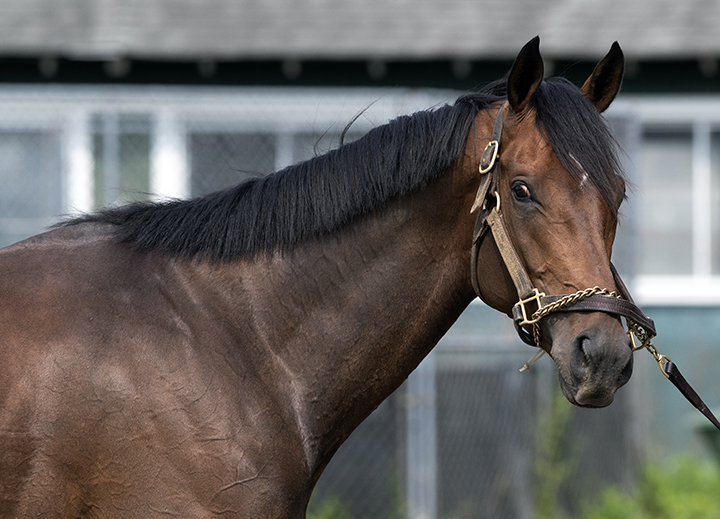
His name was Halo, with all that it implies. But the nearly black stallion was anything but angelic. As a yearling, he objected so strenuously to the scenario in the walking ring that he flipped outside the sale pavilion. During his racing career, he would eject his exercise rider and take solo turns around the training track in Aiken, S.C., and occasionally take unscheduled trips to romance the fillies at neighboring barns. As a stallion, he had a reputation for being aggressive and territorial, and required a muzzle to be handled.
But perhaps all that fire is why Halo survived. After all, he not only escaped serious injury when he flipped as a yearling, he also survived a colic surgery to remove a benign fatty tumor while his stud career was on the rise. And perhaps all that fire is why Halo’s male line has refused to fade away. A half-century after his birth, Halo’s line had faded down to, essentially, a single major representative in Kentucky for 2019. It comes roaring back with two promising representatives in the 2020 incoming sire class, Catholic Boy at Claiborne Farm and Yoshida at WinStar Farm. Both are dual-surface Grade 1 winners.
Halo, a son of Hail to Reason, was bred in Kentucky by John Gaines, and was purchased by Charles W. Engelhard Jr. as a Keeneland July yearling to race under his Cragwood Stable banner. Hall of Fame trainer MacKenzie Miller was able to manage the tempestuous colt to a fairly successful racing career. Halo won 9 of 31 starts with four stakes victories, highlighted by the Grade 1 United Nations Handicap in 1974.
Halo entered stud at Windfields Farm in Maryland in 1975, and emerged as a breakout stallion in the early 1980s. His daughter Glorious Song was the 1980 Canadian Horse of the Year, and two years later his son Sunny’s Halo earned a Sovereign Award as Canada’s champion 2-year-old. Sunny’s Halo went on to win three Grade 1 races as a 3-year-old, including the 1983 Kentucky Derby. That same year, Devil’s Bag was the Eclipse Award champion 2-year-old, helping to place Halo atop the leading sire list for the first time, and earn him a shot in Kentucky.
Texas oilman Tom Tatham purchased a majority of the shares in Halo’s syndicate and moved the stallion to Arthur B. Hancock III’s Stone Farm in Kentucky, beginning with the 1984 season. Halo recovered from his colic episode and necessary surgery after his arrival to continue to produce notable offspring. Among those was 1989 Horse of the Year Sunday Silence for Stone Farm and partners. The horse was never worse than second in his career, with six Grade 1 victories including his Kentucky Derby, Preakness Stakes, and Breeders’ Cup Classic scores against arch-rival Easy Goer.
Buoyed by Sunday Silence, Halo led the national sire list again in 1989. His other standout offspring included Kentucky Oaks winner Goodbye Halo, who scored seven Grade 1 victories; Canadian champions Rainbow Connection and Tilt My Halo; and Mexican Horse of the Year Top Halo. In total, Halo produced 749 registered foals prior to being pensioned in 1997, and his death three years later at age 31. From those, he was represented by 465 winners from 612 starters, for total progeny earnings of $44,692,653. He was represented by 63 stakes winners, 29 of those graded or group winners, and seven champions worldwide.
But despite Halo’s success, American breeders showed little interest in Sunday Silence as he approached retirement – even though Halo, who was 20 at the time, had no other outstanding heirs apparent. And so he was purchased by Shadai Farm founder, Zenya Yoshida. In Japan, Sunday Silence found his perfect gene pool, and swiftly established his dynasty. With 25 champions among his 172 stakes winners, he was the leading sire in Japan every year from 1995 to 2007, and his daughters made him his adopted country’s leading broodmare sire every year from 2007 to 2014. His progeny earned a staggering $730,561,473, thanks to inflated purses in Japan.
Remarkably, Sunday Silence continued to hold his leading sire title for years after his premature death at age 16 in 2002, felled by complications from a leg infection and laminitis.
“It is with deep regret that we witness the passing of Sunday Silence, who has given us so many outstanding racehorses, and whose name is known not only in our country but throughout the world,” Japan Racing Association president Masayuki Takahashi said in an official statement at the time of the horse’s death. “I pray for the success of those he has left behind, for the success of his sons and daughters in racing and in breeding.”
Sunday Silence’s sons and grandsons continued to dominate Japan’s sire list. His sons Agnes Tachyon and Manhattan Cafe were Japan’s leading sires of 2008 and 2009, respectively, before Japanese Triple Crown winner Deep Impact, another son of Sunday Silence, took over the list in 2012. Deep Impact has led that list each year since – and, like his late sire, may be poised to maintain the lead for several years after a relatively early death, as he died in July at age 17 due to a cervical spinal fracture. Deep Impact is the sire of 16 champions, with his top earner being two-time Japanese Horse of the Year Gentildonna. His son Saxon Warrior won the English 2000 Guineas and entered stud this year at Coolmore’s Irish headquarters, providing a strong rep of the sire line for Europe.
Sunday Silence’s other notable sons at stud have included Stay Gold, sire of Japanese Triple Crown winner Orfevre, and Heart’s Cry, sire of Just a Way, who was ranked the world’s best racehorse in 2014. Orfevre is the fifth-highest-earning horse in worldwide racing history – just behind Gentildonna in fourth.
But while Halo’s legacy blazed and continues to burn in Japan, his line sparked and fizzled in the country of his birth. Many of his sons found their success as regional sires, including Sunny’s Halo in Texas, and thus did not get the chance to make a larger impact on the Thoroughbred gene pool the way Kentucky stallions, with larger books, have. Among the stallion’s sons in Kentucky, Devil’s Bag was a useful if not spectacular sire until his death at age 24 at Claiborne Farm. His best runners included Japanese champion Taiki Shuttle and multiple Grade 1 winner Devil His Due. The best of Devil His Due’s stakes winners was Dubai World Cup winner Roses in May, who was snapped up to begin his stud career in Japan as that country continued to pursue the bloodline. Halo’s Grade 1 winners Lively One and Jolie’s Halo both eventually went to stand in Japan as well – and, in a cruel twist of fate, the best U.S.-sired sons of each stallion never produced offspring. Lively One was the sire of Eclipse champion juvenile Answer Lively, who had fertility problems; Jolie’s Halo sired Grade 1 winner Hal’s Hope, who died during surgery for an intestinal problem and never stood at stud. Poor luck also befell Halo’s multiple graded stakes winner Saint Ballado, who died early, at age 13. Saint Ballado’s best son, Horse of the Year Saint Liam, was euthanized after breaking his leg in a freak accident while being led to his paddock – and although his lone crop included Horse of the Year Havre de Grace, he did not leave a quality son behind.
Meanwhile, with the Japanese bloodstock industry experiencing a largely insular period as it grew, few of Sunday Silence’s sons stood out of the country or made their way back to North America. Adena Springs brought Japanese-born Silent Name to Kentucky in 2008. Silent Name was a stakes winner in France, later won the Grade 2 Commonwealth Stakes at Keeneland, and placed in three Grade 1 events at California. The only son of Sunday Silence in North America, Silent Name stands at Adena Springs North in Ontario and is the sire of 32 stakes winners through Nov. 25. The 17-year-old stallion’s best runners include multiple Grade 2 winner Silentio, who was third to champion Wise Dan in the 2013 Breeders’ Cup Mile. Sunday Silence’s champion son Hat Trick won the Group 1 Mile Championship in Japan and Group 1 Hong Kong Mile in 2005. He also stood in Kentucky, at Walmac and then Gainesway, but was exported to stand in his current country of residence, Brazil. Hat Trick is the sire of 38 stakes winners, led by European champion Dabirsim, and King David, a Grade 1 winner in New York.
The preeminent keeper of Halo’s flame in the United States has been More Than Ready, who moved with the Vinery stallions to WinStar Farm when Vinery wound down its U.S. stallion operations. More Than Ready is by Halo’s late son Southern Halo, who was multiple times Argentina’s leading sire. Southern Halo also shuttled to stand at Coolmore’s Ashford Stud in Kentucky, and there he sired More Than Ready, a Grade 1-winning sprinter who has gone on to be a wildly versatile sire. More Than Ready continues to produce Grade 1 winners in his home country on both turf and dirt this year at age 22, and continues to shuttle to Vinery Australia, where he is also a leading sire, represented by champions More Joyous, Phelan Ready, Samaready, and Sebring.
“It’s been almost 20 years and he’s still going strong as a top stallion,” said Todd Pletcher, who trained More Than Ready. “The longevity of his career has been phenomenal, especially when you consider that he’s been shuttling to Australia his entire career. As successful as he’s been here, he’s been even more successful in Australia. It’s fun for us to see them reproduce themselves with successful racehorses.”
More Than Ready recently had his 200th stakes winner, and is closing in on another milestone, with 95 graded/group stakes winners through Nov. 25. In his home country, he is represented by two-time Breeders’ Cup Sprint winner and Eclipse Award champion Roy H, as well as this year’s Breeders’ Cup Mile winner Uni, Breeders’ Cup Turf Sprint winner Regally Ready, and More Than Real, Pluck, and Rushing Fall, all of whom won 2-year-old turf races at the Breeders’ Cup. More Than Ready is also the sire of champions in Mauritius, Peru, Puerto Rico, South Africa, and Venezuela.
More Than Ready, now looking for his own heirs at stud, is represented by 14 sons advertised worldwide – including two who have recently left the country. Multiple Grade 1 winner Verrazano will not return to Coolmore in Kentucky for 2020, having been purchased by Brazilian interests, and Grade 1-winning juvenile Daredevil, the sire of three stakes horses from his first crop while standing alongside his sire at WinStar, was recently sold to stand in Turkey. More Than Ready’s sons remaining in Kentucky include Grade 1 winner Funtastic, who will have his first foals next year for Three Chimneys.
This coming breeding season, More Than Ready’s son Catholic Boy enters the fray. The colt’s two Grade 1 victories came in last year’s Belmont Derby on turf and, in his subsequent start, the Travers Stakes on dirt. Both races were at the classic 1 1/4-mile distance. Catholic Boy, trained throughout his career by Jonathan Thomas, also won the Grade 2 Remsen Stakes on dirt, and the Grade 2 Dixie Stakes, Grade 3 Pennine Ridge Stakes, and Grade 3 With Anticipation Stakes on turf.
“A graded stakes winner on both dirt and turf at 2, and Grade 1 winner on both dirt and turf at 3, makes him one of the most versatile and unique stallion prospects on the market,” Claiborne’s Walker Hancock said. “Plus, being a son of More Than Ready opens him up to breed to a very wide variety of mares.”
Meanwhile, WinStar, which has been a guardian of Halo’s line in Kentucky via More Than Ready, fittingly welcomes in a Japanese-bred grandson of Halo’s greatest son. Yoshida, by the Sunday Silence horse Heart’s Cry, was bred in Japan by Northern Farm. WinStar purchased him as a yearling in Japan in 2015, for the equivalent of $765,160, and has campaigned him with partners China Horse Club and Head of Plains Partners.
“We went to Japan and were looking for some Sunday Silence blood,” WinStar executive Elliott Walden said earlier this year of the selection process. “We couldn’t quite afford the Deep Impacts at the time. They’re very hard to buy. We landed on Yoshida. He’s out of a Grade 1 winner on the dirt at Saratoga – Hilda’s Passion won the Ballerina. I felt there might be some dirt possibilities in his future, and we were hoping that if he were able to do his job on the racetrack, that he would be very attractive to American breeders.
“I think that he brings something back to the breed. Having some international bloodlines coming back – they’ve been going the other way for 30 years – bringing them back, I think, makes some sense.”
Yoshida won the Grade 1 Turf Classic on the 2018 Kentucky Derby undercard on a yielding Churchill Downs turf course. Later that season, he added his Grade 1 win on dirt, rallying from 10th in the field of 14 to win the Woodward Stakes. He finished second in the Whitney and third in the Woodward, both Grade 1 events on dirt, this past summer at Saratoga, and won the Grade 3 Hill Price on the Belmont turf in 2017.
For connoisseurs of Halo’s bloodline, its resurgence through a versatile son like Catholic Boy or Yoshida would be perfectly angelic.