

Calls to back Horseracing Integrity Act dominate at Round Table
SARATOGA SPRINGS, N.Y. – Saying that the sport of racing is facing an “existential crisis,” Bill Lear, the vice chairman of The Jockey Club, said on Sunday that the entire industry needs to join together behind his organization’s support of a federal bill that would create a national policy-making body for the sport.
Lear’s impassioned comments, which were the highlight of The Jockey Club’s annual Round Table Conference on Matters Pertaining to Racing on Sunday, underscored his organization’s focus on the federal bill as the industry grapples with the fallout from a spate of catastrophic injuries earlier this year at Santa Anita, a crisis that has led anti-racing groups and some politicians to call for racing to be banned in California and elsewhere.
At the same time, Lear’s presentation, and others on the Round Table program, contained acknowledgements that the bill’s future is uncertain without industry-wide buy-in from constituencies that have so far refused to join in the effort and have, in some cases, actively lobbied against the bill. Those constituencies include horsemen’s groups who are uncomfortable with the organization’s motives and object to a provision in the bill that would ban the raceday use of the anti-bleeding medication furosemide, also known as Lasix.
“We are in a crisis,” said Lear, who was a primary author of the bill, which is called the Horseracing Integrity Act. “I think we all know that. It threatens the very existence of our sport. Many people believe that they are staring at the abyss. The future of Thoroughbred racing and breeding is at stake. We have to do more to protect our athletes. We have to do more to get the cheaters and abusers out of our sport. And there is a path forward. HIA represents that path. It can put us on the road to not just recovery but prosperity, if we will all just join in.”
Lear, who is a lawyer and a trustee of the racing and sales company Keeneland, delivered his speech in a manner suggestive of a closing argument to a jury, beginning with an outline of what he called the industry’s failed efforts in the past to adopt uniform rules and ending with his call for support from those that have opposed the bill or sat on the sidelines. The bill has been introduced to the House, and a companion bill has been introduced in the Senate, but previous versions of the bill have failed to be called up for any vote in the legislative process.
“We are moving forward, not withstanding what you may have heard from other folks,” Lear said. “We have widespread support, but there’s a lot of room at the table for others to pitch in.”
The Jockey Club appeared to be doubling down on its push for the legislation even as other organizations and its own representatives are conducting preliminary talks on an alternate approach.
In the weeks prior to this year’s Round Table, a large array of racing organizations, including The Jockey Club, began informal discussions on gaining consensus on a federal approach to implementing national safety reforms, according to multiple officials who spoke on the condition of anonymity over the past week. The meetings have been organized by the National Thoroughbred Racing Association, an industry trade group that conducts federal lobbying efforts on behalf of the industry but has remained neutral in the past on the HIA due to disagreements about aspects of the bill among members of its board.
Supporters of the alternate approach believe that a focus on health and safety reforms would send a message to legislators that the industry is united on a federal approach, according to the officials. Efforts to gain consensus on the approach are ongoing, the officials said, and could falter in the weeks ahead, but officials participating in the process have said they have been encouraged by the talks, even if many details remain to be worked out.
“There’s still a lot of TBDs,” said one official, using the abbreviation for “to be determined.”
Lear’s presentation was preceded by a speech by David Fuscus, the president of the crisis-management firm Xenophon Strategies, which was hired earlier this year by The Jockey Club to advise the organization on its response to the Santa Anita crisis. Fuscus used similar language to Lear’s in commenting on the severity of the public perception problem facing racing, and he said that the black eye on racing could not be healed without “broad coalitions to go out to the public” to explain the industry’s response and put in place “meaningful” reforms.
“Recognize that we can’t market or spin our way back to the public perception of eight months ago,” Fuscus said. “That is gone forever . . . This story is not going away. We can’t wait it out, we can’t muddy the waters. This is the most critical time American horseracing has ever experienced. And without better unity and action, this sport will be diminished, and in places it will cease to exist.”
Stuart Janney, the chairman of The Jockey Club, announced immediately after Lear’s presentation that the organization’s Thoroughbred Safety Committee this week had approved a recommendation that the U.S. racing industry ban the use of the whip “for encouragement” in races, a call that will surely be met with resistance from riders’ and horsemen’s organizations based on their opposition to previous calls for restrictions on the use of the whip that were short of a ban. Janney said that the proposed ban would still allow use of the whip “to avoid dangerous situations.”
Janney noted in his comments that the U.S. would stand alone in implementing an outright ban on using the whip to urge a horse on – many European countries currently have limits on the use of the whip in the race, but do not prohibit its use – but he said that such a ban would address longstanding concerns about how the use of the whip, especially in the stretch, scores negatively with the public.
“Consumer research conducted earlier this year indicated that making penalties stricter for violation of rules regarding use of the riding crop received the most support among current and potential fans,” Janney said. “No horse or rider will be disadvantaged by the rules, and we will still have fair winners.”
Janney’s announcement of the recommendation on whip use came just prior to the intermission in the three-hour Round Table program and was one of three small speeches he gave during the conference. In his closing remarks, Janney again emphasized the need for the racing industry to unify behind change, while stressing that The Jockey Club remains committed to promoting the sport even in the midst of the ongoing crisis.
“Horseracing is a sport rich in tradition, but we can and we must embrace change,” Janney said. “Consensus is not always easily achieved, but when proposed solutions make common sense, it should be. The programs and initiatives you heard about today, especially the Horseracing Integrity Act, make all the sense in the world. If indeed we want to become that highly regarded national sport, we should embrace positive change, sooner rather than later. Again, we hope you will join in these efforts.”
In other Round Table presentations:
► Kim Kelly, the chief stipendiary steward for the Hong Kong Jockey Club, urged the United States and Canada to adopt so-called Category 1 interference rules, saying that North America’s current reliance on Category 2 rules “yields inconsistent and undesirable outcomes.” The call for the adoption of Category 1 rules was much discussed in the week leading up to the Round Table at a number of meetings of both domestic and international regulatory bodies on Thursday and Friday in Saratoga Springs.
Under Category 1, stewards are not supposed to issue a disqualification unless the horse that was the cause of the incident, in the opinion of the stewards, would have finished behind the horse or horses that were impeded if the incident had never occurred. Supporters of the rules frequently state that the adoption of the rules would lead to more “consistency” in stewards’ decisions, citing the fact that in jurisdictions that have adopted the rules, stewards issue far fewer disqualifications than when they were using Category 2 rules.
Category 2 rules generally require stewards to determine whether a horse impeded the progress of another horse. If so, the rules are usually interpreted to require the stewards to place the horse behind the impacted horse in the official order of finish. Even so, there is also a significant amount of wiggle room in the rules giving stewards the leeway to determine whether the incident had a meaningful impact on the race, which is generally where all the debate arises in North American jurisdictions.
Kelly said that “owners and bettors consistently favor Category 1” rules in places where the rules have recently been adopted, such as Japan, France, and Germany. He said that Category 1 is in no way a “perfect system,” but that Category 2 rules are “significantly less perfect” than the alternative.
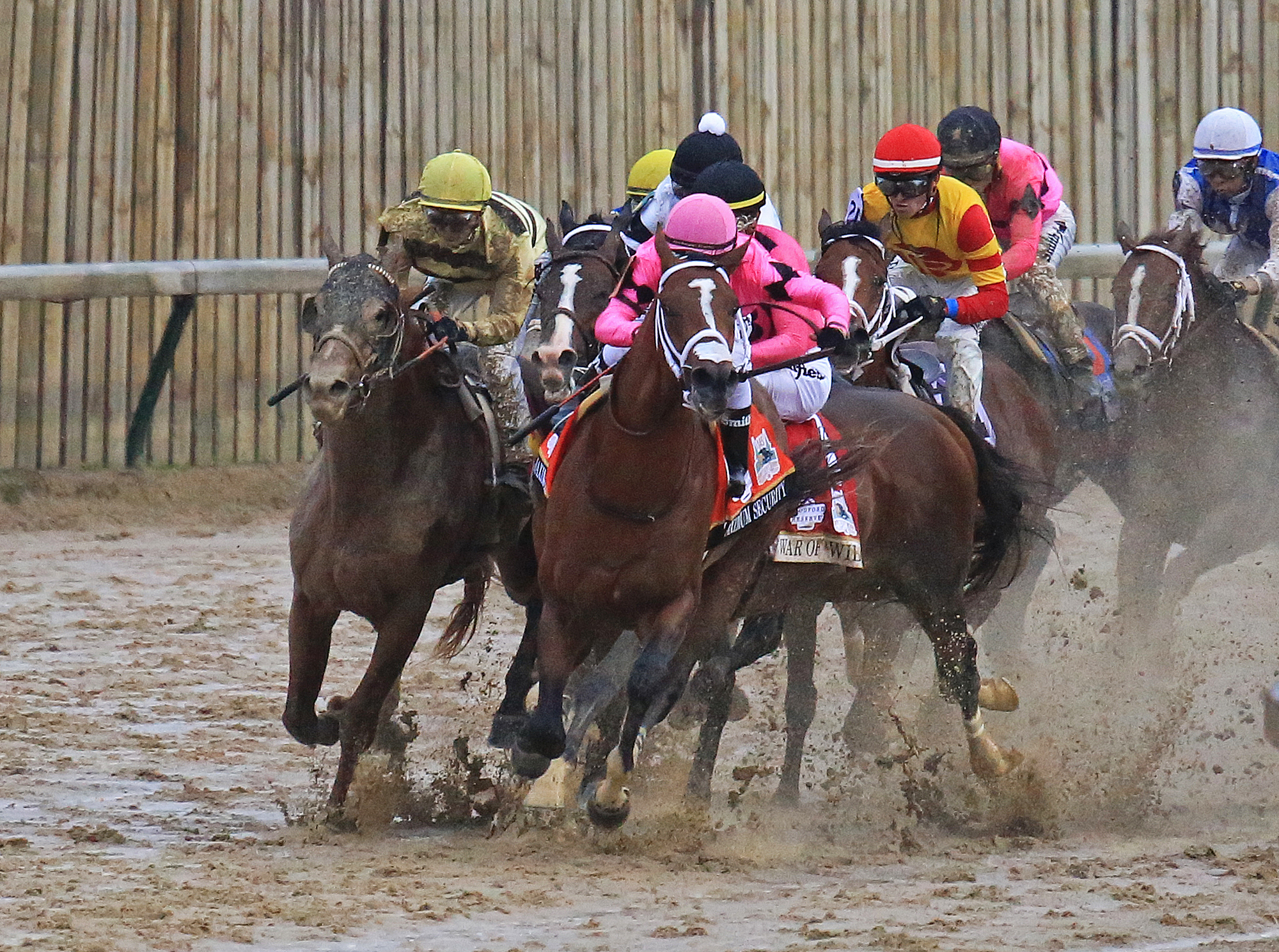
Kelly also said that under Category 1 rules, Maximum Security would not have been disqualified from the 2019 Kentucky Derby, saying there was “no cogent argument” to be made that the interference he caused impacted any of the horses to such a degree that they would have finished ahead of him.
► Mike Mulvihill, the executive vice president of research, league, and operations strategy at Fox Sports, said that the network is eagerly anticipating the launch of its own sports-betting application, perhaps as early as later this year. At the close of his presentation, he urged racing constituencies to work with the network in providing content to the betting application, noting that FS2, one of its networks, would provide more than 700 hours of live television coverage of racing in 2020, mostly through a partnership with the New York Racing Association.
The entry of Fox Sports into the horseracing betting market could be a controversial topic in racing, particularly if the company’s entrance results in upheaval in the resale market of simulcast signals to account-wagering companies. But Mulvihill said that racing must embrace the change that is accompanying the growth in sports wagering in the U.S. since last year’s Supreme Court ruling giving states the ability to legalize the practice.
“There will never be another now,” Mulvihill said. “It’s true for our fans and it’s true for our businesses.”
► Dr. Nancy Cox, the dean of the University of Kentucky’s College of Agriculture, Food, and Environment, said that the college intends to develop research and assessment programs on racing surfaces as part of a larger push to improve safety measures in place at racetracks. She said the research programs could include projects examining new types of artificial surfaces and grass blends.
► In the final presentation on the program, John Messara, the founder of Arrowfield Stud in Australia, was interviewed by Jim Gagliano, the chief operating officer of The Jockey Club. During the interview session, Messara said that he believed the U.S. would increase its standing in the international racing community if it embraced the federal bill support by The Jockey Club, and he also said that U.S. breeding interests would benefit if the U.S.’s medication rules were consistent with the rest of the world.
Although there are a handful of minor differences between the U.S. rules and those endorsed by the International Federation of Horseracing Authorities, the lone significant difference is the legal raceday use of Lasix in the U.S.
“You’ve got everything to unleash a monster of economic rewards if you were to join the rest of the world,” Messara said, in reference to demand for American bloodlines and breeding stock.