

Breeze-show times don't tell the entire story
:quality(75))
As horses prepared for the 2021 Ocala Breeders’ Sales Co.’s March sale of 2-year-olds in training, which was set to kick off that season after the first wave of the COVID-19 pandemic had ravaged the prior year’s breeze-up calendar, a gray colt by Race Day, a stallion exported to Korea a few months prior, breezed a furlong in a modest 10 2/5 seconds.
Getting the lion’s share of the attention were the 25 juveniles who blitzed a furlong in 9 4/5 seconds on the Ocala Training Center’s all-weather Safetrack. One of those, a filly from the first crop of the promising Practical Joke, emerged from that pack to top the sale when sold for $750,000 to Hideyuki Mori. The same day, the Race Day colt sold for $40,000 to Carlos Perez.
The Practical Joke filly, Clos de Mesnil, hasn’t done badly for herself, winning three times from 16 starts in Japan and earning $211,870. But Perez cashed in quickly, as the Race Day colt, White Abarrio, won his debut six months later and was promptly sold to C2 Racing Stable. White Abarrio has since become a multiple Grade 1 winner, with his biggest score coming in last year’s Breeders’ Cup Classic. He has career earnings of $5,146,350.
White Abarrio is the cover boy for the OBS March catalog as the juvenile sales season begins with a stable calendar and a marketplace showing promising signs. Robust purse structures have led to a demand for young stock, as seen at last year’s yearling sales when pinhookers stocked up for this season. White Abarrio, himself a $7,500 short yearling purchase and successful pinhook, shows that there are successful horses to be found at all breeze time levels and price points.
“The yearling market was strong,” said bloodstock agent Ramiro Restrepo of Marquee Bloodstock, who also is a South Florida representative for Fasig-Tipton. “A bunch of partnership groups took the lion’s share of the big-pedigree, big-physical yearlings, but a lot of sharp pinhookers and horsemen were active as well. It will be interesting to see how [the horses have] developed over the winter, into spring. . . . Let’s see how the chips fall.”
Juveniles can distinguish themselves with exceptional pedigrees or stellar conformation, just as they did in the yearling marketplace. However, the breeze shows provide an opportunity to see that conformation in action, to get an idea of the finished product and how quickly a horse may return an investment.
“The ultra-high-end horse needs to do it all,” said Carlos Manresa, director of operations for consignor Sequel. “It needs to have pedigree that indicates a high probability of success, and it needs to have an outstanding work that shows that the foundational pieces are there. All else being equal, there is a direct correlation in the market between time and price.”
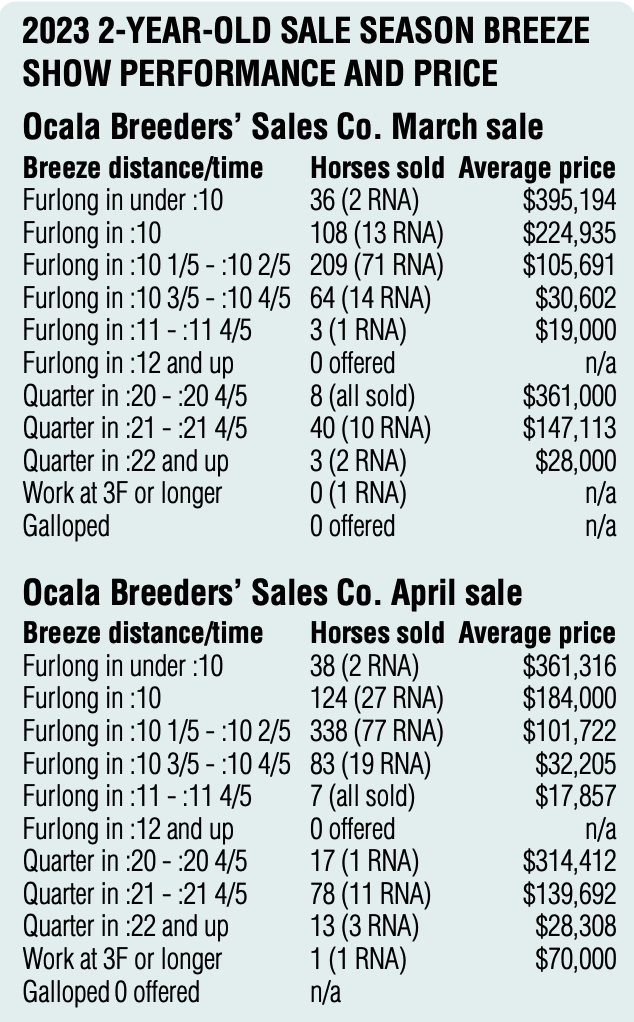
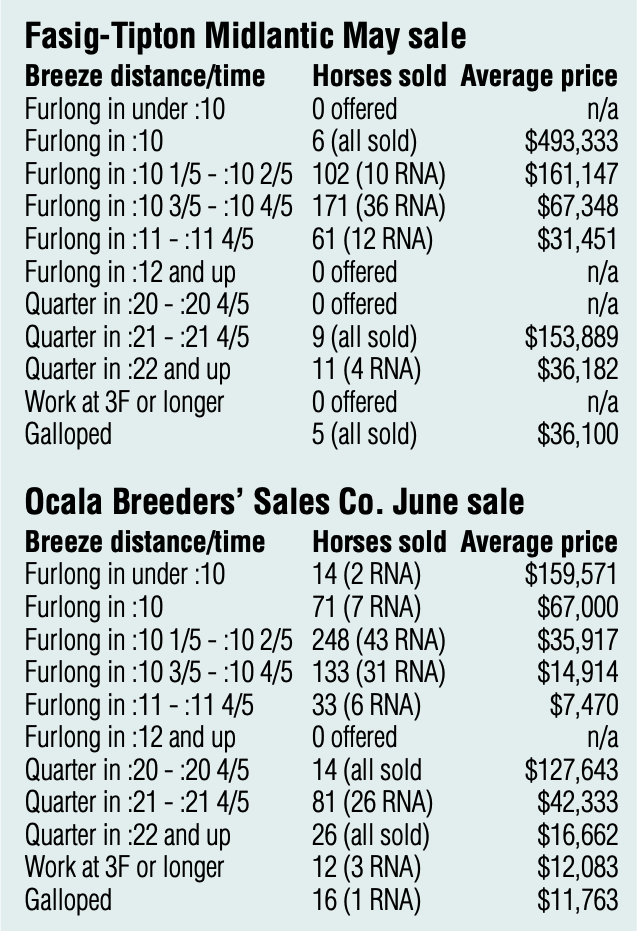
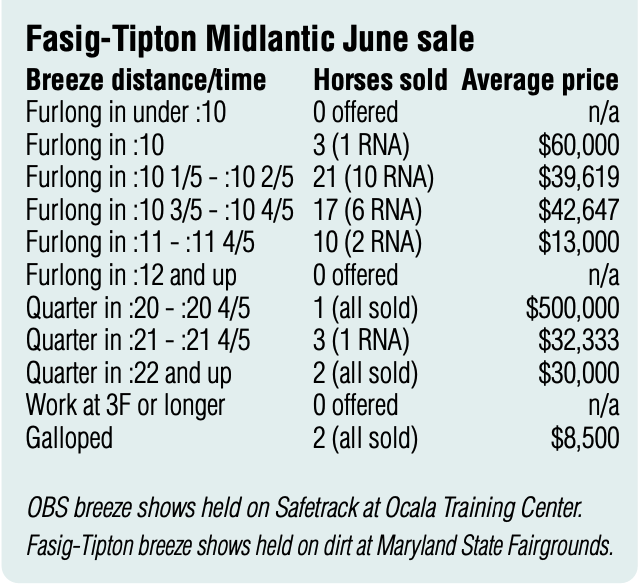
That correlation was certainly seen when Sequel brought a young Hejazi to the 2022 Fasig-Tipton Midlantic 2-year-olds in training sale. The colt worked a furlong on the dirt at the Maryland State Fairgrounds in 9 4/5 seconds – the fastest work at that sale in a decade. Hejazi subsequently sold for a sale-record $3.55 million to Amr Zedan and is multiple Grade 1-placed.
Flying under the radar at the same sale, despite a strong work in 10 seconds flat, was Mage. The colt was scouted out by Restrepo and OGMA Investments and purchased for $290,000. He won the 2023 Kentucky Derby and placed in three other Grade 1 events while earning more than $2.5 million.
“Action, stride, movement, class, [and] temperament,” Restrepo listed as qualities he is looking for when a juvenile breezes. “Everyone has their individual taste and eyes certain qualities. If a horse moves efficiently, within itself, and puts up a fast time and gallop-out, you know it’s going to draw a lot of attention.”
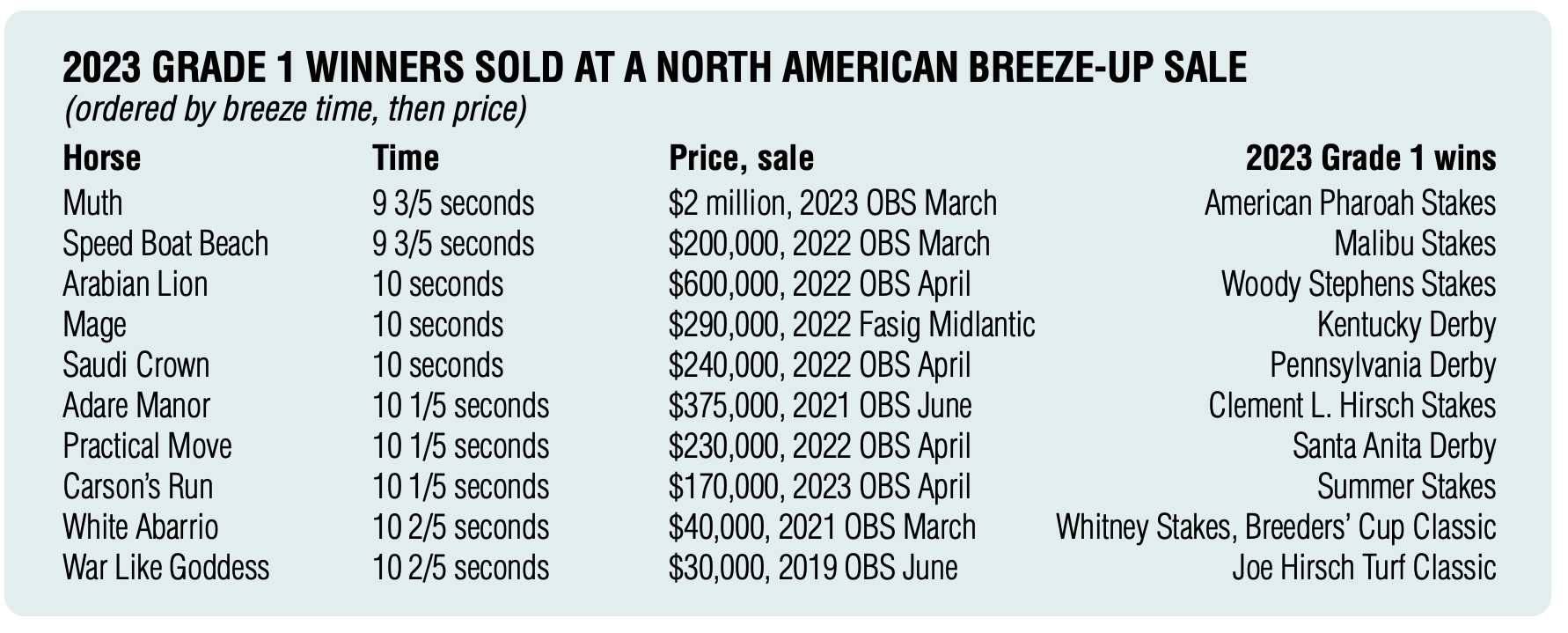
Mage was one of nine individual Grade 1 winners in the United States in 2023 who were purchased at a 2-year-old in training sale. The most expensive on that list was Muth, sold for $2 million at last year’s OBS March sale after shading 10 seconds in his work. Although the prices aren’t a straight line down the list from Muth, with that speedy work, the two least expensive horses in the group were the two to work the slowest, at 10 2/5 seconds – White Abarrio and War Like Goddess, who was purchased for $30,000 at the 2019 OBS June sale.
At the other end of the spectrum from bullet workers like Muth are the horses whose connections choose to gallop them during the under-tack preview show, seeking to highlight their athleticism and movement without pushing for a specific time. Six-figure price tags and stakes performers can emerge from this group, too, like the filly Yo Cuz, brought to the 2021 Fasig-Tipton Midlantic sale by breeder Seidman Stables and consignor Hidden Brook.
“I was told I might lose money not breezing but I don’t feel it’s necessary, or good for young horses,” Maggie Seidman said, adding that Hidden Brook approved.
Yo Cuz was purchased for $125,000 by Dream Maker Racing. She raced for that outfit throughout her career, winning three New York-bred stakes and earning $406,800. Tom Gallo of Dream Maker told track publicity after a win in the 2021 New York Stallion Series Fifth Avenue Division that the filly’s gallop caught his attention.
“The thing that stood out for us was that she was one of the few in that sale who galloped and didn’t breeze,” Gallo said. “We like when people take time with their horses.”
While the prices are lower for galloping juveniles, they are just as likely to actually sell as horses who work fast. During the five major-market sales with under-tack shows held in 2023, there were 98 juveniles who worked a furlong in less than 10 seconds. All but six of them sold, and the average price was $328,173. In the same time span, there were 25 juveniles who used their under-tack slot to open gallop. All but one sold, for an average of $16,070.
Through Feb. 17, eight of those 24 gallopers who sold have started, with two winners. The average earnings per starter are $12,329, a strong start to recouping that average sale price. But working quickly didn’t diminish a horse’s chances of success, either. Of the very fastest workers sold – seven who went in 9 3/5 seconds last year, for an average price of $774,286 – five have started, with three winners, for average earnings of $176,980.
Still, the sample size for gallopers is smaller as the market does correlate to speed, and those targeting these sales prepare accordingly.
“As a consignor, we follow what the market values,” Manresa said. “Speed is always fashionable, but there is certainly a trend toward the importance of the gallop-out. For many buyers, this has greater significance than the [furlong or quarter] time. You really need one of those two elements to stand out and be relevant. The horses that move well while accomplishing both are the horses everybody talks about and ultimately bring the most money.”