

Breeders' Cup report: Mongolian Groom had pre-existing joint injuries
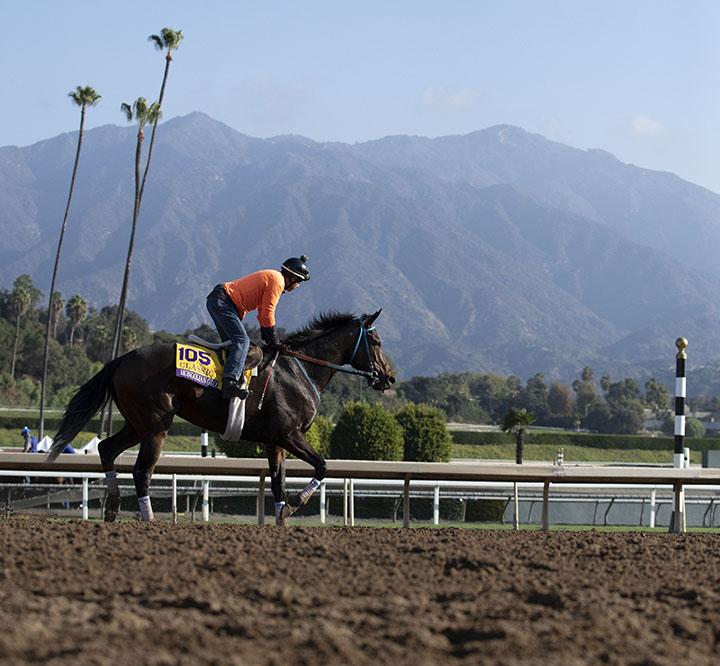
Mongolian Groom, the 2019 Breeders’ Cup Classic runner who suffered a fatal injury in the stretch of the race, had lesions on both rear fetlock joints indicative of lameness, according to a report commissioned by the Breeders’ Cup to examine the fatality, but the nature of the injury made a diagnosis of lameness difficult to detect without additional measures.
While the report notes that the post-mortem examination of the horse turned up evidence of the injuries, the report also states that there were no obvious signs of lameness that would have led to a conclusive diagnosis that the horse was unsound to race. The report also states that Mongolian Groom was examined on multiple occasions to determine whether the horse was lame as follow-ups to concerns noted by veterinarians about his gait, but that those follow-ups were “negative” for clinical signs of lameness.
The report, conducted by Dr. Larry Bramlage, an equine surgeon at Rood and Riddle who has extensive research experience in bone damage and repair, recommended six measures that Breeders’ Cup should undertake in order to more adequately assess horses for lameness. The requirements include limiting the number of veterinarians assessing the gaits of specific horses, and designating an area at the Breeders’ Cup host track that would allow for the assessment of horses while trotting in a circle.
Mongolian Groom, who was supplemented to the Breeders’ Cup by his owners, suffered his fatal injury during the last race of the two-day Breeders’ Cup event, at a track, Santa Anita, that had been placed in the spotlight all year due to a spate of fatal injuries earlier in the year. The report noted that the track surface did not appear to play a factor in the horse’s injury and that Mongolian Groom was the only horse to be injured as a result of running in the event’s 14 races.
According to Bramlage, the assessment of lameness in Mongolian Groom was complicated by the fact that the horse was sore in both hind legs, due to the lesions on the cannon bone in both fetlock joints. As a result, Mongolian Groom did not display classic signs of lameness in one limb because when a horse is “lame in both hinds or both fronts they look symmetrical because the horse can’t choose to shift weight from one limb to the other,” Bramlage wrote.
Among his six recommendations, Bramlage wrote that modifying assessments of horses as they work out prior to the Breeders’ Cup and allowing for evaluations while jogging in a circle would lead to better post-work evaluations of lameness.
“The bilaterally lame horses are most problematic,” Bramlage wrote. “Unilaterally lame horses are easier to identify and to pass judgment on. In my opinion, the key opportunities for process improvement are to improve the quality of the ontrack observations and to introduce the ability to jog horses in need of ‘extra scrutiny’ in circles at some safe location on the back side of the racetrack. This should help separate the significantly lame horses from the horses that have routine soreness. It would also create the threshold for requesting radiographic or ultrasonographic imaging prior to clearance for competition for horses of concern.”
The report states that Mongolian Groom’s primary hands-on caretaker, his groom Edgar Pardilla, “had cared for him for nine months and felt the horse had never shown any pain, heat, or swelling in his limbs at any point.” An assessment of lameness was also “further complicated by the fact that his racing form continued to improve all year long,” Bramlage wrote.
Still, the report noted that multiple records of the horse’s examination history from his workouts in 2019 included jargonistic references to lameness in either or both of his hind limbs. However, the report also noted that during the lead-up to the Breeders’ Cup, “both hind fetlocks had been flexed with no increase in lameness noted” and that “no clear-cut lameness was noted in any of the barn exams, including the morning of the race.”
Bramlage also wrote that “there is no evidence that the horse’s injury was ignored or covered up.”
In a statement accompanying the release of the report, Breeders’ Cup chairman Fred Hertrich said that the organization will “review Dr. Bramlage’s recommendations for improvements to the processes that were in place” for the 2019 event and “discuss them in detail at the next board meeting for adoption at future events.”
The full report can be found here.